
The Prospect of Whitby is a pub on the Wapping foreshore at 57 Wapping Wall, five minutes' walk from Wapping station, open to anyone who walks in and buys a drink. Its statutory list entry, which is the only independent record of the building, says the original building is "said to be circa 1520" and that the front was refaced in the early nineteenth century. The same entry says the interior is "much altered". Both of those things are worth knowing before you go, and neither of them is a reason not to.
It is a working pub rather than a museum: a ground-floor bar with a flagstone floor and a long pewter-topped counter, a dining room above, a terrace over the water and a replica noose on a beam facing the river. It was rated five out of five for food hygiene on 16 October 2025.
Our round-up of historic pubs in London places it among the other old taverns, and our guide to riverside pubs compares the ones that actually face the water. This page is about this building: what the record says, what survives, what is next door, and when to avoid it.
The Prospect of Whitby at a glance
- Address
- 57 Wapping Wall, London E1W 3SH, in the London Borough of Tower Hamlets
- Listing
- Grade II, list entry 1357505, first listed 29 December 1950
- Dates
- The list entry gives "said to be circa 1520" for the original building, with the front elevation refaced in the early nineteenth century
- Hygiene rating
- Five out of five, inspected 16 October 2025
- Hours read on the operator's own site, 28 September 2026
- Bar 11:00–23:00 Monday to Saturday, 12:00–22:00 Sunday. Kitchen 12:00–21:00 every day
- Nearest station
- Wapping, Windrush line of the London Overground, 429 metres and about five minutes on foot per TfL's planner
- Cost
- Free to enter. You pay for what you order at the bar
What the statutory record actually says
The entry on the National Heritage List for England describes the building as yellow brick, three storeys and three windows wide, with architraves to recessed sash windows and glazing bars, a painted imitation-stone return on the south-west side, and a hooded balcony with a needled balustrade on the river elevation.
Then come the two sentences that matter. "Original building said to be circa 1520 but north-west, or front, elevation refaced early C19." And: "Interior much altered but some C18 dado panelling on 1st floor." The entry ends by saying the building is "included principally for historic associations and as a surviving riverside inn".
That means three things. The 1520 date is reported rather than established, by Historic England as well as by us. The street front you photograph is Georgian or Regency, not Tudor. And the building is protected for what happened here and for the rarity of a surviving riverside inn, not for the fabric of the rooms.
The listing itself is old. The pub was protected on 29 December 1950, at grade II, on the same day as the parish church of St Paul at Shadwell two streets away, which was listed at the higher grade II*.
A tavern's founding year and a building's date are two different facts. A licence or a trade can run continuously on a plot while the structure is demolished and rebuilt around it. The list entry dates the fabric; the 1520 story is about the site. Neither makes the other false, and a pub that says both at once is not lying so much as eliding.
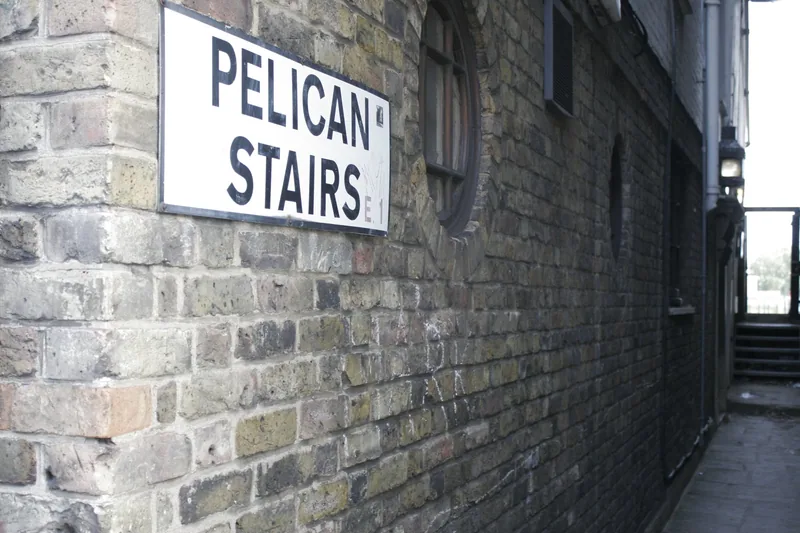
Photo: Hjamesberglen · CC BY-SA 4.0 · Wikimedia Commons · resized
The floor, the bar and the noose: which are documented
The three things visitors come to see are the flagstone floor, the pewter-topped bar and the hanging noose over the river. The record treats them differently.
- The floor and the bar counter. Neither appears in the list entry, which records only some eighteenth-century dado panelling upstairs and otherwise calls the interior much altered. They may well be old; they are not independently dated.
- The noose. A replica, hung as a memorial to the Admiralty's Execution Dock. The exact site of that dock is not certain and more than one pub claims to stand beside it; our Wapping and Rotherhithe guide sets out what is known.
- The name. This one does have an independent source. Tower Hamlets Council's conservation-area appraisal for Wapping Wall says the pub is "named after a boat that moored there in the 18th century". That is the kind of detail a council planning document carries and a pub sign does not.
The operator's own description of the building is internally inconsistent in a way worth noticing: it says the pub was built in 1520 and, two sentences later, calls the stone floor 400 years old. Those two claims cannot both be about the same floor.
Pelican Stairs, which are listed separately
Immediately beside the pub, running down to the foreshore, is a set of old wooden river stairs called Pelican Stairs. They have their own entry on the statutory list, at grade II, added on 27 September 1973, and the entry describes them simply as "old wooden stairs to River Thames from Prospect of Whitby Public House".
The listing also records that the pub, the stairs and the pumping station next door "form a group", which is the planning term for buildings whose value partly comes from standing together. Almost nobody looks at the stairs, and they are the oldest-looking thing on the site.
One serious warning. The Thames here is tidal and rises fast, and the council's appraisal notes that many of the historic stairs on this stretch are now closed to the public. Do not go down river stairs with a drink in your hand, and never let children go down alone; our Thames Path page covers the tide and the foreshore rules.
The grade II* building next door that nobody photographs
The pub is listed grade II. The building on the other side of Wapping Wall is listed grade II*, one grade higher, and it is the more remarkable of the two.
It is the London Hydraulic Power Company's pumping station, dated 1890, with the station superintendent's house at number 37 dated 1891 in its gable: red brick, slated and glazed roofs, single storey with two towers. The list entry says the buildings have landmark and group value, but that what matters more is the machinery still in place and in working order.
The plant listed inside includes two accumulator towers, two cast-iron water tanks, the inlet and filtration fittings and cast-iron hydraulic mains of six, seven and eight inches, all original apart from the electrically driven pumps of the 1950s. The station ran from 1893 until June 1977 and was the company's last working station. Historic England calls Wapping Wall the last remaining fully fitted hydraulic power station in Britain, and says the higher grade reflects that. It is not open to the public and the machinery cannot be seen from the street.
| Structure | List entry | Grade | First listed |
|---|---|---|---|
| Prospect of Whitby Public House, 57 Wapping Wall | 1357505 | II | 29 December 1950 |
| Pelican Stairs, beside the pub | 1065814 | II | 27 September 1973 |
| London Hydraulic Power Company Station with No 37 | 1242419 | II* | 27 September 1973 |
| Church of St Paul, Shadwell | 1357840 | II* | 29 December 1950 |
Hours, food and the hygiene rating
We read the hours on the operator's own website on 28 September 2026: bar 11:00 to 23:00 from Monday to Saturday and 12:00 to 22:00 on Sunday, with the kitchen serving 12:00 to 21:00 every day, Sunday included. Pub hours change, so confirm before travelling a long way.
The Food Standards Agency register records the establishment as Prospect Of Whitby Public House, 57 Wapping Wall, London E1W 3SH, in Tower Hamlets, rated five out of five at an inspection on 16 October 2025. Five is the top rating. We print the date because a rating describes one day, not today.
The kitchen is a pub kitchen: roasts on Sunday, steaks, burgers, salads. Booking is not needed for a drink and is sensible for a meal on a Sunday, as our page on the Sunday roast explains. If British pubs are new to you, read our guide to ordering at the bar first: you order and pay at the counter, there is no table service for drinks and you do not tip for a pint. Our page on what a pint costs has the published London figures rather than a guess.
Getting there, and the walk from Wapping station
Wapping station is in Zone 2 on the Windrush line of the London Overground, the line through the Thames Tunnel to Rotherhithe and New Cross. TfL's journey planner gives the walk to 57 Wapping Wall as 429 metres and about five minutes, east along Wapping High Street and then Wapping Wall.
The council's appraisal notes that the station marks the western boundary of the conservation area and sits on London's first under-river railway, the tunnel the Brunel Museum at Rotherhithe is built over. Our DLR and Overground guide explains the network, and the Overground line names page explains where Windrush came from, because the names date from 2024. Shadwell is the alternative and a longer walk; there is no Underground station within easy reach.
When to avoid it, and what goes wrong
Three honest warnings.
Summer weekend afternoons. The terrace and the balcony are small and they are the entire reason most people come. On a warm Saturday from about 13:00 the outside space is full and the queue at the bar is four deep. A weekday afternoon between 14:00 and 16:30 is a different pub, and you can sit in the old bar and read the notices on the walls.
The walk back after dark. Wapping Wall is a narrow street between high warehouses with very few people on it after about 21:00. It is not dangerous, simply empty, and the five minutes back to the station feel longer than on the way out.
Treating it as a destination on its own. It is one pub in a street with almost nothing else open. The sensible visit combines it with another of the Wapping riverside houses, which our page on Wapping Old Stairs and the Wapping pubs covers, or with the walk east into King Edward VII Memorial Park.
Do not expect the CAMRA heritage inventory to settle any of this. The Campaign for Real Ale keeps a national inventory of historic pub interiors, and it is a genuine record, but its county lists and search pages do not answer automated requests, so we cannot confirm whether any individual pub appears on it. Anyone who tells you a particular pub "is on the National Inventory" should be asked where they read it. The statutory list entry is the check that works, and it describes what survives room by room.
What else is on Wapping Wall
The street is named after the river wall it runs along the top of. Tower Hamlets' appraisal explains that breaches of that wall were a serious problem until the 1580s, when a continuous line of wharves strengthened it, and that the conservation area was designated in January 1983 by the London Docklands Development Corporation and extended by the council in October 2008.
Within two hundred metres of the pub stand seven listed warehouses, the pumping station, the stairs, a lock with its gates, bollards and capstans, and a further set of river stairs at Shadwell. Metropolitan Wharf, the long range immediately west, projects about forty feet into the river according to the appraisal. East of the pub, King Edward VII Memorial Park was planned in 1910 and opened in 1922 on the site of the former Shadwell Fish Market estate.
That is a lot of dock history in one short street, and it is the argument for walking it rather than arriving, drinking and leaving. For an organised route, our page on pub walks and historic crawls has the itineraries; for a garden rather than a terrace, see beer gardens in London; and across the river bend, eating near Tower Bridge covers the same kind of warehouse.
Frequently asked questions
Is the Prospect of Whitby really from 1520?
The statutory list entry says the original building is "said to be circa 1520", which is a reported date rather than an established one, and it records that the front elevation was refaced in the early nineteenth century. Tower Hamlets Council's conservation-area appraisal also gives the pub as circa 1520. So the date is widely repeated by official sources, but as a tradition about the site rather than a dating of the fabric you see.
Is the Prospect of Whitby the oldest riverside pub in London?
The pub says so. No independent record confirms it, and "oldest" can mean the oldest licence, the oldest building or the oldest site, which is why several London pubs can each claim a version of the title. What the list entry does say is that it is "a surviving riverside inn", which in a stretch of river that once had dozens of them is the substantive point.
What is the hygiene rating of the Prospect of Whitby?
Five out of five, the top rating, at an inspection on 16 October 2025. The Food Standards Agency register records the establishment as Prospect Of Whitby Public House, 57 Wapping Wall, London E1W 3SH, under Tower Hamlets. Ratings change at every inspection, so check the register or the certificate on the door.
How do I get to the Prospect of Whitby?
Wapping station, on the Windrush line of the London Overground in Zone 2, then about five minutes on foot east along Wapping High Street and Wapping Wall. TfL's journey planner gives the walk as 429 metres. Shadwell, on the DLR and the same Overground line, is the alternative and a longer walk.
Is the noose at the Prospect of Whitby real?
No. It is a replica, hung as a memorial to Execution Dock, where the Admiralty hanged pirates and mutineers at the low-water mark until 1830. The precise location of the dock is not established and more than one Wapping pub claims to stand next to it, so treat the gallows as a monument rather than a marker.
Sources
- Historic England - Prospect of Whitby Public House, 57 Wapping Wall, list entry 1357505, grade II (Internet Archive copy of 2 January 2026, because the live site refuses our requests) (checked September 2026)
- Historic England - Pelican Stairs, Wapping Wall, list entry 1065814, grade II (Internet Archive copy of 2 January 2026) (checked September 2026)
- Historic England - London Hydraulic Power Company Station with number 37, Wapping Wall, list entry 1242419, grade II* (Internet Archive copy of 31 December 2025) (checked September 2026)
- London Borough of Tower Hamlets - Wapping Wall Conservation Area character appraisal and management guidelines (checked September 2026)
- Food Standards Agency - food hygiene rating for Prospect Of Whitby Public House, 57 Wapping Wall, London E1W 3SH: five, inspected 16 October 2025 (checked September 2026)
- Historic England - National Heritage List for England open data: grades and listing dates for the Prospect of Whitby, Pelican Stairs, the pumping station and St Paul Shadwell (checked September 2026)
- Transport for London - Journey Planner API, walking distance between 57 Wapping Wall and Wapping station (checked September 2026)