
Ye Olde Mitre stands at 1 Ely Court, a medieval alley off Hatton Garden, and it is open Monday to Saturday and shut on Sundays. The tavern on the site was founded in 1546; the building you walk into is about 1773, and Historic England lists it Grade II mainly for what survives inside it.
It is a two-bar pub with no music and room for perhaps fifty people. Nothing on the street tells you it is there. Our round-up of the capital's oldest pubs places it among the survivors and tells the legends; the street it hides behind, its gates and its private government belong to our page on Ely Place and St Etheldreda's Church. This page is about the pub: the door, the rooms, the dates and the hours.
Ye Olde Mitre: the practical frame
- Address
- 1 Ely Court, off Ely Place and Hatton Garden, London EC1N 6SJ
- Open
- Monday to Friday 11:00 to 23:00, Saturday 11:00 to 21:00, closed Sunday (the pub's own listing, read 28 September 2026)
- Food
- Bar snacks and toasties, Monday to Friday 12:00 to 21:30, Saturday 12:00 to 16:00. No kitchen on Sunday because there is no Sunday
- Listing
- Grade II, list entry 1078281, first listed 24 October 1951
- Built
- About 1773, with internal remodelling in the early twentieth century and a later extension at the back
- Hygiene rating
- 5, the top score, at the inspection of 16 March 2023 (Food Standards Agency, Camden)
- Nearest stations
- Chancery Lane and Farringdon, four minutes' walk each by TfL's own reckoning
Both ways in, measured in metres
Ely Court runs east to west between Ely Place and Hatton Garden, and the pub sits near its western end. The distances are short enough to be worth giving precisely, because the alley is easy to overshoot. Using Historic England's grid references for the listed buildings around it, the pub door is about 30 metres due south of St Etheldreda's Church, about 40 metres from the listed porter's lodge at the Ely Place gates, and about 30 metres from the frontage of number 5 Hatton Garden.
In other words: if you are standing at the church, the pub is one building's depth behind you. If you are standing at the Ely Place gates looking up the street, it is half a minute away on your left, behind the terrace. Camden Council's own conservation appraisal describes Ely Court as a short, irregular alley of medieval origin that widens in the middle, and the widening is the bit with the pub in it and the tables outside.
From Hatton Garden the entrance is a gap in the row of jewellers, which is why people walk past. The Ely Place approach is the easier one if it is your first visit, because a gated Georgian street is harder to miss than a slot between two shopfronts.
The Sunday closure is the one that catches people, not a weekend closure. Saturday opening was added, and the pub now trades 11:00 to 21:00 on Saturdays with food until 16:00. Sunday is the day the door stays shut. Older guides, including some that are still online, say it closes all weekend.
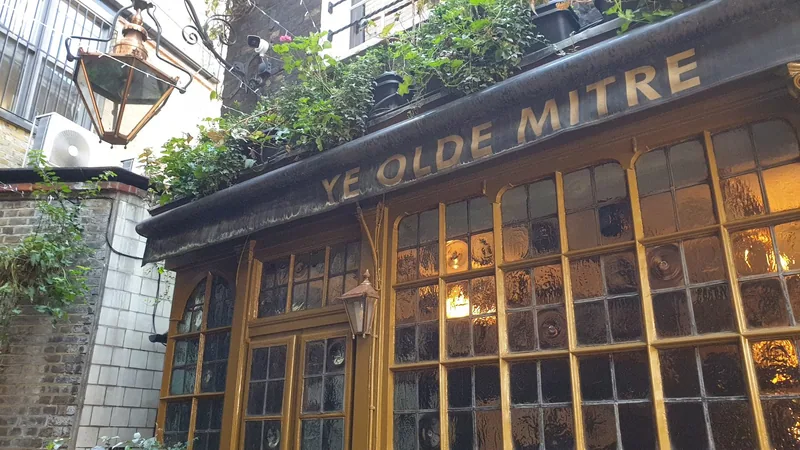
Photo: JRennocks · CC BY-SA 4.0 · Wikimedia Commons · resized
What the listing says is inside
Most descriptions of this pub are about its legends. The official one is about its joinery, and it is more interesting than it sounds. Historic England's entry records two bars, front and back, separated by a central servery, with a small snug opening off the back bar. Both bars are lined with panelling, probably installed in a refit in the 1920s, and both have fireplaces in a Tudor style that is Edwardian rather than Tudor. The bar counters are panelled too. There is a skylight over the rear part of the back bar, which is why that room is brighter than you expect from a pub with no windows onto a street.
The staircase is worth a look on the way to the toilets: its walls are covered in wide horizontal panels that the listing says may date from the late eighteenth-century construction, making them the oldest woodwork in the building. The room at the front upstairs was fitted out for public use around 1990 and is used for private hire, so it may or may not be open when you visit.
Outside, the ground floor is a glazed timber screen with a central window of eighteen square panes. To its right is a doorway that has been blocked up and framed with flat pilasters and Corinthian capitals, a piece of architectural showing-off on an alley nobody uses. Above, three storeys and an attic of stock brick under Welsh slate. The listing's verdict is that the pub keeps its early twentieth-century plan and fittings almost entirely intact, which is a rarer thing in London than a medieval date.
The cherry tree, and the words on it
In the corner of the front bar by the entrance, a glazed case holds the dried trunk of what is believed to be a cherry tree. Everyone repeats the story that Elizabeth I danced round it with Sir Christopher Hatton. What almost nobody prints is the inscription on the case itself, which the parish of St Etheldreda's records as: "The Mitre Tavern built by Bishop Goodrich in 1546. The Cherry Tree marks the boundary between the Bishop's Garden and the part leased to Sir Christopher Hatton."
That is a boundary marker, not a dance floor, and it is the more useful claim of the two. Historic England describes the trunk in the same terms, as marking the division between the properties held by the Bishop of Ely and by Hatton. The lease that created the boundary was granted in 1576 by Bishop Cox, under pressure from Elizabeth I, at a nominal rent that included a single rose each year. Our page on the street has the full sequence of who owned what and when.
1546, 1772 and 1773: three dates that get muddled
Pubs that claim a Tudor foundation date rarely occupy a Tudor building, and this one does not pretend otherwise once you read the record. Historic England states that the Mitre Tavern is believed to have been founded in 1546 for the servants at the Bishop of Ely's London house. It then states that the site and the neighbouring properties were cleared after the Crown took over the area in 1772, and dates the present public house to about 1773.
So the licence and the name may run back to 1546. The walls do not. If a date matters to you, the honest summary is a mid-Georgian pub on a mid-Tudor site, with an Edwardian interior, and that is a better sentence than most of the competing claims about which London pub is oldest.
The Ely connection is real, though, and it is not just London history. The Bishops of Ely kept this palace because they had to attend Parliament, and the cathedral city they came from is a short train ride from London today; our guide to Ely and the Fens covers that end of the story.
When to go, and the hour not to
Between 17:00 and 19:00 on a weekday the pub is full, the alley is full, and you will drink standing up outside. That is the price of a small pub in an office district. The good hours are the ones nobody uses it: any weekday before about 16:00, and Saturday, when the jewellery trade has gone home and Hatton Garden is quiet. On a Saturday afternoon you can usually sit down in the back bar.
Drinking outside in the alley is normal here and there are a few small tables, but Ely Court is a passage and a fire route, not a beer garden. If you are unsure what is and is not allowed with a drink on a London street, our summary of alcohol laws and drinking in public sets out the rules; a licensed area outside a pub is not the same thing as the pavement beyond it.
If you have not drunk in a British pub before: there is no table service here, so go to the counter, and pay when you order. Our guide to pub etiquette covers the rest, including how to wait your turn at a crowded bar without annoying anyone.
What is on the bar, and what it costs
This is a cask-ale pub belonging to Fuller's, with several hand pumps, guest ales that change, and a cider on handpull. The food is deliberately limited: bar snacks and toasted sandwiches rather than meals, and it stops at 16:00 on Saturdays. There is no television and no music, which is part of why it is quiet enough to talk in.
We do not publish prices for individual pubs, because they change without notice and a wrong price is worse than none. For what a pint costs in this part of London, and how much of it is tax, see how much a pint costs in London. If the beer matters more to you than the room, London's brewery taprooms are a different proposition entirely.
If it is shut, or too full to get in
Two alternatives are within ten minutes on foot and neither is a compromise. West and south, across Holborn, the Seven Stars and the pubs of legal London stand at the back of the law courts and keep similar office-district hours. North and east, the Jerusalem Tavern and the pubs of Clerkenwell are the better bet on a Sunday, when much of Clerkenwell is open and Ely Court is not.
If you would rather build the Mitre into a longer walk, it is the natural finishing point of the first route in our guide to pub walks and historic crawls, and the surrounding streets are covered in our guide to Holborn.
Frequently asked questions
Is Ye Olde Mitre closed at weekends?
No. It is closed on Sundays but open on Saturdays, from 11:00 to 21:00, with food served until 16:00. Those were the hours the pub published when we checked on 28 September 2026. Weekday hours run 11:00 to 23:00.
How do you find Ye Olde Mitre?
Go into Ely Court, the alley between Ely Place and Hatton Garden, from either end. From Hatton Garden it is a narrow slot between jewellery shops; from Ely Place it is a passage on the west side, about 40 metres inside the gates. The pub is roughly 30 metres behind St Etheldreda's Church.
How old is Ye Olde Mitre really?
Historic England dates the building to about 1773 and says the tavern is believed to have been founded on the site in 1546. The earlier buildings were cleared after the Crown took over the area in 1772, so the 1546 date belongs to the pub's history rather than to its walls.
Does Ye Olde Mitre serve food?
Bar snacks and toasted sandwiches rather than full meals, Monday to Friday from 12:00 to 21:30 and Saturday from 12:00 to 16:00. It is not a place to plan a proper dinner around, and there is no food at all on Sundays because the pub is shut.
Is Ye Olde Mitre wheelchair accessible?
We could not verify the pub's own access arrangements from any published source. The approach from Chancery Lane is level pavement, but Ely Court is a narrow alley and the bars are in a listed eighteenth-century building, so anyone who needs step-free access should ring ahead rather than rely on this page.
Sources
- Food Standards Agency - food hygiene rating for Ye Olde Mitre, 1 Ely Court, EC1N 6SJ (checked September 2026)
- Historic England - Ye Olde Mitre Public House, 1 Ely Court (list entry 1078281) (checked September 2026)
- Historic England - Porter's Lodge, gates and spur stones at the entrance to Ely Place (checked September 2026)
- Camden Council - Hatton Garden Conservation Area appraisal and management strategy, August 2017 (checked September 2026)
- St Etheldreda's Church - parish history, Sir Christopher Hatton and the cherry tree inscription (checked September 2026)
- Transport for London - Journey Planner, walking times from Chancery Lane and Farringdon (checked September 2026)