
High Barnet is the last station on one branch of the Northern line, twenty-nine minutes from King's Cross, and the town at the top of the hill was a market town before London reached it. Its market was granted by King John in 1199, which is where the "Chipping" in Chipping Barnet comes from, and the battlefield of 1471 north of the town is the only registered battlefield inside Greater London. Between Barnet and the centre lie the Finchleys, which are suburbs rather than destinations, and we will say plainly which parts of this are worth the journey.
The honest summary first. If you have three days in London, do not come here. If you have a week, or you have been before, or you are interested in medieval England, Chipping Barnet is a genuinely good half day: a hill-top high street of listed buildings, a free museum open five afternoons a week, almshouses, a battlefield and a Tudor schoolroom, all within ten minutes of the station.
Our Northern line guide owns the line itself, the platform indicators and the branch problem; this page is about what is at the end of it. For the countryside beyond, Trent Park and Enfield Chase covers the open land east of Barnet.
Barnet and Finchley at a glance
- High Barnet
- Zone 5, Northern line. 29 minutes to King's Cross, 32 to Tottenham Court Road. £3.80 off-peak, £5.30 peak with contactless or Oyster
- Finchley Central
- Zone 4. 19 minutes to King's Cross. The only station on the Barnet branch with lifts
- East Finchley
- Zone 3. 15 minutes to King's Cross, and the cheapest of the group at £3.30 off-peak
- Barnet Museum
- Free. 31 Wood Street, EN5 4BE. Tue, Wed, Thu and Sun 14:30-16:30; Sat 10:30-16:00. Closed Monday and Friday
- Battle of Barnet 1471
- Registered battlefield, Historic England list entry 1000001, registered 6 June 1995, 112 hectares
- Fare caps
- A day out to High Barnet lifts your cap to £15.30 for Zones 1-5, from £8.90 for Zones 1-2
The journey, and the cost of going one stop too far out
All of this is on one branch of the Northern line, and the zone you choose changes the price of your whole day. High Barnet is in Zone 5. A return trip from central London to High Barnet and back therefore pushes your contactless or Oyster daily cap from £8.90, the Zones 1 and 2 figure, up to £15.30 for Zones 1 to 5. That is £6.40 more than a day spent in the centre, per person, and it is the real cost of the trip rather than the £3.80 single fare.
Times from TfL's journey planner, measured off-peak: High Barnet to King's Cross 29 minutes, High Barnet to Tottenham Court Road 32. Finchley Central to King's Cross 19 minutes, East Finchley 15, Mill Hill East 22.
Two things about this branch are worth knowing before you set out. Mill Hill East is a single-platform spur that is often served only by a shuttle, and our Northern line guide explains the weekend arrangement. And the Northern line's Night Tube service runs on the Charing Cross branch, which does include High Barnet, East Finchley and Finchley Central, so on Friday and Saturday nights you can get back up here after midnight. That is unusual for a Zone 5 terminus and worth knowing if you are coming for an evening.
Get off at Finchley Central if you need a lift. Of the stations on this branch, TfL's own station data records lifts at Finchley Central only: two of them, with lift access marked as available. High Barnet has none, and its record explicitly says access is not via lift. Woodside Park, Totteridge & Whetstone, West Finchley, East Finchley and Mill Hill East have no lifts either.
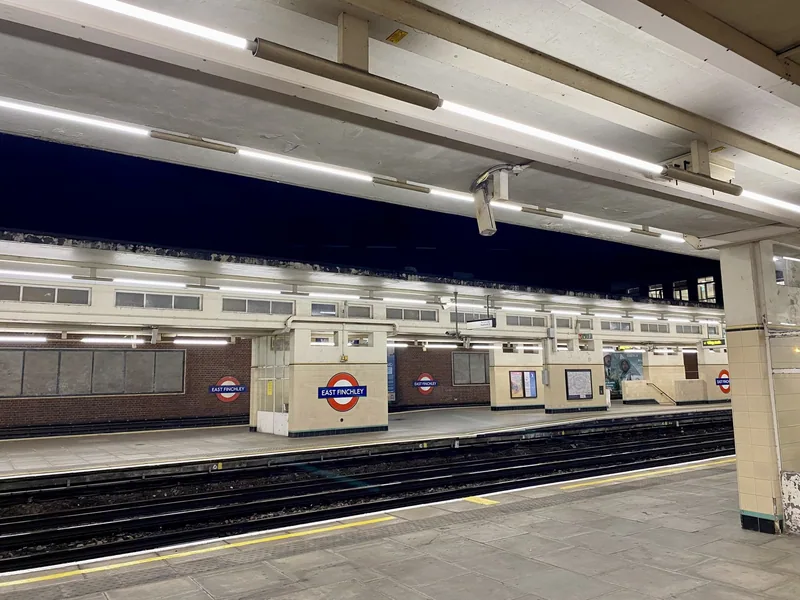
Photo: No Swan So Fine · CC BY-SA 4.0 · Wikimedia Commons · resized
Chipping Barnet: why the name, and what the market became
"Chipping" is an old English word for a market, and Barnet acquired it for a specific reason. The Victoria County History of Hertfordshire records that the market, to be held on Thursdays, was granted to the abbot of St Albans by King John in 1199. Barnet was in Hertfordshire until 1965, which is why the standard history of the town is in a Hertfordshire volume rather than a Middlesex one.
The market day then moved about for four centuries, and the reason is one of the better stories in English local history. It became Monday, possibly by a re-grant under Elizabeth I. In 1592 the inhabitants of Leighton Buzzard, whose own market was on Tuesday, complained that Barnet's market was forestalling their sale of meat in London, and it was formally decreed that Barnet should go back to Thursday. The change was apparently never made. In 1758 the lord of the manor, John Thomlinson, applied to move it to Wednesday instead, and Wednesday it stayed.
Fairs came with a court of piepowder, the travelling court that settled disputes between traders while the fair was on. Their dates were changed in 1758 to 8, 9 and 10 April and 4, 5 and 6 September, and by the early twentieth century the September fair was still a cattle and horse fair. Barnet Fair is the horse fair that gave Cockney rhyming slang its word for hair.
The battlefield, and what you can actually see
The Battle of Barnet, fought on 14 April 1471, was one of the decisive engagements of the Wars of the Roses. Historic England registered the battlefield on 6 June 1995 as list entry 1000001 — the very first entry on the Register of Historic Battlefields — covering 112 hectares centred on grid reference TQ 24514 97590, north of the town towards Hadley.
We read the whole register in September 2026 and Barnet is the only one of the forty-eight registered English battlefields that lies inside Greater London. Everything else is in the counties.
Now the honest part, because this is where visitors are disappointed. A registered battlefield is a designation, not a site with a visitor centre. The ground north of Barnet is fields, a golf course, a road and the edge of Monken Hadley Common. There is an obelisk by the road at Hadley Highstone, and the common is a pleasant walk, but there are no earthworks to look at and nothing is reconstructed. The interpretation is in the museum, not on the field.
That is why the order matters: go to the museum first, then walk north. Barnet Museum has a standing section on the battle, an archaeology project that has been working on locating it, and self-guided walks. The town also holds a Barnet Medieval Festival, which is the one occasion when the battlefield is populated rather than empty; its dates move annually and are published by the museum, so check before you plan a visit around it.
Barnet Museum, and the afternoon it is open
The museum is free, run by volunteers, and it is the reason the trip works. It is at 31 Wood Street, EN5 4BE, six minutes and 388 metres from High Barnet station by TfL's walking directions, and its opening hours are the thing to plan around:
| Day | Open |
|---|---|
| Monday | Closed |
| Tuesday, Wednesday, Thursday | 14:30 to 16:30 |
| Friday | Closed |
| Saturday | 10:30 to 16:00 |
| Sunday | 14:30 to 16:30 |
Two hours on a weekday afternoon is a short window for a journey of half an hour each way, so Saturday is the sensible day: five and a half hours, and the high street is busiest. The collection runs from the Bronze Age to the present, there is an extensive local and family history archive, copies can usually be made for a small charge, and there are free children's quizzes. Displays are on three floors with stairs and there is no public toilet. Group visits outside opening hours can be arranged by email. The museum also runs a monthly lecture programme at the parish church, free to members and £3 for non-members. For other free collections, our list of London's free museums has a dozen you can reach in fifteen minutes from the centre.
The walk round the town, in forty minutes
Wood Street and the High Street between them carry most of Chipping Barnet's listed buildings, and they are all Grade II unless noted. A sensible circuit from the station:
- Church of St John the Baptist, the parish church, listed Grade II* on 1 February 1950, at the junction of the High Street and Wood Street. This is where the museum's lectures are held.
- Tudor Hall, listed 7 April 1983 and now part of Barnet College, the surviving sixteenth-century schoolroom of the town's old grammar school. You are looking at it from outside; it is in educational use.
- Three sets of almshouses: Jesus Hospital, also known as Ravenscroft Cottages, and the Leather Sellers Almshouses, both listed on 1 February 1950, and Garrett's Almshouses, listed in 1983. Almshouses are still homes, so look from the pavement.
- Wood Street itself, which has listed houses at numbers 10, 12, 14 and 16, 15, 17, 18, 19–25, 20, 27, 30, 32, 47 and 49, 53 and 74. The museum sits among them at 31.
- Ye Olde Mitre Inne at 58 High Street, listed in 1983. It held a five-star hygiene rating at an inspection in October 2025, which is why we are willing to name it. Our guide to historic pubs in London covers the wider set.
- The Barnet Boer War Memorial, listed as recently as 27 June 2017, and the Coroner's Court, listed in 2006.
One further curiosity, if you have longer: the Physic Well. A spring with reputedly medicinal water was noted here in 1652, and Samuel Pepys came twice. On 11 July 1664 he drank five glasses and was ill all night; on 11 August 1667 he took only three, then went to the Red Lion at Underhill, where he recorded eating "the best cheese cakes I ever did eat in my life". In 1677 an alderman of London left twenty shillings a year through the Fishmongers' Company for the well's repair, and about 1808 a subscription arched it over and put a pump on it. Barnet Museum holds the material on it and publishes when the well building can be seen.
Finchley, and what is honestly there
Between Barnet and the centre lie East Finchley, Finchley Central, West Finchley and North Finchley, and this is where we have to be blunt. They are pleasant, well-off, leafy Edwardian and interwar suburbs with good schools, decent high streets and a lot of semi-detached houses. There is very little in them that a visitor to London should give up half a day for.
What there is, in order of interest: East Finchley station, which is a fine 1930s Underground building with a famous archer statue over the tracks and is covered in our page on Charles Holden's Underground stations; a large landscaped house and gardens near Finchley Central that is open to the public as a park; and the eastern edge of Hampstead Heath, which is twenty minutes' walk from East Finchley and covered in our Hampstead Heath guide. If you are on this line for the scenery, get off at Hampstead and walk on the Heath instead: our Hampstead guide and Kenwood House are what most visitors actually want from north London.
There is one Saturday-morning reason to come out here: Oak Hill parkrun in Oak Hill Park, East Barnet, a free timed 5km at 9am, and Friary Park junior parkrun for children on Sundays. Our guide to running routes in London explains how a visitor joins.
Barnet is not the way to Luton Airport, despite the map. High Barnet is the closest Northern line station to Hertfordshire, which makes people assume it helps. It does not: there is no useful rail link north from here and you would be going back into central London anyway. Our guide to getting from Luton to central London has the routes that work.
Frequently asked questions
How long does it take to get to High Barnet from central London?
Twenty-nine minutes from King's Cross and thirty-two from Tottenham Court Road on the Northern line, with no change, according to Transport for London's journey planner. High Barnet is in Zone 5, so a day's travel there lifts your contactless daily cap from £8.90 to £15.30.
Can you visit the Battle of Barnet site?
You can walk over it, but there is nothing built to see. Historic England registered the battlefield in 1995 and it covers 112 hectares of farmland, golf course and common north of the town. There is an obelisk at Hadley Highstone and the common is a good walk, but the interpretation is in Barnet Museum rather than on the ground.
Is Barnet Museum free, and when is it open?
Free. It is open Tuesday, Wednesday, Thursday and Sunday from 14:30 to 16:30, and Saturday from 10:30 to 16:00. It is closed on Monday and Friday. Saturday is much the best day to come, because two hours on a weekday afternoon is a short window for a thirty-minute journey each way.
Is Finchley worth visiting?
Not really, as a destination. It is a comfortable residential suburb with good high streets and no major sight. East Finchley station is architecturally interesting and Hampstead Heath is walkable from it, but a visitor with limited time should get off at Hampstead instead. We would rather say this plainly than pad the page.
Why is it called Chipping Barnet?
Because of the market. "Chipping" is an old word for a market, and the Victoria County History records that a Thursday market was granted to the abbot of St Albans by King John in 1199. The town appears as Chepyng Barnet in the fourteenth century and as Chipping or High Barnet by the eighteenth.
Sources
- British History Online - Victoria County History of Hertfordshire, volume 2, Parishes: Barnet (market charter, fairs and the Physic Well) (checked September 2026)
- Historic England - Battle of Barnet 1471, registered battlefield, list entry 1000001 (checked September 2026)
- Historic England - National Heritage List for England, Chipping Barnet listed buildings and the full Register of Historic Battlefields (checked September 2026)
- Barnet Museum - opening hours, address and facilities (checked September 2026)
- Food Standards Agency - food hygiene rating register (Ye Olde Mitre Inne, 58 High Street, Barnet EN5 5SJ) (checked September 2026)
- Transport for London - detailed station data (lifts and fare zones on the Barnet branch) (checked September 2026)
- Transport for London - daily and weekly fare capping (checked September 2026)