
Trent Park is a free country park at the northern end of the Piccadilly line, and since 21 July 2026 the mansion at the middle of it has been open as a museum called Trent Park House of Secrets. Adult entry is £14. The park costs nothing and the walk in from Cockfosters takes about fifteen minutes. The house is where captured German generals were bugged during the Second World War, and the basement they were listened to from is now part of the visit.
For decades this was a park with a house in it that the public could not get into, while a charitable trust campaigned and raised money to open part of it. That finally happened in the summer of 2026, which means most published guidance about Trent Park is out of date.
Two things to get straight before you go. The museum closes on Mondays and shuts for the whole of January 2027 for conservation work. And the nearest Underground station for the house is Oakwood, not Cockfosters, although Cockfosters is closer to the park itself.
Trent Park and the House of Secrets
- The park
- Free. Free car park off Cockfosters Road, next to Go Ape
- The museum
- Trent Park House of Secrets, Daffodil Crescent, Enfield EN4 0PS
- Museum hours
- Tuesday to Sunday 10am to 5pm, last admission 4pm. Closed Mondays
- Museum closure
- Open to 31 December 2026, then closed all January, reopening February 2027
- Adult ticket
- £14. Students and juniors 5 to 17 £12; under-5s free; carers free; National Art Pass 50% off
- Nearest station
- Oakwood (Piccadilly line), about 18 minutes' walk, or a free museum shuttle bus. Cockfosters is 15 minutes' walk
- From central London
- About 26 to 28 minutes from King's Cross St Pancras to Oakwood
- Step-free
- Both museum floors reachable by lift. Three pre-bookable blue badge spaces at the house
Where the park came from
The land was part of Enfield Chase, the royal hunting ground north of London, and it became a private estate by royal gift. In 1779 George III granted his physician Sir Richard Jebb a 99-year lease on 250 acres of the royal estate at Enfield, in gratitude for saving the life of the King's brother, the Duke of Gloucester, while they were in Trento in Italy. Jebb named the place Trent after the town.
Jebb commissioned the King's architect, Sir William Chambers, to build him a villa with a domed music room looking out over an artificial lake, at a cost of £19,000. The Bevan family, Quaker bankers, bought it in 1833 and rebuilt it in Victorian style in the 1890s. In 1909 the lease went to Sir Edward Sassoon, and on his death in 1912 it passed to his son Philip.
What you see now is Philip Sassoon's house. He bought the freehold in 1923, decided he disliked the Victorian mansion he had inherited, and had his architect Philip Tilden rebuild it using eighteenth-century brick, masonry and joinery bought out of London salvage yards. The result looks Georgian and is not.
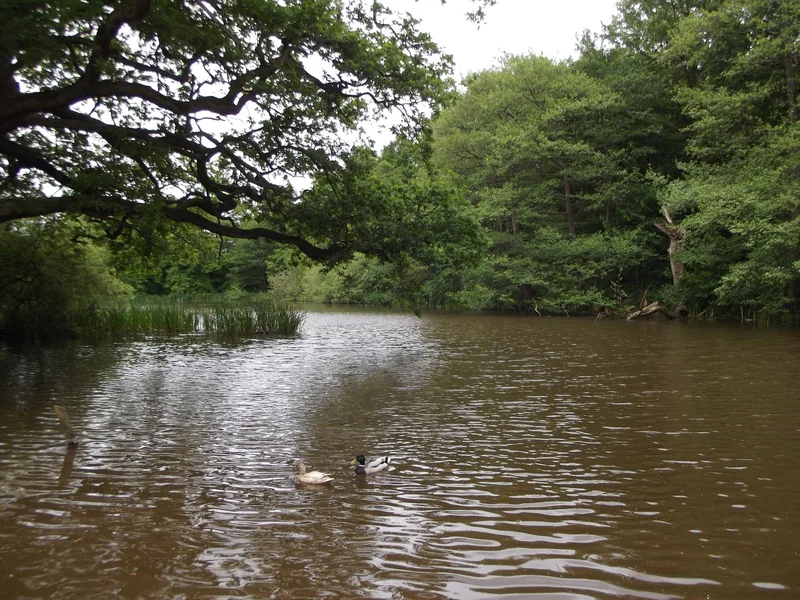
Photo: James Cracknell · CC BY-SA 4.0 · Wikimedia Commons · resized
The generals in the garden, and the listeners in the basement
Sassoon died in June 1939, aged fifty, and the house was turned into a surveillance centre. Interrogation blocks and offices went up in front of the mansion, which held senior German prisoners of war including a long list of captured generals, and the whole site was wired for sound: bugging devices were hidden in walls and skirting boards, light fittings, plant pots, window ledges, the billiard table and even the garden benches.
The prisoners were deliberately kept comfortable. They walked in the gardens, read from a German library taken from the abandoned German embassy, were taken on outings to London and had a tailor to press their uniforms. Among them were stool pigeons: British interrogators posing as captured officers, or British aristocrats with Nazi sympathies, steering conversations towards particular subjects.
Below them, in three soundproofed rooms known as M Rooms, squads of six Secret Listeners, mostly German-speaking Jewish refugees, worked two shifts, the first from 8am to 4pm and the second until the last prisoner had gone to bed, with a duty bed so that somebody was always on call. Each recording was cut straight onto a blank acetate disc, up to seven minutes at a time, then taken next door to be transcribed while a colleague kept listening. The transcripts were checked, passed to interrogators, translated, typed in German and English and sent out as Special Reports.
The museum uses two floors: the state rooms upstairs restored to their 1930s appearance, and the basement below. If the wartime intelligence story is what brings you, Bletchley Park is the other half of the same subject and a day trip rather than an afternoon, and the Churchill War Rooms are the central London equivalent.
The museum's old web address has been taken over and should not be trusted. The trust that campaigned for the museum used trentparkmuseum.org.uk for years, and that domain has lapsed and now sits with a domain reseller. Links to it still circulate in older articles and listings. The museum's current site is at trentparkhouse.org.uk, and anything you read at the old address is not the museum speaking.
What a ticket costs, and whether to book
Adult admission is £14, students and juniors aged 5 to 17 pay £12, under-fives are free, and a carer accompanying a disabled visitor goes free. Members of the Museums Association, ICOM and holders of the National Art Pass get in free or at half price on production of a card; family discounts exist but are not published as a single figure.
The museum recommends booking online and does not issue paper tickets: you show the confirmation email. A limited number of walk-up tickets is sold each day from the museum shop, so arriving without a booking is possible but not safe on a weekend. Groups of more than fifteen have to be arranged by email rather than booked online.
Allow about two hours. There is a cafe on the ground floor, open Tuesday to Sunday from 9am to 5pm, with vegetarian, vegan and gluten-free options, a shop, and lavatories in the basement with accessible ones next to the cafe and in the basement.
Getting there without a car
The park is at the end of the Piccadilly line, and both of the last two stations work. Cockfosters, the terminus, is about fifteen minutes' walk from the house by Transport for London's journey planner and is the one to use if the park is your main objective, because the main entrance and the free car park are on Cockfosters Road. Oakwood is about eighteen minutes' walk and is the station the museum names as its nearest, because of the shuttle.
That shuttle is the useful part. A free bus runs between Snakes Lane, close to Oakwood station, and Chaplin Drive a short walk from the museum. It is free with a valid museum ticket, seats must be booked in advance, and you can use it one way or both. The first departure from Snakes Lane is 09:36 and the last from Chaplin Drive is 17:22, so it does not cover a late afternoon arrival.
From central London, King's Cross St Pancras to Oakwood takes about 26 minutes if you change at Finsbury Park onto the Piccadilly line, or 28 minutes direct. Cyclists are welcome and there are racks by the cafe.
There is no car park at the house. The free car park inside Trent Country Park, off the A111 Cockfosters Road beside Go Ape, is a fifteen-minute walk from the mansion. Paid parking at Oakwood station is twenty minutes away. Three blue badge spaces sit right by the museum entrance and must be pre-booked, and anyone with mobility difficulties, blue badge or not, can be dropped off in the forecourt if they email the museum with the date and the car registration beforehand.
Access at the house
For a 1920s mansion this is better than expected. Both floors of the museum, including the basement, are reached by lift, and the museum says its primary exhibition spaces and visitor areas have been designed so that everybody can use them, within the constraints of a historic building. Assistance dogs are welcome throughout and a hearing loop is available on request.
The park around it is a different matter: it is open countryside with unsurfaced paths, slopes and mud, and we could not verify the surfaces because Enfield Council's website refuses our requests. Our guide to accessible London covers the general approach.
The park itself, and what we could not check
Trent Country Park is Enfield Council's, not the museum's, and the two are separate visits. It is a large area of woodland, grassland and water on the edge of the green belt, including the artificial lake that Jebb's villa was built to look out over, an equestrian centre and a Go Ape high-ropes course in the trees next to the free car park.
Here is the honest gap: Enfield Council's website returns an error to our research requests, and its Trent Park page is not retrievable even from the Internet Archive, so we cannot publish the park's opening and closing times, the car park hours or the current state of the trails. Check the council's own pages on the day. What we can say is that the museum treats the park car park as open when the museum is, and that the country park is not ticketed.
If you want a big free green space at the end of a Tube line and do not care about the house, Epping Forest is larger and better documented, and the Lee Valley is the other big one in this part of London. Osterley Park is the closest parallel: a country house with its own Underground station at the other end of the Piccadilly line.
Making a day of it
The sensible shape is a morning in the park and the afternoon in the house, or the reverse if you want the cafe for lunch. Two hours in the museum plus an hour and a half walking the park is a full day out from central London with about an hour of travelling at each end.
With children, the park does the work and the museum is a harder sell: the story is about eavesdropping and war, the rooms are quiet, and there is a learning room but no play space. Our guide to London with children has better bets for a wet day. For grown-up interiors of the same decade, Eltham Palace in south-east London is the other 1930s house worth the journey. And the park, being free, belongs on our list of free things to do in London.
Frequently asked questions
Is Trent Park House open to the public?
Yes, since 21 July 2026, as a museum called Trent Park House of Secrets. It opens Tuesday to Sunday from 10am to 5pm with last admission at 4pm, closes on Mondays, and shuts for the whole of January 2027 for conservation before reopening in February.
How much does Trent Park House of Secrets cost?
£14 for an adult, £12 for students and for juniors aged 5 to 17, free for under-fives and for a carer accompanying a disabled visitor. National Art Pass holders get half price, and Museums Association and ICOM members go free on production of a card. The park outside is free to everyone.
Which Tube station is best for Trent Park?
Cockfosters, the Piccadilly line terminus, is about fifteen minutes' walk and closest to the park entrance and the free car park. Oakwood is about eighteen minutes' walk and is the museum's preferred station because a free shuttle bus runs from Snakes Lane nearby to a stop close to the house.
What happened at Trent Park during the war?
The house held captured senior German officers, including many generals, in deliberately comfortable conditions while the entire building was bugged. Teams of German-speaking Jewish refugees, the Secret Listeners, recorded and transcribed their conversations from three rooms in the basement, and the results were circulated as intelligence reports.
Is Trent Country Park free?
Yes, and so is its car park off Cockfosters Road. Only the museum charges. We were unable to confirm the park's published opening and closing hours because Enfield Council's website blocks our requests, so check the council's pages if you are planning an early or late visit.
Sources
- Trent Park House of Secrets - Visit: opening times, ticket prices, getting here, facilities and accessibility (checked September 2026)
- Trent Park House of Secrets - Hidden Histories: the estate from 1779 to Sir Philip Sassoon (checked September 2026)
- Trent Park House of Secrets - The Secret Listeners and the M Rooms (checked September 2026)
- Transport for London - Journey Planner, Cockfosters and Oakwood stations to EN4 0PS on foot (checked September 2026)