
Bethnal Green is a densely built district of the East End, two stops out of Liverpool Street on the Central line. For a visitor it has one major attraction, the free Young V&A museum, and around it a set of places that explain the East End better than any museum: a 1929 municipal baths that became Britain's best-known small boxing hall, two landmark post-war housing schemes, and the station stairway where 173 people died in 1943.
Most visitors arrive for the museum, or for Columbia Road's Sunday flower market on the district's western edge, and leave without looking round. That is a pity, because almost everything below is within ten minutes' walk of Bethnal Green Tube station. Our guide to Whitechapel and the East End covers the wider area to the south; this page covers the streets of E2 between Cambridge Heath Road and Victoria Park.
Bethnal Green at a glance
- Where
- East London, E2, in the borough of Tower Hamlets, about two miles east of the City
- Tube
- Bethnal Green (Central line), about 13 to 14 minutes from Oxford Circus
- Overground
- Cambridge Heath and a separate Bethnal Green station (Weaver line), both from Liverpool Street
- Young V&A
- Free, daily 10:00-17:45, galleries close from 17:00; closed 24 to 26 December (checked November 2026)
- York Hall
- Temporarily closed, including the spa, because of a problem with the water supply (checked November 2026)
- Time needed
- Half a day for the museum and a walk; add Victoria Park for a full day
The museum in a shed from South Kensington
The large red-brick building on Cambridge Heath Road, opposite the Tube station, hides an iron frame that began life somewhere else. Historic England's list entry, which grades it II*, records that it was put up in South Kensington in 1856 to 1857 as the first, temporary home of the museum that became the V&A. Londoners called that prefabricated iron hall the "Brompton Boilers". In 1865 to 1867 it was taken down, and it was re-erected here inside a new brick skin designed by James Wild, opening as the Bethnal Green Museum in 1872.
Look up when you walk in. The exposed iron columns and bowstring roof trusses of the 1850s shed are still the structure of the main hall. Outside, the long side walls carry mosaic panels showing agriculture, the arts and the sciences, which the list entry says were assembled by women students of the South Kensington Museum's mosaic class.
For decades the building was the V&A Museum of Childhood. It reopened in 2023, after a rebuild, as Young V&A, a museum of design and play for children, young people and families, and it was Art Fund Museum of the Year in 2024. Our page on Young V&A covers the galleries, the age ranges and the busy times; the main V&A in South Kensington is where the iron shed originally stood.
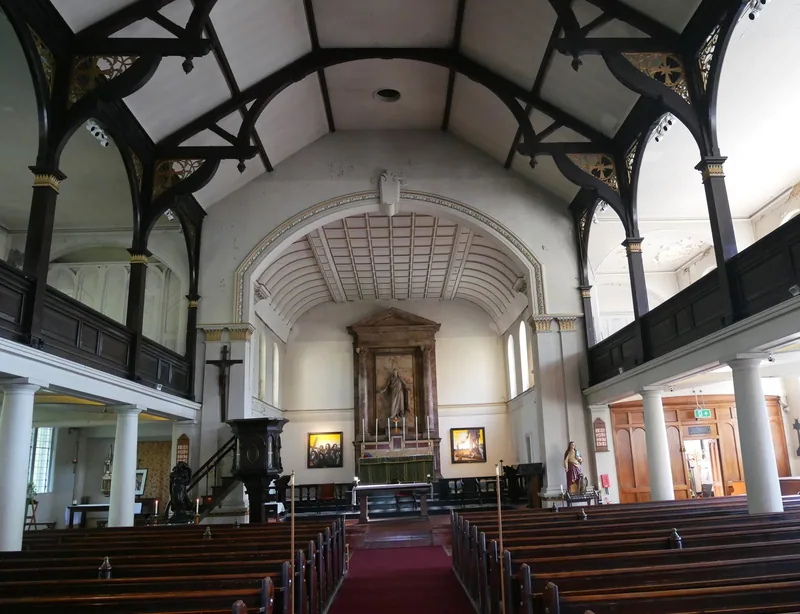
Photo: Doyle of London · CC BY-SA 4.0 · Wikimedia Commons · resized
York Hall: baths, boxing and a Turkish bath underneath
Five minutes east, on Old Ford Road, stands York Hall, a long neo-Georgian front in red brick and Portland stone. It was built by the old Bethnal Green borough as public baths and opened on 5 November 1929 by the Duke and Duchess of York, which is where the name comes from. Historic England, which listed it at Grade II in 2013, describes a building that held first- and second-class swimming pools, slipper baths, a public laundry, and Turkish and Russian baths in the basement.
The first-class pool had a floor that could be laid over it, turning it into a public hall. After about 1950 the pool went out of use and the hall took over, and York Hall became the country's best-known venue for small-hall professional boxing: the kind of evening with several bouts on the card and every seat close to the ring. The council's leisure operator gives the main hall a capacity of 1,200 for boxing and other events.
Beneath it, the three heated rooms of the 1929 Turkish bath survive with their original tiles and marble benches, and are used today as part of a council-run spa. The building is otherwise an ordinary local leisure centre with a 33-metre pool and a gym.
York Hall is shut while its water supply is repaired. In November 2026 the operator's website said the leisure centre and the spa were temporarily closed, with no reopening date. Boxing promotions book the hall independently; if you have a ticket for a fight, check with the promoter that it is going ahead at York Hall.
3 March 1943: the disaster on the station stairs
The worst event in Bethnal Green's history did not involve a single bomb. In 1943 the Central line tunnels under Cambridge Heath Road had been dug but trains were not yet running, and the unfinished station was used as an air-raid shelter, reached by one narrow staircase from the street.
On the evening of 3 March 1943 the siren sounded at 8.17pm and hundreds of people hurried to the entrance in the rain and the blackout. According to the Stairway to Heaven Memorial Trust, a woman carrying a baby slipped near the bottom of the 19 steps and others fell over her. At that moment a new anti-aircraft rocket battery in Victoria Park fired, the unfamiliar noise made people think bombs were falling, and the crowd pressed forward onto those who had fallen. By the time the last person was pulled out, 173 people had died: 84 women, 62 children and 27 men. The trust describes it as the worst civilian disaster of the Second World War in Britain. The church of St John on Bethnal Green, next to the station, was used as a mortuary.
The government held an inquiry but kept its findings out of public view during the war. For decades the only marker was a small plaque above the stairs. The memorial now beside the entrance in Bethnal Green Gardens was campaigned for by survivors and relatives, and completed and unveiled in December 2017. Its upper part is a teak staircase that appears to hang in the air beside the real one, the same size as the space where people were crushed, with 173 openings in its roof for light. The names and ages of the dead are on it, and the plinth carries accounts from survivors and from people on duty that night.
It is a place of mourning for families who still live locally, and a memorial service is held each year around the anniversary in early March. Visit it quietly, as you would a grave.
St John on Bethnal Green and the gardens
The church opposite the museum, with the odd little domed tower, is by Sir John Soane, built in 1824 to 1825 and listed at Grade I. It is one of only a handful of churches he designed. The roof and interior were restored in 1871 after a fire, and the chancel was altered by G. F. Bodley in 1888. Outside it stands the borough's war memorial, a granite cross listed in 2017.
Behind the museum and the church lie Bethnal Green Gardens and the smaller Museum Gardens, a plain but welcome patch of green with a playground, used by families killing time before or after Young V&A. In the forecourt of the museum stands a statue called the Eagle Slayer, which is listed in its own right.
Two housing schemes worth the walk
Bethnal Green was bombed heavily and rebuilt by its own borough council, and it is one of the best places in London to see what post-war architects were trying to do with council housing. Two examples are a short walk apart.
Keeling House on Claredale Street, west of Cambridge Heath Road, is a 16-storey "cluster" block designed by Denys Lasdun, the architect of the National Theatre, and built in 1957 to 1959. Four towers of two-storey maisonettes are linked to a central core of stairs and lifts, an idea meant to keep the neighbourly feel of the terraced street. It is listed at Grade II* and is now private flats: you can look from the street, but not go in. Our page on brutalist London puts it alongside the better-known concrete of the South Bank and the Barbican.
The Cranbrook Estate, on the north side of Roman Road, was designed for the same council by Skinner, Bailey and Lubetkin and built in the early 1960s: tall point blocks set around a formal garden, with bungalows for older residents. Berthold Lubetkin is best known for the penguin pool at London Zoo. Note that the estate itself is not a listed building; what is listed, at Grade II*, is the bronze sculpture at its centre, Elisabeth Frink's "Blind Beggar and his Dog" of 1958, a reference to the old local legend of the Blind Beggar of Bethnal Green. Roman Road's street market begins a few minutes further east, and our guide to Bow and Mile End covers it.
Bethnal Green Road and the cafés
Bethnal Green Road runs west from the Tube station towards Shoreditch, a long ordinary high street of grocers, takeaways and market stalls. Near the western end, where it meets Brick Lane, it becomes part of the Brick Lane market area on a Sunday.
The best-known place to eat on it is E Pellicci at number 332, a family-run café with a yellow Vitrolite front and a wood-panelled interior, which serves cooked breakfasts and Italian dishes. It holds a food hygiene rating of 5, from an inspection in October 2025. For more options in the streets to the west, see our page on where to eat in Shoreditch.
Victoria Park and the canal edge
At the north-eastern edge of Bethnal Green, beyond York Hall, lies Victoria Park, the largest park in this part of east London, with lakes, cafés and a long tree-lined drive. It is the natural next step after the museum on a fine day, about fifteen minutes' walk from the station along Old Ford Road. The Regent's Canal runs along the park's western side, and its towpath is a quiet walking route west towards Broadway Market and Islington.
Getting there, and which Bethnal Green station
The Central line station is the one you want for the museum, the memorial and York Hall. Bethnal Green is in Zone 2, so a journey from the West End costs less than you may expect. The station is not step-free.
Confusingly, there is a second station called Bethnal Green, on the Overground's Weaver line from Liverpool Street, about nine minutes' walk to the west, with no connection between the two. If a journey planner tells you to change at Bethnal Green, it means walking between them. For Columbia Road, Cambridge Heath on the same Overground line is closer. The Central line's Night Tube service at weekends makes it an easy place to get back from late.
Is Bethnal Green worth the trip?
With children under about twelve, yes, without question: Young V&A is free, purpose-built and one of the best things to do with a family in London. For adults without children, the museum alone is not enough reason, but the museum building, Soane's church, the memorial and a walk past York Hall and Keeling House make a good half-day on the way to Victoria Park or Columbia Road. If you are looking for a place to stay, our page on staying in Shoreditch and the East explains why rooms sold as "Shoreditch" are often here.
Frequently asked questions
What happened at Bethnal Green station in 1943?
On 3 March 1943, during an air-raid alert, a crowd hurrying into the unfinished station, then used as a shelter, fell on the narrow entrance stairs. 173 people were crushed to death, 62 of them children. No bomb fell. A memorial now stands beside the entrance.
Is Young V&A free?
Yes. Young V&A in Bethnal Green is free and open daily from 10:00 to 17:45, with galleries closing from 17:00, and closed from 24 to 26 December (checked November 2026). Some special exhibitions and events may charge.
Why is York Hall famous?
York Hall opened as public baths in 1929, and its main hall, built over a swimming pool, became Britain's best-known venue for small-hall professional boxing. A Turkish bath from 1929 survives in the basement. In November 2026 the building was temporarily closed because of a water supply problem.
Is Bethnal Green a safe area to visit?
It is a busy, ordinary residential and shopping district with the usual city precautions. The museum, gardens and main roads around the station are busy throughout the day, and the Central line runs all night at weekends.
Is the Cranbrook Estate listed?
No. The estate, designed by Skinner, Bailey and Lubetkin, is not on the national list. The sculpture at its centre, Elisabeth Frink's Blind Beggar and his Dog, is listed at Grade II*.
Sources
- Historic England - Bethnal Green Museum, list entry 1357777 (checked November 2026)
- Historic England - York Hall, list entry 1412973 (checked November 2026)
- Historic England - Keeling House, list entry 1242108 (checked November 2026)
- Historic England - Blind Beggar and His Dog, Cranbrook Estate, list entry 1031598 (checked November 2026)
- Historic England - Church of St John on Bethnal Green, list entry 1065245 (checked November 2026)
- V&A - Young V&A, opening times and admission (checked November 2026)
- Be Well (Tower Hamlets Council) - York Hall Leisure Centre (checked November 2026)
- Stairway to Heaven Memorial Trust - Appeal and Memorial project (checked November 2026)