
Young V&A is a free museum of play and design for children up to 14, run by the Victoria and Albert Museum in Bethnal Green, east London. It is open every day from 10:00 to 17:45, you do not need to book, and two to three hours is about right for a family with children under ten.
It used to be the V&A Museum of Childhood, a building full of dolls' houses and toys in glass cases. After a three-year, £13 million redevelopment it reopened on 1 July 2023 as something different: three galleries called Play, Imagine and Design, built around about 2,000 objects from the V&A's collections, with things to build, climb into, dress up in and play with between them. A year later it won Art Fund Museum of the Year 2024, the largest museum prize in the world.
This page is about how a visit works. For the main museum in South Kensington, see our guide to the V&A; for the area around it, our page on Bethnal Green.
Young V&A at a glance
- Address
- Cambridge Heath Road, Bethnal Green, London E2 9PA
- Opening hours
- Daily 10:00 to 17:45; the galleries start closing from 17:00 (V&A, checked November 2026)
- Closed
- 24 to 26 December
- Admission
- Free, no booking. Some temporary exhibitions charge
- Who it is for
- Designed with and for 0 to 14 year olds; children must be supervised by an adult at all times
- Nearest station
- Bethnal Green (Central line), two minutes' walk
- Quietest
- Weekday afternoons 13:00 to 15:00, and the last hour
- Current exhibition
- Inside Aardman: Wallace & Gromit and Friends, sold out, closes 15 November 2026; no successor listed yet (checked November 2026)
The three galleries, and which age each one suits
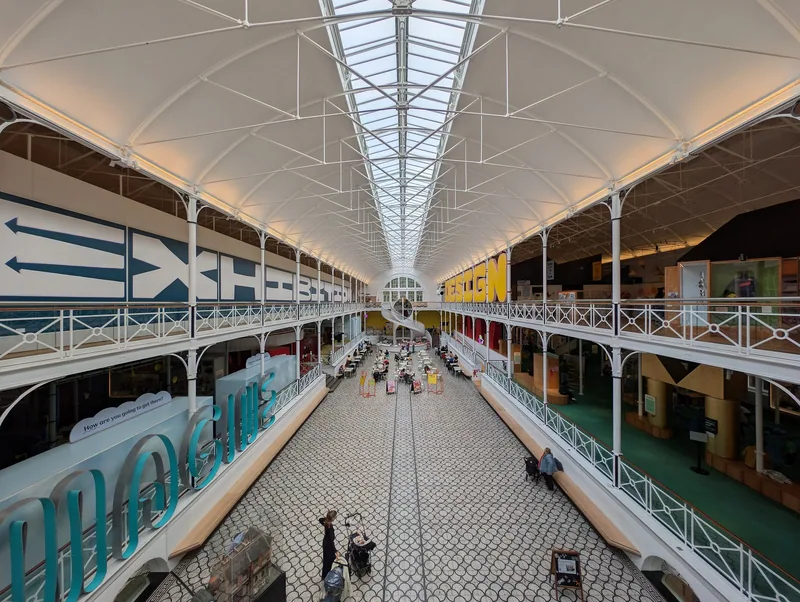
You come in through a Welcome Area into the Town Square, the big central hall on the ground floor, with the café at its far end. The galleries are built for different ages, but nothing stops a twelve-year-old from going into the toddler zone or a parent from lingering in the design studio.
Play, to the right of the Town Square, is for the youngest. The V&A describes colours, textures and shapes put at a baby's eye level, a construction zone with den-building and a large marble run, and the Arcade, which tells the history of board games and video games with plenty of games to actually play. If you have a child under five, this is where the visit will happen.
Imagine, on the other side of the square, is about stories and characters. The objects people come for are here: Joey, the life-size horse puppet from the stage play War Horse; a Superman costume; and Rachel Whiteread's Place (Village), an installation made from dozens of dolls' houses. There is also a performance area, the Stage, where children put on shows and events take place.
Design, up the big staircase on the upper floor, is aimed at older children. It introduces how designers work, from idea to problem-solving, with workshops in the Open Studio and The Shed, a space for the work of a contemporary designer or artist. Opposite it is the temporary exhibition gallery, which is the part of the building most likely to charge.
Over-14s may not dress up here. Children aged 14 and under are welcome to come in costume as long as their faces are not fully covered. For safeguarding reasons the museum does not allow visitors over 14 to wear costumes, and masks of any kind are banned except for medical or religious reasons.
How long to allow, and what a short visit misses
An hour gets you round the Town Square, one gallery and a look at the building. Two hours is enough for most families with children of three to nine, and is what we would plan for. With a toddler who has found the marble run, or a ten-year-old doing a workshop in the Design gallery, it can easily stretch to three hours with lunch.
What a short visit misses is the upper floor. Families with small children tend to settle in Play and never climb the stairs. If you have children of different ages, split up: one adult in Play, one upstairs in Design, and meet in the Town Square.
The galleries begin closing at 17:00, so arriving at 16:00 gives you less than an hour. Older children who loved the Design gallery can carry on at home with mused, the V&A's free online design space for ages 10 to 15.
Why the building is a Victorian iron shed
Look up when you come in. The tall central hall, with galleries round its edges and a roof of slender iron trusses and long skylights, is one of the earliest prefabricated iron-framed buildings to survive anywhere, and Historic England lists it at Grade II* for that reason.
It was not built here. The iron frame went up in South Kensington in 1856 to 1857 as the first home of the South Kensington Museum, the institution that became the V&A. It looked a little like the Crystal Palace, but it was clad in corrugated iron instead of glass, and with its three curved roofs it earned the mocking nickname "the Brompton Boilers". When the museum outgrew it, most of the structure was taken down between 1865 and 1867 and re-erected in Bethnal Green, now wrapped in red brick to a design by James Wild. It opened as the Bethnal Green Museum on 24 June 1872, the first museum in east London.
It became the Museum of Childhood in 1974. The 2023 redevelopment, by the architects De Matos Ryan and AOC, uncovered the original windows and restored the black-and-white marble mosaic floor of the main hall. The listing records that the floor was apparently laid by women prisoners from the gaol at Woking.
Food, lockers and the things you cannot bring in
The café at the end of the Town Square is open 10:00 to 17:00 every day, with hot and cold meals, cakes, coffee and children's lunch boxes, plus high chairs and a bottle warmer. Alcohol is not allowed anywhere on site.
You are welcome to bring your own cold food. The museum lets you eat a packed lunch in the Town Square, in the neighbouring Museum Gardens, and in the Common Room on weekends and in Tower Hamlets school holidays. There is a microwave and bottle warmer in the café for families. This makes it one of the cheapest days out in London with children: for two adults and two children the only compulsory cost is the fare, and children under 11 travel free on the Tube with a paying adult, as our page on children's fares explains.
- Lockers: 24 free lockers on the lower-ground floor, first come, first served, for small items.
- Luggage: wheeled bags and anything larger than 56 by 45 by 21 centimetres are not allowed in the galleries, and there is nowhere to leave a suitcase. Do not come here on the way to the airport.
- Pushchairs: there is a buggy park in the Welcome Area, with an overflow at busy times.
- Not allowed: helium balloons, and birthday parties: the museum will not let groups reserve space or decorate it.
Step-free inside, but not at the station
The building itself is step-free throughout. The entrance is level, there are lifts on the right as you enter the Town Square and at the back of the Imagine gallery, and the Play gallery has a ramp. Accessible toilets and baby changing are on the lower-ground floor, along with an assisted accessible toilet with a ceiling hoist and a changing table for older children; ask for the key in the Community Room.
Wheelchairs and ear defenders can be borrowed, and the museum asks you to book them at least 24 hours ahead. The Reading Room on the lower-ground floor is a quiet space for anyone who needs a break from the noise, and the V&A publishes a visual story with photographs of every space.
The catch is the journey. Bethnal Green station is not step-free, and the V&A gives Whitechapel, 0.8 miles away, as the nearest step-free station. Our guide to step-free transport explains the alternatives, and the buses below are the easier option with a wheelchair or a heavy pushchair.
Getting there from Liverpool Street and beyond
Bethnal Green is one stop east of Liverpool Street on the Central line, and the museum is two minutes from the station exit. Cambridge Heath on the Overground's Weaver line, also from Liverpool Street, is about five minutes' walk. Buses 106, 254, 388 and D6 stop nearby. Parking is limited and the museum advises public transport.
Weekday afternoons are the calm window. The museum says it is typically quieter between 13:00 and 15:00 on weekdays and towards closing time, and especially busy at weekends and in school holidays, when there may be a short wait to get in. A wet Saturday in half-term is the worst combination.
Is it worth the trip to east London?
For children under about ten, yes, and on a rainy day it is one of the best free options in London. It is built for touching and playing in a way the big South Kensington museums are not,, and it costs nothing. Our list of rainy-day activities for children puts it alongside the alternatives.
For teenagers it is less certain. The Design gallery and the exhibitions can hold a curious thirteen-year-old, but a fourteen-year-old who wanted to see the V&A's fashion may be happier at the V&A East Storehouse in Hackney Wick, where you walk among the stored collection. And adults without children will see the building and the Whiteread in half an hour.
What else is within walking distance
The museum sits on the edge of Museum Gardens, a small park with space to run around. From there you can make a full east London day:
- Victoria Park, with its playgrounds and lakes, is roughly 15 minutes' walk north-east (our estimate).
- On a Sunday morning, Columbia Road flower market is roughly 15 minutes' walk west (our estimate); go early with a pushchair.
- The Ragged School Museum in Mile End, a Victorian schoolroom, is one more stop east on the Central line.
- For more city farms and free play areas, see our page on London's city farms and playgrounds.
Our wider guide to London with children and our list of free museums have more for a week of family sightseeing.
Frequently asked questions
Is Young V&A free?
Yes. General admission is free and you do not need to book a ticket. Some temporary exhibitions in the upper-floor gallery charge, and the popular ones sell out, but the three main galleries, Play, Imagine and Design, are always free.
What age is Young V&A for?
The museum was designed with and for children aged 0 to 14. Play suits babies and toddlers, Imagine works for most primary-school ages, and the Design gallery upstairs is aimed at older children. Adults are welcome, but children must be supervised by an adult at all times.
Is Young V&A the same as the Museum of Childhood?
It is the same museum in the same building on Cambridge Heath Road. The V&A Museum of Childhood closed for a three-year redevelopment and reopened as Young V&A on 1 July 2023, with new galleries and far more hands-on activities than glass cases.
How do I get to Young V&A?
Take the Central line to Bethnal Green, one stop from Liverpool Street; the museum is two minutes' walk from the station. Cambridge Heath on the Overground is five minutes away, and buses 106, 254, 388 and D6 stop nearby.
Can you take a pushchair into Young V&A?
Yes. The whole building is step-free with lifts, and there is a buggy park in the Welcome Area by the entrance. The nearby Tube station is not step-free, though, so a bus or Whitechapel station may be easier.
Sources
- V&A - Visit Young V&A: opening times, getting here, facilities (checked November 2026)
- V&A - Access at Young V&A (checked November 2026)
- V&A - Young V&A visual story (checked November 2026)
- V&A - Young V&A: countdown to summer 2023 (opening date) (checked November 2026)
- V&A - Young V&A wins Art Fund Museum of the Year 2024 (checked November 2026)
- Historic England - Bethnal Green Museum, list entry 1357777, Grade II* (checked November 2026)
- V&A - What's on at Young V&A (checked November 2026)