
Golders Green is seventeen minutes from Tottenham Court Road on the Northern line, in Zone 3, and it has two things a visitor cannot get anywhere else in London: the best concentration of Jewish food shops in the city, and a crematorium whose garden is listed at Grade I, the highest grade Historic England gives. Up the road at Colindale is the Royal Air Force Museum, which is free. Everything on this page is free to look at except the food.
Hendon adjoins it to the north-west and is a bigger, plainer place: a 1920s and 1930s suburb built along the Northern line, with a university campus, an enormous road junction and the site of the aerodrome that became the museum. Neither is a sight in the ordinary sense. Both reward a specific interest.
Our guide to salt beef and Jewish food in London owns Golders Green Road as a place to eat and shop, with named bakeries and what they sell. The RAF Museum London owns the hangars, the free ticket and the parking charges. This page is about the district: the crematorium, the theatre nobody looks at, what Hendon actually is, and how the fares and the last trains work.
Golders Green and Hendon at a glance
- Golders Green
- Zone 3, Northern line. 17 minutes to Tottenham Court Road. £3.30 off-peak, £3.90 peak. Two lifts, lift access available
- Hendon Central
- On the Zone 3 and 4 boundary, so charged at the cheaper rate. 22 minutes to Tottenham Court Road, £3.30 off-peak. One lift
- Golders Green Crematorium
- Grade I registered landscape, Hoop Lane NW11. TfL: 1,015 metres and 13 minutes' walk from the station. Free
- RAF Museum London
- Free, open daily 10:00-17:00, last entry 16:30. Nearest station Colindale, not Hendon Central
- Night Tube
- Yes. Golders Green, Hendon Central, Brent Cross, Colindale, Burnt Oak and Edgware are all on the Northern line night service on Friday and Saturday nights
- Fare cap
- A day to Golders Green keeps you inside the £10.50 Zones 1-3 cap; Colindale lifts it to £12.80 for Zones 1-4
The crematorium, and why it is listed at Grade I
This is the reason to come, and almost nothing written for visitors explains it. Golders Green Crematorium is not simply a crematorium with a garden. Historic England registered the landscape at Grade I on 9 January 2002 — the same grade as Kew and Stowe, and one that fewer than one in ten registered parks and gardens in England holds.
The reason given is that it is London's first crematorium and England's first purpose-designed crematorium landscape, opened in 1902. Before that, Londoners who wished to be cremated had to use Woking, which had opened in 1885. Golders Green was deliberately sited within easy driving distance of central London, and the register notes that well over a quarter of a million cremations have taken place here since. The land was bought in 1900 for £6,000; the first buildings cost £21,000.
The buildings are by Sir Ernest George and Alfred Yeates, and they are listed Grade II in their own right. The intention was a long red-brick range in a Lombardic Romanesque style linked by a cloister some 240 feet long, but the money arrived in instalments and the range was built in phases over almost forty years, from the West Chapel and West Columbarium of 1901–03 to the Chapel of Memory of 1938–39. A single-storey spine of cloisters joins them along the south side, and the wall plaques inside it are part of the listing.
The planting was laid out by William Robinson, the gardener who argued English gardens out of Victorian formality and into the wild garden, and who was a director of the company. The Cloister Garden at the north-east corner is what survives of a pergola he advised on in 1907, backed by a red-brick wall that curves round into an exedra.
What to look for in the garden
Three things in particular, and they are all free to see:
- The Philipson Mausoleum, by Sir Edwin Lutyens, 1914–15, listed Grade II*. A circular single-storey building in Portland stone with a domed roof and a narrow external corridor enclosed by a stone lattice screen. It faces the Eastern Path, about ninety metres south-east of the larger mausoleum. A Lutyens building in a crematorium garden is not something you expect to find at the end of the Northern line.
- The Martin Smith Mausoleum, 1904–05, by Paul Phipps, listed Grade II: square in plan, brick with Portland stone dressings, Baroque Revival, at the east end of the main path.
- "Into the Silent Land", a bronze by Henry Pegram of about 1924, listed Grade II: a shrouded figure raising a girl above a sea of souls. It was given to the crematorium by the Royal Society of Arts in 1937, originally stood on the lawn, and was moved into the tree belt on the eastern edge in the late twentieth century, about 130 metres south-east of the Martin Smith Mausoleum. It is the single strangest and best thing here.
At the western end of the main path is a war memorial in the form of a stone Ionic temple, with a formal lily pond, both of 1919–20. The big lawn south of the path is planted with large numbers of crocuses, so late February and early March is the best time of year to see it.
This is a working crematorium, not a park. Funerals take place here every working day, and the courtyards off Hoop Lane are car parks for mourners. Come quietly, keep off the chapel approaches when a service is going on, do not photograph people, and use the garden paths rather than the lawns. The gardens are open for people to walk in; the buildings belong to whoever is grieving in them that day.
The entrance is from Hoop Lane on the north side, which TfL measures at 1,015 metres and thirteen minutes from Golders Green station. The Jewish cemetery across Hoop Lane is a separate institution with its own rules and is not part of the registered landscape.
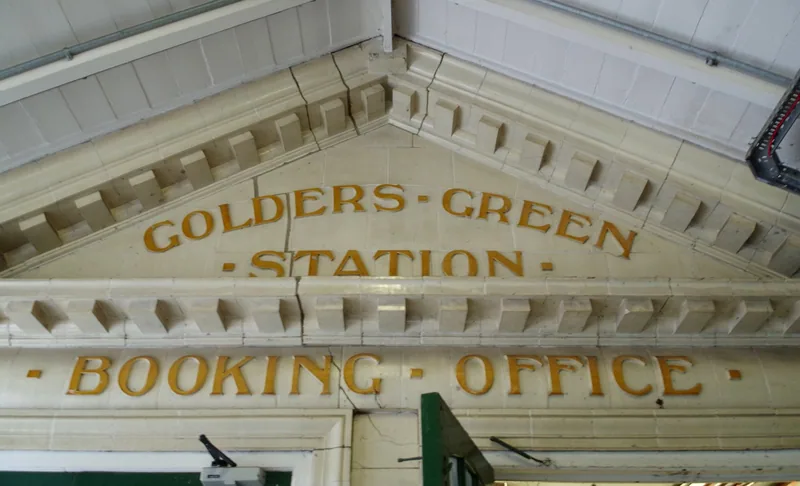
Photo: mattbuck (category) · CC BY-SA 4.0 · Wikimedia Commons · resized
The theatre facing the bus station
Standing at Golders Green bus station, most people look at the buses. Turn round. The large building whose main façade faces the bus station is the Golders Green Hippodrome, and Historic England lists it Grade II, first listed on 23 October 1973.
The listing describes a variety theatre of 1913 by Bertie Crewe, with an asphalt roof carrying an octagonal cupola. The façade towards the bus station is three storeys and seven bays between rusticated stair towers with Diocletian attic windows, with a giant Ionic order, pediments over the second-floor windows and small-paned casements, some with coloured leaded glass. The old exit doors in the centre, which once let the pit and the gallery out, are panelled with small coloured lights.
Inside, which you are unlikely to see, the listing records a square proscenium flanked by giant Doric columns, with urns and pediments above the boxes surmounted by charioteers pulled by lions. Historic England listed it as a rare example of a surviving suburban theatre, largely intact. Its use has changed more than once since 1913 and we are not going to state what occupies it this month; the exterior is the point, and it is free and forty seconds from the Tube.
Three other buildings in Golders Green carry Grade II listings, all added recently: the Golders Green Synagogue, listed 21 May 2007; the Golders Green Unitarian Church, listed 23 July 2004; and numbers 4 to 8 Golders Green Road, listed 9 July 2002.
Golders Green Road, in one paragraph
The shops begin immediately outside the station and run west. Bakeries, butchers, fishmongers, restaurants and kosher supermarkets are strung along a single high street, with more in Hendon and Edgware, and it is where the everyday Jewish food shopping of north-west London happens rather than a heritage quarter put on for visitors. Our salt beef and Jewish food guide, linked above, names the bakeries, explains what challah is, and — importantly — explains the difference between kosher and kosher-style, which changes what you can order and when places are shut. Friday afternoon and Saturday are not shopping days here.
Hendon: what it is, and what it is not
Hendon is where this page has to be plain. It is a large interwar suburb of brick semi-detached houses, built when the Underground arrived, with a university campus, a shopping centre at Brent Cross and the M1 and North Circular meeting in a knot of flyovers. There is no old village centre at Hendon Central, no museum in Hendon itself, and no reason for a visitor with a week in London to get off the train there.
Three things are worth knowing anyway.
The aerodrome. Hendon was one of the birthplaces of British aviation: the pioneer Claude Grahame-White had works on the site before the First World War. What became of it is the Royal Air Force Museum, and the crucial practical point is that the museum is not at Hendon Central. Get off at Colindale, two stops further north, and walk about ten minutes. Our RAF Museum page has the hangars, the free ticket, the parking charges and the bus that stops outside; it also explains that Colindale is in Zone 4, which lifts your daily cap.
The zone boundary. Hendon Central sits on the boundary between Zones 3 and 4, and a boundary station is charged at whichever of the two rates is cheaper. That makes it £3.30 off-peak to Tottenham Court Road, the same as Golders Green in Zone 3, and it keeps a day here inside the £10.50 Zones 1 to 3 cap. Travelling on to Colindale instead pushes the cap to £12.80.
The Saturday morning run. Sunny Hill parkrun takes place in Sunny Hill Park in Hendon, a free timed 5km at 9am, and it is the nearest organised run to either station. Our guide to running routes in London explains the single registration and the barcode rule that a visitor cannot skip.
Green space, and the walk south to Hampstead
The best green space near Golders Green is not in Golders Green. Walk or take a bus south-east and you reach Golders Hill Park and the Hill Garden, which has a small free zoo and a pergola, and beyond it the western side of Hampstead Heath. From the Heath it is a short walk to Kenwood House, which is free and holds a Rembrandt self-portrait and a Vermeer.
That is how to make a day of this corner of London: the crematorium garden in the morning, the food shops for lunch, then south to the Heath and Kenwood, coming back into town from Hampstead rather than Golders Green. Our Hampstead guide covers the other end of that walk, and free things to do in London puts the day in context, because none of it costs anything.
Getting here, and getting back late
All three stations are on the Northern line's Edgware branch, and which one you use changes both the fare and the walk.
| Station | Zone | To Tottenham Court Road | Fare off-peak / peak | Lifts |
|---|---|---|---|---|
| Golders Green | 3 | 17 min | £3.30 / £3.90 | 2, lift access available |
| Hendon Central | 3 and 4 boundary | 22 min | £3.30 / £3.90 | 1, lift access available |
| Colindale (for the RAF Museum) | 4 | 24 min | £3.60 / £4.80 | Recorded in one TfL file, not the other |
Golders Green is the most usable of the three with a pushchair or a suitcase. The Colindale discrepancy is in TfL's own data, so do not rely on a lift there.
Golders Green bus station outside the Tube is one of the bigger interchanges in north London and the practical way to reach Hampstead, Brent Cross and the Heath without going back into town. Our guide to London buses explains the Hopper fare.
The late-night picture is unusually good for Zone 3. The Northern line runs a Night Tube service on Friday and Saturday nights that includes Golders Green, Hendon Central, Brent Cross, Colindale, Burnt Oak and Edgware, so an evening in the West End does not have to end early. Our Night Tube guide has the lines and the fares, which are charged at off-peak rates. The Northern line guide explains the branch structure, which is the one thing that catches people out on this line.
Frequently asked questions
Can you visit Golders Green Crematorium?
Yes. The gardens are open for people to walk in and there is no charge. It is a working crematorium with funerals every working day, so behave as you would in any cemetery: keep away from the chapel approaches during services, do not photograph mourners, and stay on the paths. The entrance is from Hoop Lane, thirteen minutes' walk from the station.
Why is Golders Green Crematorium important?
Because it was the first. Historic England registered the landscape at Grade I in 2002 as London's first crematorium and England's first purpose-designed crematorium landscape, opened in 1902 with buildings by Sir Ernest George and Alfred Yeates and planting by William Robinson. It also holds a Lutyens mausoleum listed at Grade II* and a listed bronze by Henry Pegram.
Is the RAF Museum in Hendon or Colindale?
Colindale. The museum is on the site of the old Hendon aerodrome and carries the Hendon name in ordinary speech, but the station to use is Colindale, two stops north of Hendon Central on the Northern line, and then about ten minutes on foot. Getting off at Hendon Central is the standard mistake.
When are the shops on Golders Green Road shut?
Many of the Jewish businesses close early on Friday afternoon and all day Saturday for the Sabbath, and reopen on Sunday. That reverses the usual London pattern, so Sunday is a good shopping day here and Saturday is the worst. Our Jewish food guide explains which places are kosher and which are kosher-style, because the rules differ.
Sources
- Historic England - Golders Green Crematorium, registered park and garden, list entry 1001575, Grade I (checked September 2026)
- Historic England - Mausoleum to the Philipson Family, Golders Green Crematorium, list entry 1064788, Grade II* (checked September 2026)
- Historic England - Golders Green Hippodrome, list entry 1286941, Grade II (checked September 2026)
- RAF Museum London - opening times and free admission (checked September 2026)
- Transport for London - detailed station data (fare zones and lifts at Golders Green and Hendon Central) (checked September 2026)
- Transport for London - Night Tube lines and stations (checked September 2026)
- Transport for London - daily and weekly fare capping (checked September 2026)