
Enfield Town is the northern terminus of the Weaver line, thirty-six minutes from Liverpool Street, and it has two things of genuine historical weight standing a hundred metres apart. Its market was granted by royal charter in 1303. And the bank on the east side of the town square is a listed building specifically because the world's first cash machine was switched on outside it, by a television comedian, on 27 June 1967. Both are free to look at, and hardly any visitor to London comes here.
The town sits at the northern edge of Greater London where the built-up area gives out. West of it is Enfield Chase; east of it the ground falls away to the Lea valley, its reservoirs and its navigation. The New River, a seventeenth-century aqueduct that still carries water to London, passes straight through the middle of the town, and its towpath is the best flat walk in this part of the city.
Our guide to the six Overground line names explains what the Weaver line is and why it is called that; the New River Path owns the walk and says the Enfield to Wood Green stretch is the best of it; and Forty Hall owns the Grade I house and Tudor palace site north of the town, including the four days a week it opens. This page is Enfield Town itself.
Enfield Town at a glance
- Station
- Enfield Town, Zone 5, Weaver line (London Overground). Terminus. Toilets. No lift recorded in TfL's station data
- Journey
- 36 minutes to Liverpool Street, direct. £3.80 off-peak, £5.30 peak with contactless or Oyster
- Fare cap
- Zone 5 lifts your daily cap to £15.30, from £8.90 for Zones 1 and 2
- Market charter
- 1303, a weekly market and two three-day fairs granted to Humphrey de Bohun
- The cash machine
- Barclays Bank, 20 The Town, EN2 6LS. Grade II, listed 30 March 2023. World's first ATM inaugurated 27 June 1967
- Everything on this page
- Free. The town square, the church, Gentleman's Row and the New River path cost nothing
The bank, the gold cash machine and the blue plaque
Start here, because it is fifty paces from the station and almost nobody knows it.
Barclays Bank at 20 The Town was added to the National Heritage List for England at Grade II on 30 March 2023. Historic England's entry describes a bank of 1897 designed by William Gilbee Scott for the London and Provincial Bank, in a Flemish Renaissance style: red brick laid in Flemish bond with stone dressings, a double-height ashlar-faced ground floor with an arched opening in each of its four bays, a shaped gable over the two central bays with a segmental pediment and urns, and a pitched roof topped by an elaborate cupola with a leaded dome and a spire. Over the door the word BANK is carved in relief among foliage, and between the windows on the town-square side there is a datestone reading 1897.
The history in the listing is better than the architecture. The London and Provincial Bank had been the first bank to open a branch in Enfield Town, in 1875. In 1894 it bought the site of the Greyhound Inn and a row of three-storey houses on the eastern side of the market square, ran an architectural competition in 1896, and built Scott's winning design.
Then, on 27 June 1967, the world's first operational automated teller machine was inaugurated at this branch by the comedian Reg Varney. It had been developed jointly by De La Rue Instruments and Barclays Management Services Department under John Shepherd-Barron, De La Rue's managing director. It issued a £10 note when the customer inserted a special paper voucher punched with dots corresponding to a four-digit personal number — which is where the PIN comes from. Historic England records why Enfield was chosen: a representative banking clientele, good pavement access, high windows, and proximity to Barclays' head office.
Walk round to the town square side and look at the pair of cash machines. One of the two is painted gold, to commemorate the original, and there is a round blue metal plaque below one of the windows recording the 1967 installation. Both are on the west elevation facing the square, not on the main front. This is the only place in the world where you can withdraw money from a listed monument to the cash machine.
The listing also notes group value with the adjacent Old Vestry Office and its forecourt railings, both Grade II, so the two buildings are best looked at together.
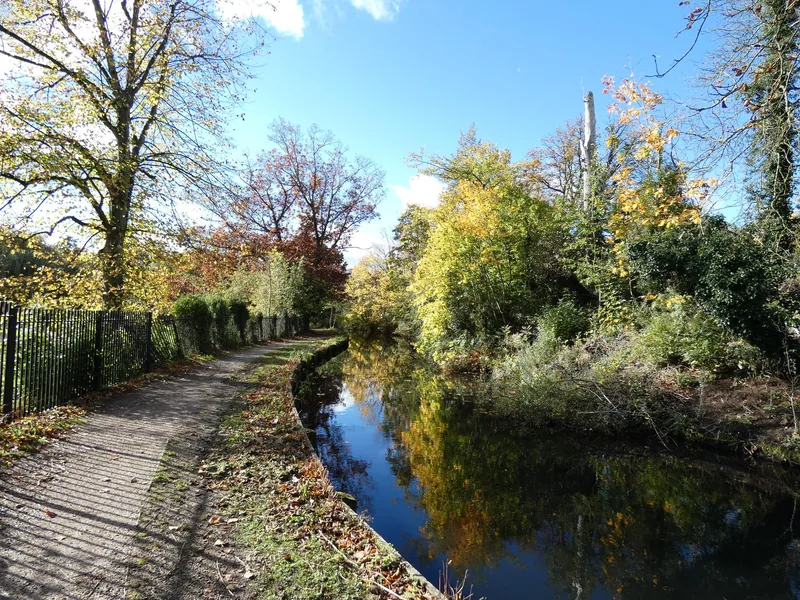
Photo: James Cracknell · CC BY-SA 4.0 · Wikimedia Commons · resized
The market, from 1303 to the curate who kicked over a stall
The Victoria County History of Middlesex sets out Enfield's market history, and it is unusually entertaining.
In 1303 the king granted Humphrey de Bohun a weekly market at Enfield and two annual fairs of three days each, at the feasts of St Andrew, 30 November, and of the Assumption, 15 August. The Assumption fair later moved to 23 September and was suppressed as a source of immorality in 1869. The St Andrew's day fair turned into a cheese fair and by 1823 was used only for selling old horses and cattle.
The market itself had a rougher ride. In 1585 a Sunday meat market by the church gate was vehemently opposed by the clergy, who invited preachers to condemn it and then petitioned Lord Burghley to have it closed. In 1586 some parishioners asked for it to be kept, complaining that the curate, Leonard Thickpenny, had overturned a stall and threatened to beat the butcher. They lost.
In 1618 James I granted a Saturday market, with a court of pie-powder to settle traders' disputes on the spot, to Sir Nicholas Salter and others, and stipulated that the profits be reserved for the poor. It was held south of the church, on the site of a house called the Vine that the parish bought in 1632. By 1823 it was moribund despite two attempts to revive it. It was revived successfully later, and was trading on its old site each Saturday in 1971 and twice weekly from 1974.
There is still a market in the town square today. We could not confirm its current trading days, because Enfield Council's website returns an access-denied error to us on every path, including its home page and sitemap, and we tested that with an ordinary browser signature as well. Rather than publish days we have not read, we say plainly: check the current days locally or by telephone before you plan a trip around the market.
Gentleman's Row, which is the reason to walk west
Two minutes west of the square, on the far side of the New River, is Gentleman's Row: a narrow lane of Georgian houses that is the best-preserved street in the borough and is almost entirely unknown outside it.
Historic England lists a remarkable proportion of it, and of the streets around it. These are private homes and a working church: there is nothing to go into, and the point is a ten-minute walk down a lane with water on one side.
| What | Grade | First listed |
|---|---|---|
| Church of St Andrew, Enfield parish church | II* | 19 March 1951 |
| North-east building, Enfield Grammar School | II* | 19 March 1951 |
| Clarendon Cottage, Gentleman's Row | II* | 19 March 1951 |
| Gentleman's Row: 7–9, 13–15, 23, 25, 27–33, and Eastbury, Sedgecrop, Fortescue Lodge, Brecon House, The Haven, The Laurels, Rivulet House, Little Park | II | 1951 and 1974 |
| Four bridges over the New River, one at the south end of Parsonage Gardens | II | 20 March 1990 |
| Four K6 telephone kiosks near the Church Street junction | II | 5 January 1988 |
| Barclays Bank, 20 The Town | II | 30 March 2023 |
Three Grade II* buildings within two hundred metres is more than most outer London town centres manage, and the four red telephone kiosks are a rarer survival than any of them.
Where to have a drink
For a drink, the Crown & Horseshoes on Horseshoe Lane is listed Grade II, on 31 January 1974, and it sits beside the New River. It held a five-star hygiene rating at an inspection in January 2026, which is why we are willing to name it; ratings change at every inspection, so check the current one on the Food Standards Agency register. Our guide to historic pubs in London covers the wider set, and pub etiquette explains ordering at the bar.
East to the Lea valley, and one rule that is not optional
From the town it is a short bus ride or a long walk east to the Lea valley: reservoirs, the navigation, marshes, a regional park that runs from Hertfordshire down to the Thames. It is flat, open, has more water than anywhere else in London, and is the best cycling country inside the boundary. Our guide to travelling with a bike in London explains which trains take bicycles and when, which matters because the Weaver line is how you get a bike out here. Further down the valley, Walthamstow Wetlands is the part with a visitor centre.
Swimming is illegal in the Lea Valley Regional Park, not merely dangerous. The park authority's own byelaws prohibit bathing throughout the park. Reservoirs and navigations look inviting on a hot day and people drown in them every summer, but the point here is legal as well as practical: there is no stretch where it is permitted. Use a lido or a supervised open-water venue instead.
North of the town, Forty Hall is a free Grade I house in a Grade II registered park of about thirty-two hectares, registered on 10 June 1996, with the buried remains of a Tudor royal palace in the field beside it. Our Forty Hall page has the four days a week the house opens and the summer-hours problem, which is the thing that wastes people's journeys.
West of the town, Grovelands Park has a free timed 5km parkrun on Saturday mornings at 9am, and Enfield Town Park, five hundred metres from the station, has a junior parkrun for children aged four to fourteen on Sundays. Our guide to running routes in London explains the single worldwide registration and the barcode rule.
Getting here, and the honest verdict
Enfield Town is the terminus of one branch of the Weaver line, thirty-six minutes from Liverpool Street with no change, in Zone 5. The fare is £3.80 off-peak and £5.30 at peak times with contactless or Oyster, and a day out here lifts your daily cap from £8.90 to £15.30, which is the real cost of the trip. Our explainer on the DLR and the Overground covers how the Overground is fared and ticketed. TfL's station data records toilets at the station but no lift; the platforms at a surface terminus are generally reached on the level, but we have not verified a step-free route, so check with TfL if that matters to you.
The verdict. Enfield Town is not a substitute for anything in central London and we would not send a first-time visitor here. It is a good half day for three kinds of person: anyone interested in the history of money, who will find the cash machine story worth the fare on its own; anyone who likes Georgian streets without crowds, who will get Gentleman's Row to themselves; and anyone walking or cycling the New River or the Lea valley, for whom this is the natural starting point. Compare it with a closer inner suburb such as Camden Town before you commit a day to it.
Frequently asked questions
Where was the world's first cash machine?
Outside Barclays Bank at 20 The Town, Enfield, where it was inaugurated on 27 June 1967 by the comedian Reg Varney. It was developed by De La Rue Instruments with Barclays under John Shepherd-Barron and issued a £10 note against a punched paper voucher and a four-digit number. The building is now listed Grade II partly for that reason.
How long does it take to get to Enfield Town from central London?
Thirty-six minutes from Liverpool Street on the Weaver line, direct, with no change. Enfield Town is in Zone 5, so the single fare is £3.80 off-peak and £5.30 at peak times, and a day's travel there lifts your contactless daily cap from £8.90 to £15.30.
Is there still a market in Enfield Town?
Yes, in the town square, but we could not confirm the current trading days. Enfield Council's website returns an access-denied error to us on every page, including its home page, so rather than guess we suggest checking locally. The market has a charter of 1303 and a second grant from James I in 1618.
Can you swim in the Lea Valley?
No. The Lee Valley Regional Park Authority's byelaws prohibit bathing throughout the park, so swimming in the reservoirs and navigations is not merely dangerous but against the rules. People drown in them every summer. Use a lido or a supervised open-water swimming venue instead.
Is Enfield Town worth visiting?
For a second or third trip to London, yes, as a half day. It has a Grade II* church and grammar school building, a Georgian lane of listed houses, the New River running through the middle, and the listed bank where the cash machine was invented. For a first visit with three days, no: stay closer in.
Sources
- Historic England - Barclays Bank, 20 The Town, Enfield, list entry 1484988, Grade II (checked September 2026)
- British History Online - Victoria County History of Middlesex, volume 5, Enfield: Economic history (markets and fairs) (checked September 2026)
- Historic England - National Heritage List for England, Enfield Town listed buildings including Gentleman's Row and the Church of St Andrew (checked September 2026)
- Food Standards Agency - food hygiene rating register (Crown & Horseshoes, 15 Horseshoe Lane, Enfield EN2 6PZ) (checked September 2026)
- Transport for London - detailed station data (Enfield Town fare zone, facilities and absence of a recorded lift) (checked September 2026)
- Transport for London - daily and weekly fare capping (checked September 2026)