
The Treasures of the British Library is a free permanent exhibition in the Sir John Ritblat Gallery, with no booking and no reader's pass. It is open whenever the building is: until 8pm from Monday to Thursday, 6pm on Friday, 5pm on Saturday, and 11am to 5pm on Sunday. Forty-five minutes is enough.
The Library is at 96 Euston Road, between St Pancras and Euston, and the gallery is one floor up from the entrance hall. This is the one part of the British Library that works like a museum: you walk in off the street, there is nothing to register for, and nothing to pay. Our guide to working from a London library covers the Reader Pass and the study desks, which are a different proposition entirely.
One warning before you plan around a single object. The Library takes items off display for conservation and lends them to other institutions, and it says so plainly: if you must see a particular manuscript, contact the Library before you travel. Nothing in this gallery is guaranteed to be out on the day you arrive.
The Treasures Gallery at a glance
- Price
- Free, no booking required
- Where
- Sir John Ritblat Gallery, British Library, 96 Euston Road, London NW1 2DB
- Hours
- Monday to Thursday 09:30–20:00; Friday 09:30–18:00; Saturday 09:30–17:00; Sunday 11:00–17:00
- How long
- 30 minutes for the headline cases; 45 to 60 minutes to read properly
- Guided tour
- Treasures Tour, £10, 60 minutes, daily at 10.30 (11.30 on Sundays), from the Information Desk. Ages 11+
- Access
- Step-free throughout; manual wheelchairs free to borrow, subject to availability
- Bags
- Backpacks must go in the free cloakroom or lockers on the Lower Ground Floor
Finding it, and why people miss it
The entrance hall is the problem. It is enormous, it is full of people with laptops queuing for desks, and there is no ticket desk to point you anywhere. Walk past the information desk, take the stairs or the lift up one level, and the gallery is the dark doorway on your left. There is no barrier and nobody will check anything.
On the way up you pass the King's Library, the six-storey glass tower holding the historic library of King George III. That is not in the Treasures Gallery and costs nothing to look at; it is simply the middle of the building. The Library itself is listed at grade I, which is rare for a building of its age.
Monday to Thursday it is open until 8pm, and almost empty after six. Most London museums shut at five or six. This one keeps the gallery open for two and a half hours after the last coach party has left King's Cross, and the evening is by far the best time to read the labels. Our guide to museum late openings lists the others.
What is actually in the cases
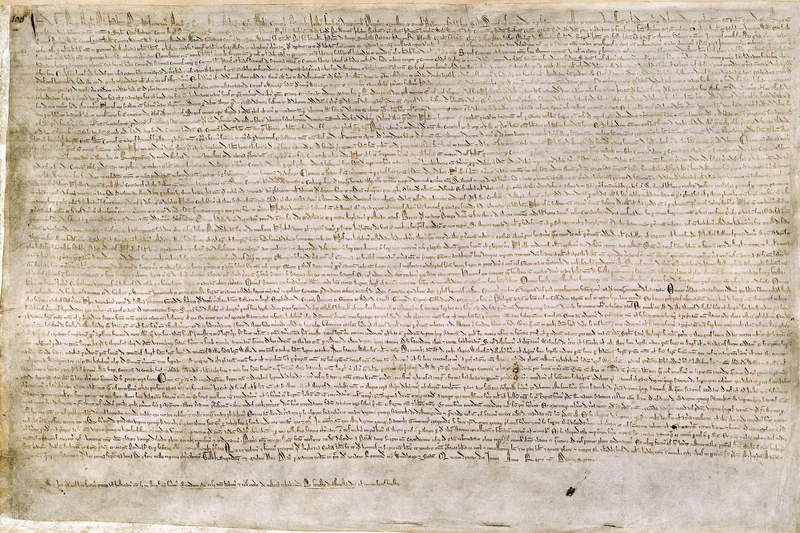
The gallery is arranged by theme rather than chronology, in cases labelled Literature, Art, Maps, Historical Documents, Sacred Texts and more, covering over two thousand years. The Library's own description of the highlights names Magna Carta, Beowulf, Shakespeare, Monty Python and Andrea Levy, which is a fair summary of the range: a founding constitutional document and a manuscript poem in one room, a comedy script and a recent novelist in the next.
Sound recordings sit alongside the manuscripts, which is the thing most visitors do not expect from a library. The £10 tour highlights the second largest atlas in the world and the George III library alongside Magna Carta, which tells you what the staff themselves think is worth pointing at.
The honest experience of the room is that it is small for what it holds. Half a dozen cases in, you stop reading everything and start choosing. Pick two themes from the case labels and do those properly. Trying to see all of it in twenty minutes produces nothing but a list.
The objects that may not be there
Older guides to this gallery promise a fixed set: the Lindisfarne Gospels, Shakespeare's First Folio, handwritten Beatles lyrics, Leonardo's notebook. Those have all been shown here, and several are long-standing residents, but the Library does not publish an object list for the gallery and warns that items rotate off display for conservation or are lent out.
So treat any such list, including that one, as a description of the kind of thing in the room rather than a promise. If one object is the reason you are making the journey, the Library asks you to contact it in advance to check, and that is genuinely worth doing.
A cold, dark room, on purpose
The Library warns that the Sir John Ritblat Gallery is kept cooler and darker than the rest of the building, because light and humidity fade and damage manuscripts, and it recommends bringing an extra layer. That is not a small point in January, and it is the single most useful sentence on the official page.
It also explains why the room feels different from every other gallery you will visit in London. Your eyes take a minute to adjust, the labels are lit rather than the space, and photography in these conditions produces very little. Look instead.
The free display inside the free gallery
The Library puts small temporary displays into the Treasures Gallery, free and without booking, and they are the reason to look at the listings before you go. From 29 June 2026 to 17 January 2027 four cases are given to American Revolution: 250 Years from the Declaration of Independence: letters, maps and printed documents tracing how the Declaration came to be written, and how Frederick Douglass and Martin Luther King Jr later used its wording. Large print guides are available.
Four cases is a twenty-minute display, not an exhibition, and the Library describes it as such. That is the right expectation to bring.
The £10 tour, and whether to take it
The Treasures Tour runs daily, lasts about sixty minutes, costs £10 with concessions for students and under-26s, and leaves from the Information Desk in the Entrance Hall. It is normally at 10.30, and 11.30 on Sundays, with an extra 15.00 slot on some Saturdays. Carers go free and children aged 11 and over can attend with an adult. Private tours for up to fifteen people cost £150, Monday to Friday.
Take it if you like being told what to look at by somebody who works with the collection, because the labels in this gallery are short and the objects need context. Skip it if you are travelling with children under eleven, who are not admitted, or if you have less than two hours in the building. There is also a Building Tour on Fridays and Sundays for the architecture rather than the objects.
The paid exhibition, from 30 October 2026
Agatha Christie: A World of Mystery runs from Friday 30 October 2026 to Sunday 20 June 2027 in the Library's paid exhibition space, priced from £25 at peak and £20 to £23 off-peak, with concessions, and free for Members. It is built as a sequence of sets: a country house, a First World War dispensary, an Orient Express carriage, an archaeological dig, a West End theatre.
The objects justify the ticket. Christie's 1937 Remington typewriter, said to have been used for And Then There Were None; the typescript of House of Beauty, her first short story, written as a teenager; her notes for the stage version of Witness for the Prosecution; and her study notes for the pharmaceutical exam she sat in 1917, which is where the poisons came from. Paid exhibitions keep different hours from the building: Tuesdays to 8pm, most other days to 6pm.
Bags, lockers and the luggage gauge at the door
This catches out anyone arriving from a train. Luggage larger than 56cm high by 45cm wide by 25cm deep is not allowed into the building at all, and there is a size gauge outside the entrance to measure it against. The restriction does not apply to pushchairs, folding bicycles, umbrellas or walking sticks. E-scooters, e-bikes, e-unicycles and their batteries are banned.
Anything within the limit is fine, and the cloakroom and digital lockers on the Lower Ground Floor are free, though the cloakroom is closed on Sundays when the lockers still work. Backpacks have to be left before you enter the gallery. If you have a suitcase, use the station instead: our guide to left luggage at London's stations has the prices at King's Cross and St Pancras, both a few minutes away.
Access, and the cyber-attack question
There is step-free access to the Treasures Gallery and accessible toilets on every floor; the nearest Changing Places toilet is in King's Cross station. Blue Badge bays are on Ossulston Street, and the Ossulston Street entrance is fully ramped, about 100 metres from the main door. Guide and assistance dogs are welcome, with water bowls at the Information Desk, the Reading Rooms and the cafés. Baby changing is on three floors.
The Library is still recovering from the cyber-attack that disrupted its systems, and says not every service is back. That affects the catalogue and research services rather than the gallery, and it is the reason the Reader Pass must still be applied for in person. If your visit has a research purpose, check first; if you just want to see the Treasures Gallery, none of it applies.
An hour at King's Cross, including this
The Library sits between two of London's best buildings. St Pancras next door is worth twenty minutes on its own, and the station guide explains how to move between the two. The courtyard in front, with Eduardo Paolozzi's bronze Newton, has cycle parking behind it and somewhere to sit off the traffic.
If you have half a day, add the Wellcome Collection on Euston Road, which is also free, and walk on to the British Museum fifteen minutes south. Our guide to King's Cross covers the canal and Coal Drops Yard, and the Library is two minutes from the Eurostar gates, which makes it the best place in London to wait for a train to Paris. There is free Wi-Fi with no password, and our guide to free Wi-Fi explains how that compares with the stations outside.
Frequently asked questions
Is the British Library Treasures Gallery free?
Yes. The Treasures of the British Library is a free permanent exhibition in the Sir John Ritblat Gallery, with no booking and no ticket. You do not need a Reader Pass, and there is no barrier or registration of any kind. The Library's paid exhibitions are separate.
Do I need a reader's pass to see Magna Carta at the British Library?
No. The Treasures Gallery is open to anyone during building hours, and the Reader Pass is only for consulting collection items in the Reading Rooms. Bear in mind that the Library rotates items off display for conservation, so contact it in advance if one specific object is the reason for your visit.
What time does the British Library Treasures Gallery close?
It follows the building: 8pm Monday to Thursday, 6pm on Friday, 5pm on Saturday, and 5pm on Sunday, when the building does not open until 11am. The late Monday to Thursday closing is unusual for London and the gallery is quietest after about 6pm.
How long does the Treasures Gallery take?
Thirty minutes to walk round it, forty-five to sixty minutes to read the cases you care about. The room is smaller than its reputation suggests and it rewards choosing two or three themes rather than trying to see everything.
Can I take a suitcase into the British Library?
No. Anything larger than 56cm by 45cm by 25cm is refused at the door and there is a size gauge outside to check against. Pushchairs, folding bicycles, umbrellas and walking sticks are exempt. Smaller bags can go in the free lockers or cloakroom on the Lower Ground Floor, and backpacks must be left there before entering the gallery.
Sources
- British Library - Visit: opening hours, facilities and accessibility (checked September 2026)
- British Library - Treasures of the British Library (checked September 2026)
- British Library - Treasures Tour, price and times (checked September 2026)
- British Library - American Revolution: 250 Years from the Declaration of Independence (checked September 2026)
- British Library - Agatha Christie: A World of Mystery (checked September 2026)
- British Library - Cyber-attack and service recovery (checked September 2026)