
The most dependable place in central London to sit with a laptop for three hours, free, with a socket and without buying anything, is a public library. The British Library at St Pancras opens its public desks to anyone who walks in, and the borough libraries do the same. A café will usually tolerate about ninety minutes.
Plenty of visitors need an hour or two of real work in the middle of a trip: a call home, a form to submit, a boarding pass that will not print. The question is not whether London has wi-fi, because it does almost everywhere. The question is where you can settle in without someone standing over your table.
Our guide to free wi-fi in London covers the networks themselves. This page is about the buildings: their opening hours, whether you need a card to get in, and what happens if you stay too long.
Where to sit for three hours
- British Library, St Pancras
- Public desks, free, no card needed. Building open Mon–Thu 9.30am–8pm, Fri 9.30am–6pm, Sat 9.30am–5pm, Sun 11am–5pm
- British Library Reading Rooms
- Free, but need a Reader Pass issued in person with photo ID and proof of a home address
- Barbican Library
- Level 2 of the Barbican Centre. Anyone may use it; membership is only needed to borrow
- Guildhall Library
- Free study space with no appointment and free wi-fi in the reading room
- West End Arts Library
- 35 St Martin's Street, WC2H 7DE. Mon–Fri 10am–8pm, Sat 10am–5pm, closed Sunday. No lift
- Canada Water Library
- Ground floor from 8am on weekdays; open until 8pm Monday to Friday
- A café
- Roughly 90 minutes on one purchase, less at lunchtime
The British Library is two buildings in one, and only one of them is easy
Walk in from Euston Road and you are in the public part of the Library: the entrance hall, the upper floors around the glass tower of the King's Library, the cafés and a scattering of desks. That part is open to everyone, with no registration of any kind. The Library's own description of its study options is blunt about it: anyone can use the public desks for free, but collection items can only be consulted in the Reading Rooms.
The public desks fill up. They are busiest between about 11am and 4pm on weekdays and during university term. Early morning and the last two hours before closing are noticeably easier, and Sunday afternoons are the quietest stretch of the week.
The building closes earlier than people expect on Fridays and Saturdays, and it occasionally shuts entirely for maintenance, so check the day you are going. It is a two-minute walk from the Eurostar departure gates, which makes it an unusually civilised place to wait out the hours between leaving your hotel and boarding a train; our guide to King's Cross covers what else is in walking distance, and the building next door is worth twenty minutes on its own.
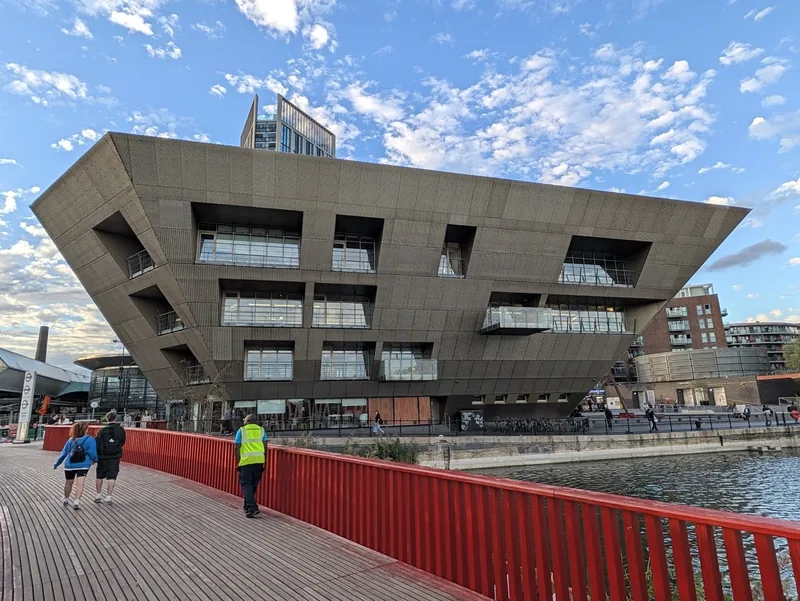
Photo: The wub · CC BY-SA 4.0 · Wikimedia Commons · resized
The Reader Pass, and why most visitors will not get one
The Reading Rooms are quieter, better lit and far more comfortable than the public floors, and the Library says plainly that you may study in them even if you are not looking at anything from the collection. They are free. The obstacle is the registration.
You have to register in person at Reader Registration. There is no online application, a consequence of the cyber-attack on the Library in October 2023 — and you must be 18 or over. The pass lasts three years. What you bring is the sticking point: either one state-issued photo ID printed with your photo, name and address, or two separate documents, one showing your name and one showing your home address. Bills, financial documents, tenancy agreements and NHS letters are accepted; a passport alone is not enough, because it does not carry an address.
Read that again if you are travelling: a foreign passport plus a hotel booking will not do it, and the Library asks for official translations of documents in other languages. Most short-stay visitors are better off using the public desks and not queueing for a card they cannot complete.
The Reading Rooms take guests as well as readers. Anyone over 18 you bring in with you needs their own Reader Pass, and so does a carer or an adult dependant. If two of you are working together, either both register or both stay on the public floors.
Barbican Library, on the level above the concert hall
Barbican Library sits on Level 2 of the Barbican Centre, reached most simply from the Silk Street entrance. The City of London runs it, and its position on visitors is straightforward: anyone is welcome to come in and use it, and membership is only required if you want to take something away.
It has free wi-fi, public computers, printing, photocopying and scanning, and places to sit and read that are not attached to a desk. There is a separate music library down a flight of stairs inside the main room, with a passenger-operated lift for anyone who cannot use them.
It closes on Sundays and bank holidays, and it shuts earlier than the arts centre around it, so do not assume the library is open because the foyer is busy. The compensation is that you are inside one of the more interesting buildings in London and can go to a free foyer concert when you stop working.
Guildhall Library: a reading room in the City that nobody uses
Guildhall Library is a reference library specialising in the history of London, entered from Aldermanbury through The London Centre, a few minutes from Bank and Moorgate. It is the best-kept free desk in the City, largely because people assume it is only for researchers.
It is not. The Library states that you do not need to book an appointment to use it as a study space, to look at the open shelves, to use a microfilm reader, or to use a computer for general internet access. Free wi-fi is available in the reading room. Booking and ID are only needed for closed-access material such as manuscripts and rare books.
Two practical warnings. Printing from the library's computers and microfilm readers is not currently available, so bring what you need digitally. And photographing the collections needs a permit, currently £7 a day for up to 30 images and £20 a day for more, card payment only; that applies to collection material, not to your own laptop screen. The Roman amphitheatre is in the same complex, which our page on Guildhall describes.
The arts library behind the National Gallery
At 35 St Martin's Street, a short walk from Leicester Square, Westminster runs what is now called the West End Arts Library. Many guidebooks and older links still call it Westminster Reference Library, which is worth knowing when you search for it.
It opens 10am to 8pm Monday to Friday and 10am to 5pm on Saturday, closed Sunday, which makes it the most useful late-opening free desk in the immediate theatre district. It has free wi-fi, a study area, bookable computers and printing, with performing arts, fine art, design and photography collections on the ground floor and the Westminster Music Library above.
Access is the problem. There are two steps at the entrance and six more immediately inside, the library occupies three floors with stairs between them, and there is no lift. Westminster will make material available at another branch on request for anyone who cannot get in; our guide to accessible London covers the wider picture.
Borough libraries, and the ones that open at 8am
Every London borough runs public libraries, and the general rule is that you can walk in and sit down without joining. Southwark puts it in writing: its libraries are free for residents and visitors alike, and every branch has desk space, computers, wi-fi and remote printing.
Canada Water Library, the one shaped like an upturned tumbler beside the station, is the most useful of them for an early start. Its ground floor — café, computers, wi-fi, printing — opens at 8am Monday to Friday, with the rest of the building from 9am, and the whole place stays open until 8pm on weekdays. Saturday is 9am to 5pm and Sunday noon to 4pm. It is on the Jubilee line and the Overground, so it is quick to reach from the centre; our guide to Wapping and Rotherhithe covers the area around it.
If you need silence and a door, several boroughs rent small meeting rooms by the hour, Southwark among them. It is usually the cheapest bookable room in London, and nobody will ask why you want it.
What a café will actually put up with
There is no rule, but there is a pattern. On a single coffee, ninety minutes is safe almost anywhere, two hours is fine in a quiet place at a quiet time, and three hours means buying something else. Nobody will say anything; they will simply stop clearing your table and start eyeing it.
The hard boundary is lunchtime. Between about noon and 2pm a table occupied by a laptop is a table that is not selling food, and central cafés near offices will either ask you to move or cut the wi-fi. Sit somewhere residential, or work around the rush.
Three things make you a welcome customer rather than an awkward one: take the smallest table you can, buy again at the ninety-minute mark, and do not run a video call out loud. Our guide to coffee in London has the places worth sitting in, and museum and gallery cafés are the most laptop-tolerant of the lot, because the whole building is designed to keep you for half a day.
Hotel lobbies are the overlooked option. Large hotels rarely challenge someone sitting in the lounge with a drink, and the wi-fi is usually better than a café's. Buy a coffee at the bar, sit away from the reception desk, and you have a quiet hour. Our page on what a London hotel room is actually like explains why your own room may not be the better choice.
Connection, sockets and the call you should not take in public
Library and museum wi-fi in London is generally good and generally open, with no more than a terms-and-conditions click. Café wi-fi is more variable, and some older pubs have walls thick enough to defeat it entirely.
For anything that matters, tether to your own mobile data instead of trusting a shared network, and treat every open network as public. Our guide to UK SIM cards and eSIMs explains what data costs here; over more than a couple of days it is usually cheaper than roaming.
Power is the other constraint. Reading rooms and study floors have sockets at the desks, cafés often do not, and the ones that exist are sometimes switched off at busy times. If you are relying on a battery, our guide to charging your phone in London covers the rental networks and what they cost.
Video calls are the thing that gets people moved on. Libraries are for silence, and taking a call in a reading room will be stopped. Use a hired meeting room, a hotel room, or a station's paid lounge. If you only need a short call, the entrance halls of the big museums are loud enough that nobody will notice.
When it is worth paying
Pay for a desk if you need three or more uninterrupted hours, if you have several calls, or if you are working somewhere you must not be overheard. Co-working chains sell day passes across central London, several large stations have paid lounges open to anyone with a ticket, and the British Library sells an annual membership that includes a members' room with its own study space and bar.
Otherwise, do not. Between the national collections, the City's reference libraries and thirty-two boroughs' worth of public ones, London gives away more free desk space than almost any capital in Europe. The two free rooms most worth the journey are covered elsewhere on this site: the reading room at the Wellcome Collection on Euston Road, and any of the free museums whose cafés will keep you all afternoon. Go early: our note on avoiding rush hour applies to seats in libraries as much as seats on trains, and find the toilets before you settle, using our guide to public toilets in London. In hot weather a stone-built library is also the coolest room within reach, as London in a heatwave explains.
Frequently asked questions
Can tourists use the British Library?
Yes. The public areas, cafés and public study desks at St Pancras are open to anyone who walks in, with no card, no booking and nothing to buy. The Reading Rooms are also free but need a Reader Pass, which must be obtained in person with photo identification and a document showing your home address.
Do I need a library card to sit and work in a London library?
Generally no. Borough libraries across London let anyone use their desks, computers and wi-fi without joining; Southwark, for example, states that its libraries are free for residents and visitors. Membership is normally only required to borrow books or to use some online resources from home.
How long can you sit in a London café with a laptop?
About ninety minutes on one purchase is the unwritten standard, and two hours passes without comment in a quiet place. Buy something again after that. Avoid occupying a table between noon and 2pm in the business districts, when some cafés restrict wi-fi or ask laptop users to move.
Which library in central London is open latest?
The West End Arts Library at 35 St Martin's Street opens until 8pm Monday to Friday, and the British Library building at St Pancras is open until 8pm Monday to Thursday. Canada Water Library, a short ride from the centre, also runs to 8pm on weekdays.
Is there anywhere free to take a video call in London?
Not in a library, where calls are not allowed. The practical free options are a hotel lobby with a drink bought at the bar, the entrance hall of a large museum, or outdoors in a park in dry weather. For anything confidential, hire a meeting room by the hour at a borough library.
Sources
- The British Library - Reading Rooms and study spaces (checked September 2026)
- The British Library - Reader Pass: registration and accepted ID (checked September 2026)
- The British Library - Visit: London opening hours (checked September 2026)
- City of London - Barbican Library (checked September 2026)
- City of London - Visit Guildhall Library (checked September 2026)
- Westminster City Council - West End Arts Library: opening times and access (checked September 2026)
- Southwark Council - Space for you in our libraries (checked September 2026)
- Southwark Council - Canada Water Library opening hours (checked September 2026)