
The Clowns' Gallery-Museum in Dalston is not open, and it is not a question of catching the right day of the month. The museum lives in the crypt of Holy Trinity Church on Beechwood Road, and the church itself is closed for renovation work: its congregation has moved to All Saints Haggerston until it reopens. Nobody has published a date. Everything else on this page is open, and most of it is stranger than clowns.
That is worth saying plainly, because the Clowns' Gallery is on every "unusual London" list and almost every one of them still prints an opening day.
London is rich in one-subject museums kept by the institution that owns the subject: a masonic hall, a livery company, a canal trust, a taxidermist with a bar. Our guide to London's best small museums covers the conventional ones. These are the odd ones.
The Clowns' Gallery-Museum: the position in September 2026
- Open?
- No. The church that houses it is closed for renovation
- Reopening
- No date announced
- Where
- Holy Trinity Church, Beechwood Road, Dalston E8
- What you can see instead
- Joseph Grimaldi's grave on Pentonville Road, free and open
What the Clowns' Gallery-Museum is, and why the eggs matter
Clowns International keeps a register of clown faces. The faces are painted on to emptied eggshells, one egg per clown, so that no two performers claim the same design, and the collection has grown into hundreds of them. It is a copyright system made out of eggs, and there is nothing else like it anywhere.
The organisation began by accident. In 1947, the circus owner Billy Smart arranged for his clowns to lay a wreath on the gravestone of Joseph Grimaldi, the greatest English clown, in the churchyard of St James's Church on Pentonville Road, as publicity before the new season. They decided to meet again the following year, and Clowns International says the tradition is kept alive to this day. The circus enthusiast Stan Bult heard about the gathering and set up the International Circus Clown Club, which became Clowns International in 1978, when membership was opened to clowns of every type rather than circus clowns alone. Bult was also the man who started painting the faces on eggshells.
What you can still see
Grimaldi's burial ground survives as a small public open space on Pentonville Road, a few minutes from Angel and about ten from King's Cross. It is free and open, and the grave is the one place connected with the collection that has not been shut.
The church at Dalston is worth a detour if you are in the area anyway, for the outside. Our guide to Dalston and Stoke Newington covers the neighbourhood, which has plenty else in it.
Check the church, not the museum, before you go to Dalston. The Clowns' Gallery-Museum has no opening hours of its own while Holy Trinity is shut for renovation, and the parish's public information is about services rather than the crypt. If a listings site gives you a first-Friday opening, that information predates the closure. Nobody has announced a reopening date for either the church or the museum.
The odd collections that are open
| Collection | Where | Open | Price |
|---|---|---|---|
| Museum of Freemasonry | Freemasons' Hall, 60 Great Queen Street WC2 | Tuesday to Saturday 10am to 5pm; closed Monday except for private tours | Free |
| The Clockmakers' Museum | Inside the Science Museum, Exhibition Road SW7 | Daily 10am to 6pm, except 24 to 26 December | Free, but the Science Museum asks all visitors to pre-book a free ticket |
| The Viktor Wynd Museum of Curiosities | 11 Mare Street E8 4RP | Tuesday to Thursday 3pm to 11pm; Friday 3pm to midnight; Saturday noon to midnight; Sunday noon to 10pm. Last admission 10pm | Galleries free; the Wunderkabinett £12 adult, £8 concession, £2.50 for under-16s before 5pm, £4 for walk-ins on Thursdays |
| London Canal Museum | 12-13 New Wharf Road N1, behind King's Cross | Tuesday to Sunday and bank holiday Mondays, 10am to 4.30pm, all year | Adult £8, concession £6.50, child 7-15 £4, family £17; under-7s free |
| Clowns' Gallery-Museum | Holy Trinity Church, Beechwood Road E8 | Closed while the church is being renovated | - |
The Museum of Freemasonry: the easiest strange museum in London
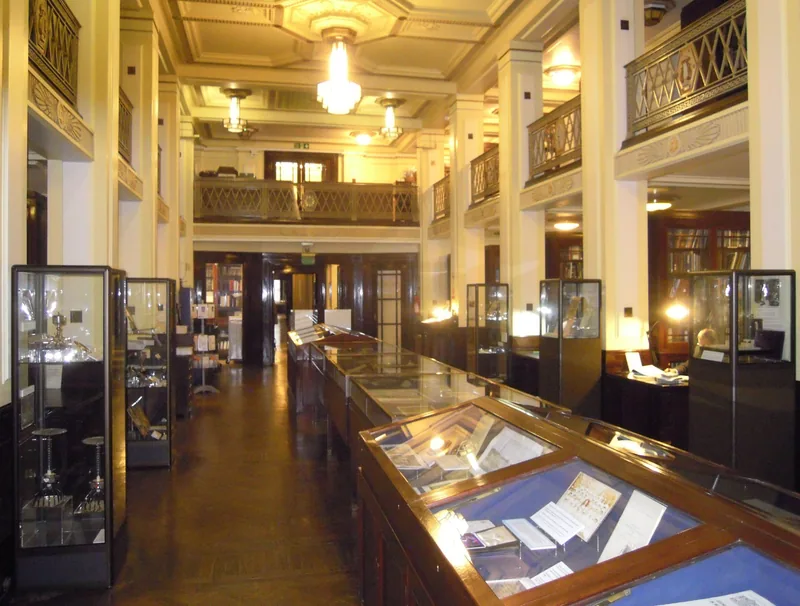
Freemasons' Hall on Great Queen Street, between Covent Garden and Holborn, is the central headquarters of English freemasonry and one of the largest interwar buildings in central London. Its museum is free, open Tuesday to Saturday from 10am to 5pm, and almost always quiet, which for a building two minutes from Covent Garden is remarkable.
The hall itself is the reason to go. Historic England lists it at Grade II*, and the entry is worth having in your head as you walk round: built 1927 to 1933 to designs by H V Ashley and Winton Newman, who won the competition because their plan fitted an awkward polygonal site; a steel frame faced in Portland stone, in what the list entry calls stripped Classical style; marble-lined halls and staircases, "richly detailed but austere neo-Grecian in pattern"; a double-height Grand Temple with a gallery, a dais and an organ, walls of Ashburton and Botticino marble under a mosaic cove and a coffered ceiling; and bronze doors in neo-Egyptian style by Walter and Donald Gilbert. It was built as the Masonic Peace Memorial Building, a memorial to freemasons killed in the First World War.
The museum collection is on the ground floor, off the grand entrance hall, with the library and reading room upstairs.
Two practical points. The Library and South Gallery close from 1pm to 2pm every day and all day on Saturdays, so a Saturday visit gets you less than a weekday one. And Mondays are closed except for private tours.
The Clockmakers' Museum: 600 watches inside a free museum
This collection was assembled by the Worshipful Company of Clockmakers and used to sit at the Guildhall in the City. It is now a gallery inside the Science Museum, where it has been for ten years, and it is free and open every day from 10am to 6pm.
The collection is more than 600 watches, 90 clocks, 30 marine chronometers, sundials and hand engraving, tracing London clock and watchmaking from 1600 onwards. The things to find:
- John Harrison's fifth marine chronometer, H5, completed in 1770. Harrison solved the problem of finding longitude at sea, and this is the last timekeeper he made.
- A four-month longcase clock by Thomas Tompion, the father of English watchmaking.
- The Space Traveller II, made almost entirely by hand by George Daniels in the early 1980s.
- The Charles Frodsham display on precision timekeeping since the Great Exhibition of 1851: a record-holding watch tested at Kew Observatory, Admiralty marine chronometers from naval and scientific voyages, and the Diamond Jubilee table clock made for Queen Elizabeth II.
There are free volunteer-led tours; ask at the desk for the schedule. Remember that the Science Museum asks every visitor to pre-book a free admission ticket, so you cannot simply walk in off Exhibition Road even though nothing costs money.
The Viktor Wynd Museum of Curiosities: thirty minutes, and that is the rule
A basement at 11 Mare Street in Hackney holding a deliberately unscientific cabinet of curiosities: taxidermy, skeletons, celebrity ephemera, occult material and things it is better not to describe. The paid part is the Wunderkabinett; the galleries above it and the bar area are free.
Two things nobody warns you about. Admission is for thirty minutes, by timed ticket, and arriving more than 15 minutes late may cost you the slot. And the room is genuinely tiny, so capacity is limited and Saturdays are the worst day; the museum advises booking online and expecting a wait.
Prices, read in September 2026: £12 adult, £8 concession, £2.50 for under-16s before 5pm, and a walk-in-only £4 on Thursdays, which is the cheapest way in by a wide margin. Admission includes a cup of tea on request, and online tickets are refundable up to 24 hours before. The bar area is 18-and-over after 5pm.
If you are in Hackney anyway, the Thursday £4 rate is one of the better-value oddities in London. It is not a museum for children, despite the under-16 price.
The London Canal Museum: an ice well under the floor
The only one of these five that charges properly, and the only one built around something you cannot see anywhere else in London. The building at 12 to 13 New Wharf Road, behind King's Cross, is a former ice warehouse put up around 1863 to store natural ice imported from Norway. Carlo Gatti, who arrived in London from Italian-speaking Switzerland in 1847 and sold waffles from a stall, established himself on this site between 1855 and 1858, most probably in 1857, the year his first cargo of 400 tons of Norwegian ice reached London. He was one of the first people in Britain to sell ice cream to the public.
Beneath the floor are the ice wells, and the museum has put a remote-controlled camera down one of them. You can swivel it around yourself, from a terminal in the building or from the other side of the world. A second well was dug in 1863, and a workman, John Parker, fell to his death during the work.
The rest is the story of London's canals: the trade that ran through this basin, the boats and the horses that pulled them, and the pusher tug Bantam IV. The museum says most visitors take between one and two hours.
Prices, read in September 2026: adult £8, concession £6.50 for students, the unwaged and over-65s with proof, child £4 for ages 7 to 15, and a family ticket at £17 covering either one adult and up to four children or two adults and up to three. Under-7s are free, and one carer for a registered disabled visitor goes free. Children under 14 must be with an adult. A family of two adults and two children aged 8 and 11 therefore pays £17, not £24, which is the most useful sum on this page.
Open Tuesday to Sunday and bank holiday Mondays, 10am to 4.30pm, all year with only a short closure, and there is a free audio tour to download. The best approach is on foot: the towpath walk from Camden Town takes about an hour with stops, and there is a free audio guide to the route.
The oddities we cover elsewhere
Several of London's strangest collections already have pages of their own here, and they belong on any list like this:
- Novelty Automation in Holborn: home-made satirical arcade machines.
- The Kirkaldy Testing Museum in Southwark, a Victorian materials testing works open three days a month.
- Dennis Severs' House in Spitalfields, a house arranged as a fiction and visited in silence.
- The Hunterian Museum in Lincoln's Inn Fields: free, and the anatomy collection people find hardest to forget.
- The Grant Museum of Zoology in Bloomsbury, a university teaching collection of skeletons and specimens in jars.
- The Museum of the Mind at Bethlem, on the history of psychiatric care.
- The Fan Museum in Greenwich, devoted to fans and nothing else.
- The Cinema Museum in Kennington, everything that used to be inside a picture house.
- The Cartoon Museum in Fitzrovia.
Building a day out of them
Two routes work.
- North London. London Canal Museum at 10am, the towpath west to Camden, then Grimaldi's burial ground on Pentonville Road on the way back to Angel. Half a day, about £8 a head.
- Central. Museum of Freemasonry at 10am on a weekday, when the library is open before its lunchtime closure, then Novelty Automation in Holborn, then the Hunterian in Lincoln's Inn Fields. All three within ten minutes of each other, and all free apart from Novelty Automation's coins.
The Clockmakers' Museum fits neither, being in South Kensington: treat it as thirty minutes bolted on to a Science Museum visit. And the Viktor Wynd does not open until 3pm, which makes it an evening. For everything else that costs nothing, see our list of free museums in London.
Frequently asked questions
Is the Clowns' Gallery-Museum in Dalston open?
No. The museum is in the crypt of Holy Trinity Church on Beechwood Road, and the church is closed for renovation work, with its congregation worshipping at All Saints Haggerston in the meantime. No reopening date has been announced for either the church or the museum, and listings showing a monthly opening day are out of date.
What is the Clown Egg Register?
A record of clown faces painted on to blown eggshells, one egg per performer, kept by Clowns International so that no two clowns use the same make-up design. The practice was started by the circus enthusiast Stan Bult, who painted the faces as a hobby, and the collection has grown to several hundred eggs.
Which of London's strange museums is free?
The Museum of Freemasonry, Tuesday to Saturday. The Clockmakers' Museum, inside the Science Museum, although the Science Museum asks visitors to pre-book a free ticket. The galleries and bar area at the Viktor Wynd Museum are free, but its Wunderkabinett costs £12, and the London Canal Museum charges £8 for an adult.
How long do you get in the Viktor Wynd Museum?
Thirty minutes. Admission to the Wunderkabinett is a timed ticket for a half-hour slot, and arriving more than 15 minutes late may cost you the space. The room is very small and Saturday is the busiest day, so the museum advises booking online.
What is the cheapest way to see the London Canal Museum with children?
The family ticket at £17, covering one adult with up to four children or two adults with up to three. Children aged 6 and under go free anyway, so a couple with two small children pays £16 for the two adults. The child rate of £4 applies from age 7 to 15, and under-14s must be accompanied.
Sources
- Church of England, A Church Near You - Holy Trinity Dalston: closure for renovation works and the joint worship arrangement with All Saints Haggerston (checked September 2026)
- Clowns International - the 1947 wreath-laying at Joseph Grimaldi's grave, the founding of the International Circus Clown Club and the 1978 change of name (checked September 2026)
- Museum of Freemasonry - free entry, opening hours and the library's lunchtime and Saturday closures (checked September 2026)
- Science Museum - The Clockmakers' Museum: opening times, collection size and current displays (checked September 2026)
- The Viktor Wynd Museum of Curiosities - admission prices, timed thirty-minute tickets and opening hours (checked September 2026)
- London Canal Museum - Visit for opening hours and the towpath walk, Admission for charges and concessions, and The Ice House for the building, Carlo Gatti and the ice wells (checked September 2026)
- Historic England - Freemasons' Hall, list entry 1113218, Grade II* (Internet Archive copy, 8 June 2026) (checked September 2026)