
The Fan Museum occupies two restored Georgian townhouses on Crooms Hill in Greenwich, opens Tuesday to Saturday from 11am to 5pm, and charges £5 for general entry. Allow 45 minutes to an hour. One thing has changed and matters: the Orangery at the back is no longer a public tea room, so do not plan the visit around cake.
No other museum in Britain is given over entirely to fans, and the subject sounds like a joke until you are standing in front of a late-sixteenth-century flag fan or a fan painted by Walter Sickert. Fans turn out to be a way into costume, court politics, trade with Asia, printmaking, advertising and the history of a craft that almost died out.
The museum sits five minutes' walk from Greenwich town centre, inside the Maritime Greenwich World Heritage Site, so it fits into a day you are probably already spending here. Our Greenwich guide covers the big sights; this page is the small one that people miss, and what it takes to get it right.
The Fan Museum at a glance
- General entry
- £5.00 a head; concession, child and family rates appear in the online ticket shop
- Free entry
- Visitors with disabilities and their carers
- Open
- Tuesday to Saturday, 11am-5pm; last admission 4.30pm
- Closed
- Sundays, Mondays, and often for several weeks between exhibitions
- Booking
- Online in advance or on the door; groups of more than eight must arrange a time
- Time needed
- About 45 minutes to an hour
- Address
- 12 Crooms Hill, Greenwich, London SE10 8ER
- Nearest stations
- Cutty Sark DLR, 5 minutes; Greenwich rail and DLR, 7 minutes
What £5 gets you, room by room
The whole of the visitable interior is four spaces, and knowing that in advance stops you hunting for more.
The Green Room is where the museum tells you to start. An introductory film explains how the place came about, and the cases around it cover the subject from the ground up: types of fan, the materials, the tools, and illustrated explanations of how a fan is actually built. Two objects stand out here. One is a fan painted by Walter Sickert. The other is an important late-sixteenth-century flag fan, surviving from a period when fans were still exotic novelties in western Europe.
The Yellow Room continues the permanent display on the same floor.
The Reception Room and the stairway are given over to the art of fan painting, with framed works from the seventeenth century onwards, and to the Worshipful Company of Fan Makers, a City of London livery company the museum has long been associated with.
The first-floor Gallery holds the temporary exhibition, which changes every few months. This is the part that will be different on your visit from anyone else's, and it is also the part that can close the museum altogether.
A free audio guide, narrated by the curator, covers the ground-floor permanent displays. Large-text versions of the script and magnifying sheets can be asked for at reception. Lighting is kept at medium levels throughout for conservation, which is worth knowing if your eyes need more.
Ask the curator before you travel for one particular fan. The museum says that if a specific object is the reason for your visit, contact the curator beforehand to check whether it is on display, in storage or out on loan. In a collection this size, most of it is not on show at any one time.
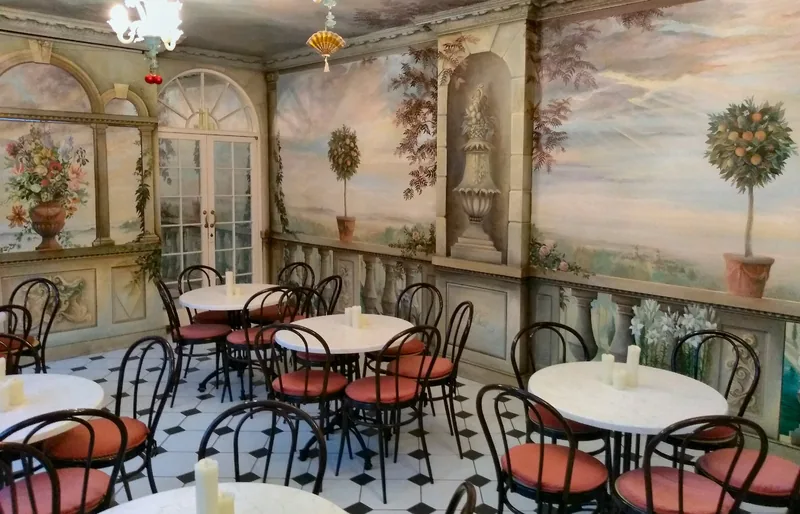
The Orangery is not a tea room any more
Older guidebooks, and a good deal of what is written about Greenwich online, describe an orangery behind the museum where you can take afternoon tea. That is out of date. The museum's own group-visits page states that the Orangery is no longer available as a public café.
What it is now is a private hire space, used for bookings, functions and celebrations inside museum operating hours. The published rates are £165 an hour, £600 for a half day of four hours and £1,000 for a full day, with a separate wedding rate of £500 for a morning or afternoon session. Groups visiting the museum can pre-book tea, coffee and biscuits there at £5.00 a head, but it must be arranged at least two weeks ahead.
There are two honest ways for an ordinary visitor to get inside it. The first is to book one of the museum's own ticketed events, several of which are held in the Orangery: an embroidery workshop, an evening chamber play, ghost stories by candlelight at Christmas. The second is a private fan-making workshop, which is held there for small groups and carries no hire charge.
If you came to Greenwich wanting tea and a cake, the town centre is five minutes downhill and full of options; our guide to afternoon tea in London covers the grander versions elsewhere in the city.
The exhibition calendar can close the door on you
No other detail matters as much, and the website does not put it in bold. The museum shuts for weeks at a time while it changes the exhibition in the first-floor Gallery.
In 2026 it closed to the public from 5 April and reopened on Saturday 9 May, a gap of almost five weeks. The exhibition that followed, Monarchy: An Exhibition of Royal Fans, ran to Saturday 26 September 2026. The next show, on the contemporary French fan maker Frédérick Gay, was launched with a private view on Friday 9 October 2026 as part of the Art History Festival.
Read those dates together and the pattern is clear: there is a hole in early October 2026, as there was in April, and there will be others. The museum publishes changes to its opening days through its social media channels rather than a maintained closure calendar, so a telephone call to 0208 305 1441 is a reasonable precaution if you are travelling any distance.
Never assume Tuesday to Saturday means every Tuesday to Saturday. The museum has closed for a month at a time between exhibitions, and September 2026 ended one show with the next not opening until October. Check the museum's own channels for the week you are going, not just the standard hours.
Making a fan yourself, on the first Saturday of the month
The workshops are the part of the programme that turns a twenty-minute curiosity into a genuine afternoon, and they are not well known.
Fan-making workshops run on the first Saturday of each month, from 1.30pm to 4.30pm, led by the museum's fan-making facilitator. Each participant makes two common types of fan. Sticks, equipment and tools are included, and there is a tea or coffee break in the middle. Groups are capped at six people so that everyone gets attention, which is also why they sell out.
You have to bring two things yourself: one large unfolded sheet of patterned A3 paper, and a metre of wrapping paper. The museum asks for non-glossy paper, nothing too thick, and no tissue or foil. Buy them before you arrive; this is not a Greenwich high-street errand you want to be running at 1.20pm.
For a group of five or six, a private workshop can be arranged in the Orangery instead, subject to the facilitator's availability, with no premises charge because of the cultural nature of the booking.
Tickets, groups and the rates you will not find on the website
Tickets can be bought online in advance through the museum's ticketing partner, or in person at the door. Each ticket is redeemable once, and you show the order confirmation to staff on arrival.
Two figures are published on the museum's own pages. General entry is £5.00 a head, and visitors with disabilities and their carers get in free. Concession, child and family rates exist but are shown inside the booking system rather than on the website, so check them there when you book.
Groups are treated differently. Up to 24 people are welcome on general entry, but any group of more than eight must contact the museum office first to arrange a time, because the rooms are small. For those bookings, concessions and discounts do not apply and everyone pays the flat £5.00. A guided tour with a member of the curatorial team costs £10.00 per person, must be pre-booked, and again carries no discounts. All the details, including dietary needs if you are adding refreshments, have to reach the museum at least two weeks before the visit.
One step, three steps, a ramp and a lift
The access position in a pair of listed Georgian houses is never simple, and the museum sets it out in unusual detail.
What works
- A portable folding ramp, 153cm by 77cm, covers the single step from the street to the courtyard and the three steps up to the front door
- A lift runs to all levels, operated by keyholding staff, and at least one keyholder is always on duty
- Two manual wheelchairs can be borrowed on request
- Accessible toilet and baby changing on the ground floor; lightweight folding stools throughout
- Guide dogs are welcome
What does not
- The internal stairs to the first-floor Gallery are one flight with a handrail, and there are further steps at the back towards the Orangery
- Prams and pushchairs are stored securely in the Reception Room but cannot be taken round the displays
- Only handbags and small backpacks come in; cloakroom space is very limited and you may be asked to carry a backpack by hand or wear it on your front
- Lighting is deliberately low for conservation
- No pets other than guide dogs
The museum prefers cashless payment. Our accessible London guide sets out how the rest of the city compares.
Getting to Crooms Hill
Cutty Sark DLR is the closest station, about five minutes and 0.2 miles away; Greenwich station, served by both the DLR and South Eastern trains from London Bridge and Cannon Street, is seven minutes and 0.3 miles. Buses 177, 180, 188, 199, 286 and 386 all serve the town. For how the DLR connects with everything else, see our page on the DLR and the Overground.
The slow way is better. Uber Boat by Thames Clippers calls at Greenwich Pier with direct services from Westminster, Waterloo and Woolwich Arsenal, and arriving by river and walking up past the market is a far nicer approach than coming out of a tunnel at Greenwich station; our page on the Thames river bus explains the fares, which do not count towards the daily cap.
Crooms Hill runs up the western edge of Greenwich Park, so the walk from the town centre is a gentle climb rather than a flat stroll. If you are driving, the Burney Street pay and display car park is two minutes away.
What to put either side of it
Three quarters of an hour will not fill a day, and the Fan Museum works best as the odd item in a Greenwich itinerary rather than the reason for one.
Greenwich Park starts at the top of the road, and the climb to the viewpoint is the best free thing in this part of London. Greenwich Market and the Old Royal Naval College with its Painted Hall are both five minutes downhill. Note one date before you plan around the hill: the Royal Observatory closes on 2 November 2026 for rebuilding and is not due to reopen until summer 2027.
If you are staying locally, our guide to Greenwich as a base works through the travel times, and our comparison of Greenwich or Richmond for a day out may settle the question of whether to come at all. For eating, the Greenwich and O2 food guide has the options beyond the market stalls.
It also belongs to a small family of London museums built around one obsession. Our round-up of the smallest museums in London sets them side by side, and two more are worth a detour: the Victorian machine shop at the Kirkaldy Testing Museum in Southwark, and the Roman temple under a bank in the City. For a free equivalent with a medieval building attached, try the Museum of the Order of St John. On a wet afternoon, our list of things to do indoors has more.
Frequently asked questions
How much does the Fan Museum cost?
General entry is £5.00 a head, and that is the flat rate paid by groups of more than eight, with no concessions applied. Visitors with disabilities and their carers get in free. Concession, child and family prices are shown inside the online ticket shop when you book.
Does the Fan Museum still have a tea room?
No. The museum states that the Orangery is no longer available as a public café. It is now hired out for private functions during opening hours, and groups can pre-book tea, coffee and biscuits there at £5.00 a head with two weeks' notice. Ticketed evening events are also held in it.
How long do you need at the Fan Museum?
Between 45 minutes and an hour covers the ground-floor permanent displays, the stairway of fan paintings and the temporary exhibition upstairs. Add three hours if you are booked onto a fan-making workshop, which runs from 1.30pm to 4.30pm on the first Saturday of the month.
Is the Fan Museum ever closed during the week?
Yes, and this catches people out. Besides being shut on Sundays and Mondays, it closes for weeks at a time between temporary exhibitions. In 2026 it was closed from 5 April until 9 May. Check the museum's social media channels or telephone before making a special journey.
Is the Fan Museum suitable for wheelchair users?
Largely yes. Staff bring out a portable ramp for the step up from the street and for the three that follow, and a lift run by keyholding staff reaches every level. Two manual wheelchairs can be borrowed. Pushchairs must be left in the Reception Room rather than taken round the displays.
Sources
- The Fan Museum - Plan your visit (checked September 2026)
- The Fan Museum - Group visits and guided tours (checked September 2026)
- The Fan Museum - Access and facilities (checked September 2026)
- The Fan Museum - Fan making workshops (checked September 2026)
- The Fan Museum - Orangery hire rates and terms (checked September 2026)
- The Fan Museum - Events calendar (checked September 2026)
- The Fan Museum - Getting to us (checked September 2026)