
There is no public opening at Armoury House. It is the headquarters of the Honourable Artillery Company, a private regiment and charity, and its own website says that any public visit or tour is strictly by appointment with the Archivist. What you get for free is the view from City Road: a Georgian house with a copper flag tower, a large private sports field behind a wall in the middle of London, and a castellated Victorian barracks next door.
The Honourable Artillery Company describes itself as the oldest regiment in the British Army. It traces its origin to 25 August 1537, when Henry VIII granted a charter to the Fraternity or Guild of Artillery of Longbows, Crossbows and Handguns. It is still a unit of the Army Reserve, the second most senior one, and it has never been amalgamated with another regiment, which it shares with only the five Foot Guards regiments.
All of which means that the large green space you can glimpse from the top of City Road is not a park. It is the Artillery Garden, and it is private ground belonging to a regiment that has been drilling somewhere in Finsbury since 1641.
Armoury House and the Artillery Garden at a glance
- Address
- Armoury House, City Road, London EC1Y 2BQ
- Listing
- Grade II*, list entry 1195537, first listed 27 August 1957
- Built
- Central block 1734 to 1736; flag tower added early 1800s; wings 1828, raised to three storeys 1894
- Public access
- None on a normal day. Visits and tours only by prior appointment with the Company Archivist, by email
- Cost to look from outside
- Free
- Nearest station
- Old Street, about five minutes on foot; Moorgate and Barbican both about ten
- Best free thing next door
- Bunhill Fields Burial Ground, immediately west, open daily and Grade I on the register of parks and gardens
What you can see from the pavement, and where to stand
The house faces east onto City Road, set back behind its own forecourt and railings. The statutory list description gives you the vocabulary for what you are looking at, and it is a building that rewards the vocabulary.
The central block is five bays wide and two storeys tall, in brown brick laid in Flemish bond with Portland stone dressings and a Welsh slate roof. The middle three bays step forward slightly, with chamfered quoins marking both those bays and the outer corners of the building. Ground-floor windows have flat arches with double keystones and iron guards; the first-floor windows are round-arched with gauged brick heads. Above the cornice the parapet carries stone grenades as finials, which is the clearest sign from the street that this is a military building rather than a country house. On the ridge sits the copper-covered flag tower.
The two wings are yellow brick rather than brown, three storeys rather than two, and set back. They were finished in 1828 and raised from two storeys to three in 1894, which is why the brick does not match.
The prostyle Doric porch is the detail to look for. It has a triglyph frieze to the entablature, iron railings with urn finials on top of it, and a scrolled wrought-iron lampholder projecting from the entablature. Stand on the far pavement of City Road and it reads clearly; stand at the gate and you lose the top.
One small discrepancy to be aware of. The list entry dates the flag tower to 1806; the Company's own account of its estate says a distinctive flag tower was added to the roof in 1802. Both figures are printed here because two authoritative sources disagree, and neither offers a reason to prefer the other.
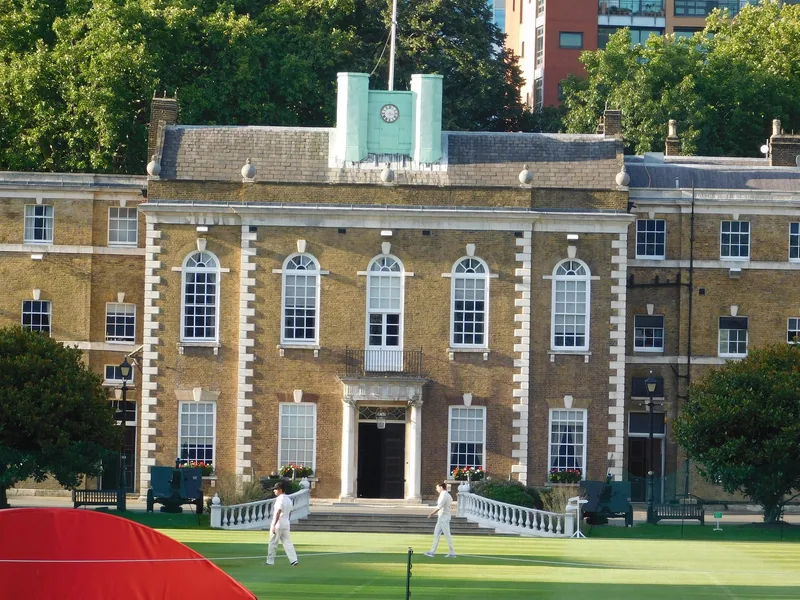
Photo: Paul the Archivist · CC BY-SA 4.0 · Wikimedia Commons · resized
The Artillery Garden, and two things that happened in it
The Company leased ground in Finsbury from the City of London in 1641 and moved here completely in 1658, from the older Artillery Garden in Bishopsgate. The ground has been in continuous use ever since, which makes it one of the longest-used sports fields in the country.
Two events on it are worth knowing about before you look through the railings:
- Cricket. The Company's own records show cricket being played on the Artillery Garden as early as 1725, decades before Lord's existed.
- The first balloon flight from English soil. Vincenzo Lunardi ascended from the Artillery Garden in September 1784, watched by a very large crowd. There is nothing to see now, which is exactly the sort of fact that makes a plain field worth two minutes of attention.
Today the ground is used for the Regiment's physical training and for rugby, football and cricket in season, and for the Company's summer and winter balls and its Open Evening. Trees were planted round the borders to mark the millennium. You will sometimes find a match in progress, visible over the wall from Bunhill Row on the western side, which is the best angle on the ground itself. Do not expect to be able to walk in: the gates are manned and the field is not a public right of way.
Finsbury Barracks, the building people mistake for the house
Immediately south of Armoury House stands a lower, heavier, castellated building in rough grey stone that looks far more like a castle than the Georgian house does. This is Finsbury Barracks, and visitors regularly photograph it thinking it is the HAC headquarters.
It was completed in 1857 to the design of Joseph Jennings, built in Kentish ragstone for the Commission of Lieutenancy for the City of London as the headquarters of the Royal London Militia. It is listed separately, at Grade II, under list entry 1207595. The Company has owned it since 1961 but leases it to the Reserve Forces' and Cadets' Association, which maintains it for the Army Reserve unit based there. An extension faced in striped stone and granite, by Arnold & Boston, was opened in 1996.
The rooms behind the door, and the one way to ask
The interior is the reason the building is Grade II* rather than Grade II, and the list entry describes it room by room. The Long Room fills the whole first-floor front of the original house, with full-height fielded panelling installed in 1919 around original door architraves, chimneypieces at each end, eighteenth-century cast-iron grates, a painting of the royal arms of 1736 above, and a musicians' gallery on the north side attributed to Richard Pepys.
The Court Room at the rear is the showpiece: eighteenth-century panelling, a deep frieze filled with grisaille paintings on military subjects, a carved wooden chimneypiece with scrolled consoles, a medallion portrait of George II in a rococo frame above it, and the President's chair beneath a double-ogee canopy carried on columns that are trefoil-shaped in plan. There is also an entrance hall panelled and tunnel-vaulted in the 1930s, with wrought-iron gates of about 1740, and a stained-glass war memorial window of about 1950 on the stair half-landing.
The Albert Room at the back began as a mid-nineteenth-century drill hall, completed in 1862 and named for Prince Albert, the Company's Captain-General, who died in December 1861. It keeps its Victorian iron-trussed roof and was refurbished and extended in 2007 as part of the suite now called the Prince Consort Rooms.
None of this is open to the public. The Company's museum is for members and their guests, and its restaurant is for members, guests and corporate diners. The site does say that specific educational or special-interest visits by appointment might be considered depending on the nature of the request, and directs such enquiries to the Archivist through the Company's general email address. If you are going to ask, ask well in advance and have a real reason. There is also a dress code inside: jacket, collared shirt and tie, trousers and smart shoes, or the equivalent.
Do not build a day around getting inside Armoury House. There is no ticket, no open day published in advance and no rolling tour programme. Treat the outside as a ten-minute stop on a longer walk, and check the Open House Festival programme in late summer if you want to know which normally closed London buildings are opening in any given September.
Where the money came from, and why it matters to the building
Armoury House replaced a smaller seventeenth-century armoury. The central block cost £1,690 to build and furnish, which was met partly from an invested gift of £500 made by George I in 1722, partly from members' subscriptions, and partly from the City of London's Court of Lieutenancy. It was designed by Thomas Stibbs, himself a member of the Company.
The connection with the City runs through the whole story. Until 1779 the Company was tied to the City's Trained Bands; the link ended after a quarrel with the Lord Mayor and City funding was withdrawn in 1780. The Company nonetheless helped defend the City during the Gordon Riots of June 1780, and a grateful Lord Mayor presented it with two brass field guns in 1781 that now stand on the Great Stairs. It has provided guards of honour in the City since 1768. If you want the background to that relationship, start with the City of London explained and the ceremonies of the City.
Ten minutes here, and what to do with the rest of the hour
This corner of the border between Islington and the City is unusually rich for a place nobody visits on purpose. Everything below is within a five-minute walk of the Armoury House gate.
| Where | What it is | Cost |
|---|---|---|
| Bunhill Fields Burial Ground | The dissenters' burial ground immediately west, where Bunyan, Defoe and Blake are among dozens of monuments listed individually in 2011, and which is Grade I on the register of parks and gardens | Free |
| Wesley's Chapel and John Wesley's House | Across City Road; the chapel is Grade I, the house is Grade I, and Wesley's tomb behind the chapel is Grade II* | Free, donations invited |
| Whitbread's Brewery, Chiswell Street | A whole group of listed brewery buildings south of the Artillery Garden, including the former Porter Tun Room and the Grade II* Partner's House | Free to look at; not open |
| The Barbican | Ten minutes south-west, and the largest set of interiors in the area you can simply walk into | Free to walk through |
Our guides to Bunhill Fields and London's dissenters and Wesley's Chapel cover the two free interiors in detail, and the Barbican Centre and Brutalist London take you south from there. Islington begins immediately north of Old Street, Clerkenwell lies west, and the Charterhouse is the nearest great private house in the area that does let visitors in. For other City buildings that keep their doors shut, see the livery halls and when they open and the Lloyd's Building. If you are collecting free things rather than closed doors, our list of free things to do in London is the better starting point.
Frequently asked questions
Can you visit Armoury House in London?
Not on a normal day. The Honourable Artillery Company states on its own website that public visits and tours are strictly by appointment with the Archivist, and that its small museum is for members and their guests. Educational or special-interest visits may be considered on request. There is no ticket and no published opening calendar.
Is the Honourable Artillery Company really the oldest regiment in the British Army?
That is the Company's own claim, and it rests on the charter granted by Henry VIII on 25 August 1537. The Company has been described as a regiment since the seventeenth century and is today a major unit of the Army Reserve, the second most senior. It is also one of very few British regiments never to have been amalgamated.
Can you watch cricket at the Artillery Garden?
The ground is private and used by the Regiment for training and for its own sports teams, so there is no public fixture list and no spectator access. You can see across the field from the pavement on Bunhill Row when a match is being played, but treat that as a lucky glimpse rather than a plan.
What is the castle-like building next to Armoury House?
Finsbury Barracks, completed in 1857 to a design by Joseph Jennings in Kentish ragstone, built as the headquarters of the Royal London Militia. It is listed at Grade II in its own right and is leased by the Company to the Reserve Forces' and Cadets' Association for the Army Reserve unit based there.
Which Tube station is closest to Armoury House?
Old Street, about five minutes on foot down City Road, on the Northern line and Great Northern rail services. Moorgate and Barbican are both around ten minutes to the south, which is the direction you want if you are combining the visit with the Barbican.
Sources
- Historic England - Armoury House, list entry 1195537 (Grade II*) (checked September 2026)
- Historic England - Finsbury Barracks and attached railings, list entry 1207595 (Grade II) (checked September 2026)
- Honourable Artillery Company - Estate: Armoury House, Finsbury Barracks and the Artillery Garden (checked September 2026)
- Honourable Artillery Company - Who we are (checked September 2026)
- Honourable Artillery Company - History 1537 to 1799 (checked September 2026)
- Honourable Artillery Company - Frequently asked questions (checked September 2026)
- Historic England - Bunhill Fields Burial Ground, register of parks and gardens, Grade I (checked September 2026)