
Mansion House is the official residence and office of the Lord Mayor of the City of London, and it is closed to the public except on pre-booked guided tours. A ticket costs £9.50, or £7.50 with a concession, for one hour, with a maximum of forty people. There are no tickets at the door, nobody under fourteen is admitted, and there are no tours at all in August, on public holidays or when the house is being used for something else.
That is the practical answer, and it is the one most pages about the building leave out. Everything else here is what a ticket actually buys: a Grade I interior by George Dance the Elder, a hall that is called Egyptian and is not, eighty-four Dutch paintings and one of the largest collections of civic gold and silver in the world.
Our guide to the City of London explained covers the constitution the building sits at the top of, and the Lord Mayor's Show covers the one day a year when the whole thing comes out onto the street.
Mansion House at a glance
- Where
- Walbrook, at Bank junction, EC4. Bank and Mansion House stations are both under three minutes
- Tour price
- £9.50 standard, £7.50 concessions (September 2026)
- Length
- One hour. Arrive ten minutes early for security
- Booking
- Pre-booked only, through the Corporation's Eventbrite listings. No door sales
- Age limit
- Not suitable for under-14s. Guide dogs only
- Closed
- All of August, public holidays, and any day the house is in use
- Listing
- Grade I, list entry 1064604, listed 4 January 1950
Whose house it is, and what the office is called now
The Lord Mayor of the City of London is elected by the liverymen of the City's companies in Common Hall on Michaelmas Day, 29 September, and takes office in November. The post goes back to 1189 and is not the same job as Mayor of London, which is the elected mayor of the whole capital.
There is a change of title worth knowing. The 697th holder of the office, Alderwoman Dame Susan Langley, was elected on 29 September 2025 and took office at the Silent Ceremony on Friday 7 November 2025. She is the third woman to hold the post and the first to be styled Lady Mayor, and the Corporation's own website now uses that form throughout. Her year ends with the next Show.
The Lord Mayor's two Sheriffs are also elected by the livery each September, and they are custodians of the Old Bailey as well as part of the civic team: see our page on the Old Bailey for the court they look after and the livery halls for the companies that elect them.
The three tours, and which one you want
| Tour | Price | Length and size | How to book |
|---|---|---|---|
| Weekly guided tour, led by a City of London Guide | £9.50; £7.50 concessions | 1 hour, maximum 40 | Pre-booked tickets only, via Eventbrite. No door sales |
| Self-organised group tour (non-commercial), led by a City Corporation employee | £150 per group | 1 hour, maximum 40 | By telephone, 020 7397 9316 |
| Art Collection tour, led by qualified art guides | £200 per group | 1.5 hours, maximum 20 | By telephone, 020 7397 9316, up to three months ahead |
For a couple or a family of adults, the weekly tour is the only sensible choice: the group prices work out at £3.75 a head only if you can fill forty places. The Art Collection tour is the one to organise if you care about the paintings, because it runs half an hour longer and is capped at twenty.
Telephone on the morning of your tour. The Corporation states plainly that tours may be cancelled at short notice, and gives a number to ring on the day to confirm: 020 7397 9306. If it is cancelled a new date is arranged. This is a working government building, and a state visit or a banquet outranks you.
The entrance is not the one with the columns
Dance's building went up between 1739 and 1753, and Historic England's description is of a monumental classical block with a rusticated ground storey and Corinthian columns and pilasters running through two storeys. The narrow north front carries an eight-columned portico with a richly carved tympanum and balustraded steps at either side, altered in the nineteenth century.
You will not go in that way. The list entry notes that a small Doric portico on the west side, at ground floor level, is now the main entrance, and the Corporation explains why: the entrance was moved to the side because of roadworks. This is the Walbrook Entrance, created in 1846 by the architect James Bunning so that the Lord Mayor could come and go without ceremony. The space behind it had been designed as an eight-stall stable and coach house and was never used as one.
Two objects in that entrance hall are worth finding before the tour moves off. The benches date from 1811. And there is an eighteenth-century Hallkeeper's Chair built as a draught excluder, with a drawer underneath for a hot pan or a shovel of coal, so that the man on the door could keep warm through a City winter.
The Egyptian Hall, which is Roman
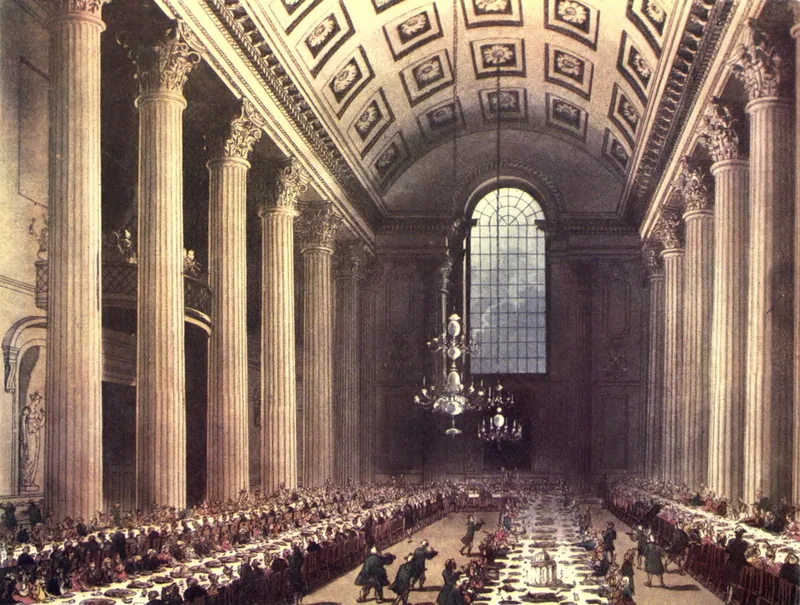
The largest room in the house seats 350 and rises through the whole height of the building, and its name is a red herring. The Corporation is explicit: the Egyptian Hall is inspired by Roman designs described by Vitruvius, with giant columns and a narrower attic storey, a form popularised by Palladio in the sixteenth century and fashionable in the eighteenth. There is nothing Egyptian about it.
The marble statues in it were an afterthought, and the record of how they arrived is unusually complete. The idea came up in 1850 at a banquet for Prince Albert, when the hall was judged to be under-decorated; the General Purposes Committee proposed statues on subjects from English poets; the Court of Common Council approved it; and the figures were installed in 1863. Each weighs about three-quarters of a ton and stands seven feet tall. Historic England dates the marble sculpture in the house to 1854-64 and the stained glass to 1868, so treat 1863 as the installation rather than the carving.
The Salon, and the chandeliers that kept breaking
The Salon began as a roofless courtyard and was covered over quite early by George Dance the Younger, which gave the house a grand top-lit reception space. The crystal chandeliers in it have the best story in the building.
They used to be shared with Guildhall, and moved between the two buildings as needed. Several were broken in transport, so Mansion House bought its own in 1875, made by Messrs Osler with a high lead content for extra sparkle. They are cleaned and re-pinned by specialists. If you have seen the ones in Guildhall's Great Hall, this is why they are not the same fittings.
Eighty-four Dutch paintings, and a telephone bid
Mansion House holds the Harold Samuel Collection: 84 Dutch and Flemish paintings of the seventeenth century, which the Corporation describes as perhaps the best of Dutch art in Britain. Lord Harold Samuel of Wych Cross, a property developer, left it to the City in 1987.
The picture to look for is The Merry Lute Player by Frans Hals, painted between 1624 and 1628: a life-size half-length figure in theatrical costume. Samuel bought it at a New York auction in 1963, and it made news twice, once for the price and once because it was the first time bidding had been conducted by telephone from London. Also worth stopping at is Nicolaes Maes's A Young Woman Sewing of 1655, in which the sitter has broken off lacemaking to sew, with packets of pins tucked behind her and her feet up on a low dais to keep them off a cold tiled floor.
The Drawing Rooms hold part of the same collection and are furnished with the Nile Suite, made to commemorate Nelson's sea victories.
The plate room: five objects to ask about
The gold and silver collection is one of the largest and finest civic collections in the world. Five things in it are worth naming.
- The Pearl Sword. Its scabbard carries more than 2,500 pearls, and legend attaches it to Elizabeth I at the opening of the first Royal Exchange in 1571. It is still used when the reigning Sovereign visits the City: the Lord Mayor offers the sword, the Sovereign touches it, and the Lord Mayor then carries it before the monarch. Our page on the Royal Exchange covers the building in the story.
- The Mace, made in 1735 by John White, with a royal crown, orb and cross and the royal arms of George III.
- The Fire Cup of 1662, the only piece of City plate to survive the Great Fire of 1666, recovered from the flames at Guildhall. It began as a covered silver bowl given in 1580 by Robert Christopher of the Clothworkers' Company and was reworked into its present form in 1662.
- The Collar of Esses, bequeathed by Sir John Aleyn, Lord Mayor in 1535, and believed to have been part of Sir Thomas More's regalia. The Lord Mayor wears a replica for everyday engagements.
- A speech timer of 1975 with three egg timers in it, to keep after-dinner speakers to length. Alongside it, Queen Victoria's knife and fork from her coronation banquet of 1838, returned to the Lord Mayor in 1936.
Access, and the one thing the lift cannot solve
The Corporation lists a ramp, accessible toilets, a sound loop in the Egyptian Hall and lift access to all floors. It also makes an honest admission that matters if you are booking for a wheelchair user: much of the art collection hangs on staircases, so seeing the whole collection may not be possible. More detailed access information is published on the Mansion House events website rather than the main one. Our guide to accessible London has the wider picture.
Two other rules from the same page: no flash photography anywhere, and guide dogs are the only animals allowed.
The medieval calendar, and what you can watch for nothing
None of the following needs a ticket, and three of the four happen on the street.
- Common Hall, Michaelmas Day, 29 September. The liverymen elect the next Lord Mayor. The 2025 election was held on 29 September and produced the 697th holder of the office.
- The Silent Ceremony, a Friday in November. The new Lord Mayor is admitted to office at Guildhall in a ceremony conducted almost entirely without speech. The 2025 one was on Friday 7 November.
- The Lord Mayor's Show, the Saturday after. In 2026 that is Saturday 14 November, setting off from outside Mansion House at 11am, and it is free.
- The United Guilds' Service at St Paul's, each year, where the companies, the Corporation and the church appear together.
Mansion House is the start and finish of the Show, which means the pavement outside is the single best place to be at about 2:30pm, when the Lord Mayor returns and the Pikemen present arms. Getting there is simple on foot: our guide to walking in London covers the short hops around Bank, and St Stephen Walbrook is directly across the road if you have twenty minutes to fill.
Frequently asked questions
Can you go inside Mansion House in London?
Only on a pre-booked guided tour. Tickets are £9.50, or £7.50 with a concession, for a one-hour tour with a maximum of forty people, and none are sold at the door. There are no tours in August, on public holidays, or when the house is in use for an event.
How do you book a Mansion House tour?
Through the City of London Corporation's Eventbrite listings for the weekly guided tour. Group tours are booked by telephone on 020 7397 9316: £150 for a self-organised group of up to forty, or £200 for a 90-minute art collection tour for up to twenty, arranged up to three months ahead.
Is the Egyptian Hall at Mansion House actually Egyptian?
No. The Corporation states that it is based on Roman designs described by Vitruvius and popularised by Palladio in the sixteenth century, with giant columns and a narrower attic. The name describes an architectural type, not the decoration. The hall seats 350.
Who is the Lord Mayor of the City of London?
Alderwoman Dame Susan Langley, the 697th holder of the office, elected on 29 September 2025 and admitted at the Silent Ceremony on 7 November 2025. She is the third woman in the role and the first to be styled Lady Mayor. The office changes hands each November, so check before quoting the name.
Is Mansion House the same as Guildhall?
No. Mansion House is the Lord Mayor's residence and office at Bank junction; Guildhall, a few minutes north, is the City's civic hall, where the Court of Common Council meets and where the Silent Ceremony is held. Guildhall runs its own separate monthly tours.
Sources
- City of London Corporation - Mansion House tours (prices, duration, booking, restrictions) (checked September 2026)
- City of London Corporation - Visit Mansion House (history, rooms, accessibility, Walbrook Entrance) (checked September 2026)
- City of London Corporation - Mansion House collections (Harold Samuel Collection, sculpture, plate) (checked September 2026)
- City of London Corporation - Lady Mayor biography (checked September 2026)
- City of London Corporation newsroom - Dame Susan Langley DBE elected as 697th Lord Mayor, 29 September 2025 (checked September 2026)
- Historic England - Mansion House, list entry 1064604, Grade I (Internet Archive copy, 9 October 2024) (checked September 2026)