
For most of the City's livery halls the honest answer is that you cannot get in, and no amount of planning changes it. They are private buildings used for dinners, meetings and ceremonies, and they have no visitor entrance, no opening hours and no ticket desk. There are five real exceptions, and the most reliable is Goldsmiths' Hall on Foster Lane, which opens for a handful of guided tours a year and for Goldsmiths' Fair each autumn.
So this page does two things. It sets out the five ways the public can legitimately get inside a livery hall, with the prices and dates we read on the record. For the rest, it names the sixteen halls on the statutory list, says what the list entries record behind the doors, and gives a forty-minute walk past eight of them.
Our guide to the City of London explained covers the constitutional machinery the companies belong to, and Mansion House and the ceremonies of the City covers the one civic building that does run regular public tours.
Getting into a livery hall: the short version
- Best odds, cheapest
- Goldsmiths' Hall guided tour, £10, four dates a year, sells out
- Most reliable
- A ticketed event in a hall, such as Goldsmiths' Fair
- Free, but one weekend
- Open House Festival, September. 2026 ran 12-20 September
- Gardens only
- Open Garden Squares Weekend, June
- If all else fails
- The facades, from the street, free at any hour
What a livery company is, in four facts
The City of London Corporation puts the numbers plainly. There are more than 100 livery companies today. The oldest charter still in existence was granted to the Weavers' Company in 1155. By 1515 there were 48 companies and the Lord Mayor had to establish an order of precedence to stop them arguing about rank; the twelve at the top are still called the Great Twelve. Between them the companies now give away more than £75m a year to charity.
The relevant point for a visitor is the second half of that history. As the guilds became established, many bought large houses or built halls, and those halls were where trade and domestic disputes were settled. They were never public buildings and they are not public buildings now. The Wax Chandlers have owned their Gresham Street site since 1501, which is not the sort of continuity that comes with a ticket office.
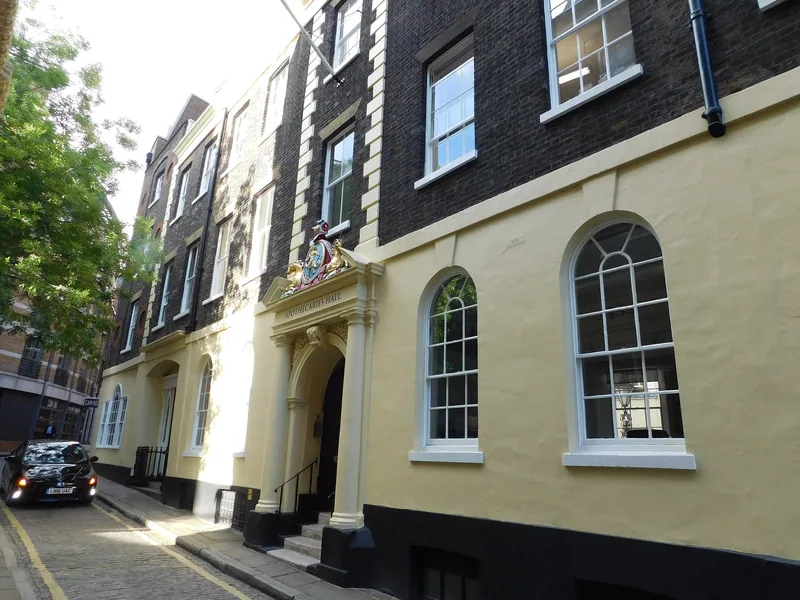
Photo: Paul the Archivist · CC BY-SA 4.0 · Wikimedia Commons · resized
Way in 1: a tour run by the company itself, £10
This is the cheapest and the best, and it applies to exactly one hall reliably. The Goldsmiths' Company opened Goldsmiths' Hall for four days of guided tours in 2026: 8 June, 20 July, 16 November and 7 December. Tickets are £10 per person and limited to two per booking, and the proceeds go to the Company's education charity.
The format is fixed. Doors open fifteen minutes early so that everyone can clear security; the 60-minute tour of the principal rooms is led by the Library and Archives team; then a curator gives ten minutes on the current displays from a collection of some 11,000 precious metal objects. An hour and a half in all.
They sell out. The 20 July 2026 tour was marked fully booked when we read it, with a note pointing people to the Company's newsletter for the November release. Sign up months ahead, not a fortnight before.
Goldsmiths' Hall is Grade I and the tour is the cheapest way into any of them. Philip Hardwick's building, the third hall on the site, opened with a banquet in July 1835; the Company has been on the site for seven centuries and the hall has housed the London Assay Office since 1478. Ten pounds for ninety minutes inside a Grade I listed interior is better value than most paid attractions in the City.
Way in 2: pay to attend an event held in the rooms
The reliable route is to attend an event. The hall is open because the event is on, and nobody checks whether you came for the silver or the ceiling.
Goldsmiths' Fair 2026 ran at Goldsmiths' Hall, Foster Lane, EC2V 6BN, from 22 September to 4 October, with 138 exhibiting jewellers and silversmiths, open 11:00 to 18:30 on most days. A run-of-show ticket was £35 booked in advance or £40 on the door; a single day was £35. The fair was closed on the Mondays between and before its two weeks.
Two more dated openings at the same hall, both read on the Company's own listings in September 2026:
- Monday 7 December 2026, 17:15 to 20:00: a History at The Hall evening lecture, this one on Dick Whittington, the man, the myth and the cat. The cat itself is on Highgate Hill.
- Tuesday 9 February 2027, 09:30 to 12:30: the Trial of the Pyx, a judicial ceremony that has tested the coinage since 1248, with a limited number of public places.
Way in 3: Open House, one weekend in September
The Open House Festival, run by the charity Open City, is the only occasion when several livery halls open free and at the same time. In 2026 it began on Saturday 12 September and finished on Sunday the 20th. Our guide to Open House London explains the mechanism, which matters here: some buildings are drop-in and some are ticketed or balloted, and the halls are usually in the second group.
You cannot plan next year's Open House from this year's programme. The festival listings come down after the event: when we checked the programme site in late September 2026 the City of London entries for the festival were no longer there. That means there is no way to find out in advance which halls will take part in 2027 until the programme is published, normally in the summer. Watch for it rather than assuming a hall that opened once will open again.
Way in 4: the gardens, in June
Several companies open their courtyards and gardens for Open Garden Squares Weekend, among them Drapers' Hall and the Stationers' Company. The 2027 weekend is Saturday 5 and Sunday 6 June, and one ticket covers the whole weekend rather than each garden separately: our page on the Open Garden Squares Weekend has the practicalities and London's secret gardens covers the rest of the year. This gets you through the gate rather than into the rooms, which for Drapers' Hall is still worth it.
Way in 5: see the collection instead of the building
From Saturday 28 November 2026, the Goldsmiths' Company's collection goes on public display in a new Goldsmiths' Gallery at the London Museum, which opens that day in Smithfield's General Market. The Company says the gallery will bring the Cheapside Hoard to new audiences. If what you want is the silver rather than the panelling, that is a better use of an afternoon than a year of waiting for a tour: see our page on Smithfield and the new London Museum.
The other substitute is Guildhall, which is not a livery hall but is the City's own great medieval hall and the one building of this kind you can book at will: a £15 guided tour, monthly, arranged through the City of London Guides.
The sixteen halls on the statutory list
We searched Historic England's open data for halls by name and found sixteen in the City. Five are Grade I, which is the top 2.5 per cent of listed buildings in England. Not every company's hall appears: the Wax Chandlers' Hall, for instance, is not there as a named entry.
| Hall | Where | Grade | Date in the list entry |
|---|---|---|---|
| Apothecaries' Hall | Black Friars Lane EC4 | I | Mainly 1670 and 1786, over remains of Blackfriars Priory |
| Goldsmiths' Hall | Foster Lane EC2 | I | 1829-35, Philip Hardwick |
| Skinners' Hall | 8-9 Dowgate Hill EC4 | I | Late 17th century, front range late 18th |
| Stationers' Hall | Stationers Hall Court, Ave Maria Lane EC4M 7DD | I | Listed January 1950 |
| Vintners' Hall | Upper Thames Street EC4 | I | 1671 and later |
| Armourers' and Braziers' Hall | 81 Coleman Street EC2 | II* | Listed January 1950 |
| Drapers' Hall | Throgmorton Street EC2 | II* | Much of it 1866-70, Herbert Williams |
| Dyers' Hall | 10-13 Dowgate Hill EC4 | II* | 1839-40 |
| Fishmongers' Hall | London Bridge | II* | 1831-34, Henry Roberts and George Gilbert Scott |
| Innholders' Hall | 29 College Street EC4 | II* | Listed January 1950 |
| Merchant Taylors' Hall | 30 Threadneedle Street EC2 | II* | Listed June 1972 |
| Tallow Chandlers' Hall | 4 Dowgate Hill EC4 | II* | 1671-72 |
| Watermen's Hall | 17-18 St Mary at Hill EC3 | II* | 1778-80 |
| Cutlers' Hall | Warwick Lane EC4 | II | 1884, with a terracotta frieze by George Tinworth |
| Ironmongers' Hall | Shaftesbury Place EC2Y 8AA | II | 1923-25, Sydney Tatchell. Listed April 2023 |
| Salters' Hall | 4 Fore Street EC2 | II | Listed November 2010 |
What is actually behind the doors, according to the list
The statutory descriptions are the closest most people will get to the interiors, and they are surprisingly specific. Four worth reading before a walk.
Tallow Chandlers' Hall, of 1671 to 1672, is a courtyard building reached by a passage between numbers 3 and 5 Dowgate Hill: an arcaded ground floor with an open cloister surviving on the west side, kitchens behind it and the hall above. Inside, the hall has good panelling with a carved frieze, a small three-sided oriel, a richly carved screen and an elaborately carved niche with a coat of arms; the parlour keeps its original panelling, carved doorcases and chimneypieces; and the court room is plainer but retains its original arrangement of seating.
Drapers' Hall hides a large mid-nineteenth-century courtyard in Portland stone behind a Baroque screen facade on Throgmorton Street. Historic England describes a magnificent suite of state rooms, a very large hall with marble Corinthian columns on pedestals carrying a balcony, a compartmented ceiling with paintings by Herbert Draper of about 1905 to 1910, and a staircase enriched with marble and alabaster.
Vintners' Hall, 1671 and later, has virtually no original external features, which is why it looks unremarkable from Upper Thames Street. The hall and court room have good joinery and carving and there is a fine staircase. Look on the west face for a statue of a charity school boy, signed Coade and dated 1840.
Apothecaries' Hall is the one with the oldest fabric: mainly 1670 and 1786, but incorporating slight medieval remains of Blackfriars Priory, with the hall on the first floor of the east range and an external stair in the south-east corner. The Society that owns it founded the Chelsea Physic Garden in 1673 to train apothecaries, and that garden is open to the public, which makes it the easiest thing on this page to visit.
A forty-minute walk past eight of them
Dowgate Hill is the reason this walk works: three halls stand within a hundred metres of each other, which happens nowhere else.
- Watermen's Hall, 17-18 St Mary at Hill, EC3. A small Portland stone front of 1778 to 80, two storeys, with pairs of Ionic pilasters and a pediment rising through the parapet. Start here.
- West to Fishmongers' Hall at the north end of London Bridge, a detached Greek revival building of 1831 to 34 by Henry Roberts and George Gilbert Scott, with a granite double basement below the level of the bridge. Then up Dowgate Hill.
- Tallow Chandlers' at number 4, Skinners' at 8-9 and Dyers' at 10-13 Dowgate Hill, within a hundred metres of each other. Look for the large modillion cornice that runs on from Tallow Chandlers' to Skinners', and for Skinners' painted front with four Ionic pilasters and sculpture in the pediment.
- Vintners' Hall on Upper Thames Street, two minutes west.
- North past the London Stone and up to Goldsmiths' Hall on Foster Lane, beside St Paul's.
- Finish at Apothecaries' Hall, Black Friars Lane, whose courtyard archway you can usually see into from the lane.
Forty minutes at a walk, an hour if you stop, all of it free, and much better on a weekday when the City is alive: our guide to the City explains what happens at the weekend. If you want to see the companies themselves rather than their buildings, they appear in force twice a year, at the United Guilds' Service in St Paul's and in the Lord Mayor's Show in November.
Frequently asked questions
Can you visit the livery halls in the City of London?
Mostly not. They are private buildings with no visitor entrance or opening hours. The exceptions are the Goldsmiths' Company's own £10 guided tours on four dates a year, ticketed events held in halls, the Open House Festival in September, and Open Garden Squares Weekend in June for courtyards and gardens.
How much does a Goldsmiths' Hall tour cost?
£10 per person, with a maximum of two tickets per booking, for a 60-minute guided tour of the principal rooms plus ten minutes with a curator. The 2026 dates were 8 June, 20 July, 16 November and 7 December. They sell out well in advance.
When is Open House and do livery halls take part?
It runs for about nine days in September; in 2026 it was 12 to 20 September. Some halls take part and entry is free, but they are usually ticketed or balloted rather than drop-in, and the programme is only published in the summer. Last year's listings are removed after the festival, so you cannot plan ahead from them.
How many livery companies are there and how many have halls?
The City of London Corporation says there are more than 100 livery companies. Only a minority own a hall. Searching Historic England's list by name, we found sixteen livery halls in the City on the statutory list, five of them at Grade I.
Which livery hall is the best one to see inside?
Goldsmiths' Hall, because it is Grade I, because Philip Hardwick's interiors are the grandest of the group, and because it is the only one with a published programme of paid tours and public events. If you cannot get a tour, a Goldsmiths' Fair ticket in late September gets you into the same rooms.
Sources
- City of London Corporation - Livery companies (numbers, 1155 charter, 1515 precedence, charitable giving) (checked September 2026)
- The Goldsmiths' Company - What's on at Goldsmiths' Hall (tour dates, Archive Experience, Trial of the Pyx) (checked September 2026)
- The Goldsmiths' Company - Goldsmiths' Fair 2026 dates, times and ticket prices (checked September 2026)
- Open City - Open House Festival 2026 dates (checked September 2026)
- Historic England - Tallow Chandlers Hall, list entry 1064685, Grade II* (Internet Archive copy, 27 February 2026) (checked September 2026)
- Historic England - Drapers' Hall, list entry 1358902, Grade II* (Internet Archive copy, 1 June 2025) (checked September 2026)
- Historic England - Vintners Hall, list entry 1180690, Grade I (Internet Archive copy, 7 January 2026) (checked September 2026)
- Historic England - Apothecaries Hall, list entry 1359133, Grade I (Internet Archive copy, 10 January 2026) (checked September 2026)