
Smithfield is still a working wholesale meat market, it trades from midnight to 7am Monday to Friday, and anyone may walk in and buy. It is also on its way out: the traders have agreed to move to the Royal Docks and will stay at Smithfield until at least 2028. Next door, in a Victorian market hall that stood empty for thirty years, the London Museum opens on 28 November 2026.
Almost everything written about Smithfield gets the history slightly wrong, so start with the shape of it. The open ground here was a livestock market in the twelfth century, and it stayed a livestock market until 1852, when an Act of Parliament pushed the live animals out to Islington. The cathedral-like iron halls that people photograph were built for cut meat afterwards, and opened in 1868. So this is roughly 850 years of trading on one site, but only about 160 years of trading in the buildings you can see.
The market is a genuine survival rather than a heritage display. Nothing is staged and nobody is selling souvenirs. That is the reason to come, and also the reason to be careful about how you behave when you get there.
Visiting Smithfield, autumn 2026
- Trading hours
- Monday to Friday, midnight to 7am. Closed Saturday, Sunday and bank holidays, and on 25 and 26 December and 1 January.
- Best time to arrive
- Well before 7am. The market advises this itself: some selling runs into mid-morning, but the full range of stalls is only open earlier.
- Cost
- Free to walk through. Anyone can buy, but prices are not displayed in a wholesale market, so you have to ask.
- Where
- Between Charterhouse Street and Farringdon Road, EC1. Formally, London Central Markets.
- Stations
- Farringdon and Barbican, both a few minutes' walk.
- How long
- Half an hour to walk the halls; an hour if you stop and talk.
- Leaving
- Traders will remain until at least 2028, then move to Albert Island in the Royal Docks as New Smithfield.
What is actually there at four in the morning
Two long iron halls, East Market and West Market, joined under one roof and separated by a central arcade called the Grand Avenue. Inside are chilled stalls: whole carcasses, boxed cuts, game in season, offal, poultry, and the suppliers who keep London's restaurants going. An overhead rail system carries meat from sealed loading bays into the stalls, the 1990s modernisation that kept the market legal inside a listed building.
The noise is forklifts, shutters and shouting. The smell is cold fat and disinfectant. It is busy in a way no other part of the City of London is at that hour. The Grand Avenue is the part to walk slowly: ornamental cast iron, stone, Welsh slate and glass, painted dark green and red, with the dragons of the City on the gates.
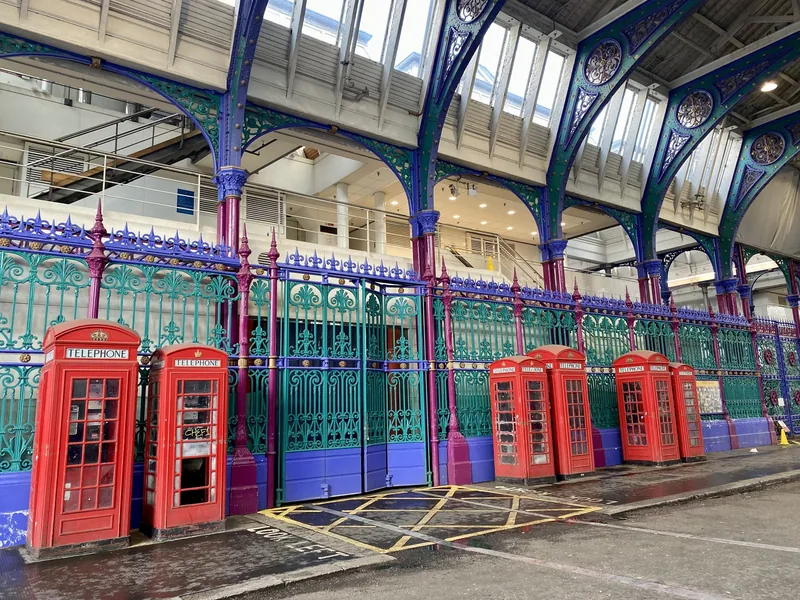
Photo: No Swan So Fine · CC BY-SA 4.0 · Wikimedia Commons · resized
The three buildings, and which is which
People say "Smithfield" and mean four different buildings. It is worth separating them, because only one of them still sells meat.
| Building | Opened | What it is now |
|---|---|---|
| East and West Market buildings | 1868 | The working meat market. Grade II* listed |
| Poultry Market | 1963, after a fire destroyed the 1875 original | Empty; becomes museum space in 2028 |
| General Market | 1883 | The London Museum, opening 28 November 2026 |
| The Rotunda | Underground car park on the site of the old railway sidings | 581 spaces; Grade II listed |
The 1868 halls were designed by Sir Horace Jones, the City Architect, who also gave London Leadenhall Market and Tower Bridge. Work began in 1866 and the opening ceremony, on 24 November 1868, was a banquet for 1,200 guests with music from the Grenadier Guards.
The Poultry Market is the surprise. From the street it is a plain 1960s box. Inside, its concrete shell roof spans 225 feet without a single column, and when it was finished in 1963 it was the largest clear-span dome roof in Europe. If you like that sort of thing, our guide to brutalist London covers the rest of the city's concrete.
How to visit a working market without getting in the way
Nobody stops you at the door, and the market says plainly that anyone can buy there. But this is a workplace at its busiest, so a few rules matter.
- Keep out of the loading bays. Forklifts have right of way over everyone.
- Walk round once before you ask about anything. Prices change daily and are not on display.
- Bring cash. Every stall takes it; only some take cards.
- If you buy, buy in wholesale quantities or do not bother. A whole rib of beef is normal here; a single chop is not.
- Ask before photographing a stall or a person. Most traders do not mind; some have had enough.
The Night Tube will not get you to Smithfield. Farringdon is served by the Elizabeth line, Thameslink and the Circle, District, Metropolitan and Hammersmith & City lines, and none of those runs a Friday-and-Saturday night service. Check the options in our guide to the Night Tube, then plan on a night bus or a cab if you are coming before the first trains.
Before the meat: Smoothfield, the fair and the scaffold
The name was originally Smoothfield, a level open space just outside the City wall next to St Bartholomew's Priory. Livestock was traded on it in the twelfth century, and Bartholomew Fair ran on the same ground from the 1130s until the authorities suppressed it in the middle of the nineteenth century for rowdiness.
It was also London's second great place of execution after Tyburn. Wat Tyler, leader of the Peasants' Revolt, was struck down at Smithfield in 1381 in front of the young Richard II. William Wallace was executed here in 1305, and a memorial to him hangs on the wall of St Bartholomew's Hospital, on the south side of the open space. In the 1550s Protestants were burned at Smithfield under Mary I, and a plaque records them near the same wall.
Two medieval survivals stand within two minutes of the market gates: the priory church of St Bartholomew the Great, whose Norman nave is the oldest church interior in the City, and the Charterhouse, a Carthusian monastery that became a mansion and then an almshouse. This concentration of trade, plague pits and public death is why almost every City ghost walk passes through here, as our page on ghost tours in London explains.
The 1852 Act that changed what Smithfield sold
By the late eighteenth century the number of live animals being driven into Smithfield was overwhelming the surrounding streets. The Smithfield Market Removal Act of 1852 moved the livestock market north of Islington and cleared the way for a covered market selling meat already cut.
The railways made that possible. Driving cattle to London on foot lost about twenty pounds of weight per animal over a hundred miles; by 1849 nearly a million of the animals sold at Smithfield arrived by train instead. That is why the market was built over railway sidings, and why there is a basement under the whole site. The sidings are the car park now.
Why the market is leaving, and when
On 26 November 2024 the City of London Corporation's Court of Common Council ended its plan to move Smithfield and Billingsgate together to Dagenham Dock, on cost grounds, and agreed instead to support the traders financially in finding their own new home. In 2025 the traders, the Corporation and the Greater London Authority named a preferred site: Albert Island, in the Royal Docks in Newham, on land owned by the GLA.
The Corporation's own explanation of why the traders want to go is worth repeating, because it is not sentiment. Traffic restrictions and congestion make central London deliveries harder every year, the site is hemmed in, and Smithfield is Grade II* listed, so the buildings cannot be altered freely. The markets will keep trading at Smithfield and Billingsgate until at least 2028, and the move needs an Act of Parliament, because primary legislation currently ties both markets to their present sites.
If seeing a working meat market matters to you, treat 2028 as a real deadline. Nothing suggests an earlier closure, but this is the last stretch of a market that has traded on the same ground for something like 850 years, and it will not be recreated in EC1.
The London Museum, opening 28 November 2026
The museum formerly called the Museum of London closed its London Wall building in December 2022 and has been rebuilding itself inside the 1883 General Market, on the west side of the site. It opens its permanent galleries on 28 November 2026, and they are free.
That is the first phase. The City Corporation confirmed in 2026 that the temporary exhibition spaces, the learning centre and the interactive collections store, which go into the 1963 Poultry Market next door, follow in 2028. So a visit in 2027 will see a museum that is genuinely open but not yet complete. Our page on the London Museum and its two sites covers the galleries, the named highlight objects, the restoration and what is open at Docklands in the meantime.
What happens to the Victorian halls after 2028
Nothing is consented yet, and anyone who tells you otherwise is guessing. Two things have been published.
The City Corporation has shown concept designs by the architects Studio Egret West for the Grade II* East and West buildings and the Grade II Rotunda, restoring them for a mix of public and commercial use, keeping a food theme through training and education units along the Grand Avenue, and cutting an opening through the Grand Avenue floor so that the basements — never open to the public in their history — could be walked through and out via the Rotunda.
Separately, in 2026 the Corporation announced a scheme for the West Smithfield Annexe, on the south-west side of the market: a food market for independent traders due to launch in early 2028, and then a boutique hotel, ground-floor shops and restaurants, and a small landscaped park, to be completed by 2030.
Breakfast, and the myth of the dawn pint
Guidebooks have been recycling the story of Smithfield pubs pouring pints for market porters at six in the morning for about forty years. Check before you rely on it. The Fox and Anchor on Charterhouse Street, the most famous of them, was advertising 8.30am as its opening time when we looked in September 2026, and it now has bedrooms upstairs and a steak menu aimed squarely at the evening trade.
The Hope on Cowcross Street and the Bishop's Finger on West Smithfield are the other two long-standing pubs at the market gates, and Smiths of Smithfield occupies a corner building on Charterhouse Street with the market on its doorstep. All four held a food hygiene rating of 4 or 5 at their most recent inspection. Hours are the variable; confirm them on the day rather than turning up at 5am hoping.
If you have come out early and want feeding properly, the cafes around Farringdon station open well before the office rush; our guide to breakfast before an early train or flight covers that hour of the morning, and Clerkenwell, immediately north, is where to spend the rest of the day. For markets you can actually shop at, see our round-up of London's food markets.
Frequently asked questions
Can the public visit Smithfield meat market?
Yes. It is a wholesale market, but it is open to anyone and you can buy there. It trades Monday to Friday from midnight to 7am and is closed at weekends and on bank holidays. Arrive well before 7am if you want to see all the stalls trading, and keep clear of the loading bays.
Is Smithfield Market closing?
It is moving rather than simply closing. In November 2024 the City of London Corporation dropped its plan to relocate the market to Dagenham, and in 2025 the traders, the Corporation and the Greater London Authority named Albert Island in the Royal Docks as the preferred new site. Trading continues at Smithfield until at least 2028, and the move requires an Act of Parliament.
When does the new London Museum at Smithfield open?
The permanent galleries open on 28 November 2026 in the General Market building, and entry is free. The temporary exhibition spaces, learning centre and collections store in the neighbouring Poultry Market open in 2028. The museum's old London Wall building has been closed since December 2022.
How old is Smithfield Market?
Livestock was traded on the open ground at Smithfield in the twelfth century, so the market is roughly 850 years old as an institution. The iron halls you see are much newer: building started in 1866 and the market opened on 24 November 1868. Meat trading in its current cut-meat form dates from after the 1852 Act that removed the live animals.
Which Tube station is best for Smithfield?
Farringdon, which has the Elizabeth line, Thameslink and four Underground lines, or Barbican, which is a similar short walk. Neither is on the Night Tube, so if you are arriving before the first trains you will need a night bus or a taxi.
Sources
- City of London Corporation - City of London Corporation ends markets' move to Dagenham as traders decide their next move (26 November 2024) (checked September 2026)
- City of London Corporation - Progress as preferred new Billingsgate and new Smithfield markets site identified in London's Royal Docks (checked September 2026)
- City of London Corporation - Historic West Smithfield Annexe set for revival with food market, hotel and new public spaces (checked September 2026)
- City of London Corporation - First concept designs for Smithfield East & West Market buildings and Rotunda unveiled (checked September 2026)
- London Museum - Opening at Smithfield in 2026 (checked September 2026)
- Food Standards Agency - Food hygiene ratings (checked September 2026)