
Acton has seven railway stations, which is more than any other place in London, and one of them stands next to the warehouse where the London Transport Museum keeps 320,000 objects it cannot fit in Covent Garden. Hanwell, three miles west, has a grade I railway viaduct by Brunel that was the first in the world built with hollow piers, and a flight of canal locks that is a scheduled monument. Neither place has a single conventional attraction.
Both are in the London Borough of Ealing, west London, in the corridor between the A40 and the Great Western main line. Acton is a big, mixed, cheap inner suburb — Victorian terraces, an old town hall, light industry, and a lot of railway. Hanwell is smaller and greener, on the edge of the Brent valley, and has the better walk.
The journeys are short. Acton Main Line to Paddington is eight minutes on the Elizabeth line, £3.30 off-peak. Hanwell to Paddington is fifteen minutes and to Bond Street nineteen. Acton Town to Piccadilly Circus is twenty-two minutes on the Piccadilly line. This is, in travel-time terms, well-connected London at outer-London prices.
Acton and Hanwell at a glance
- Where
- W3 (Acton) and W7 (Hanwell), London Borough of Ealing, west London
- Acton's seven stations
- Acton Town (District and Piccadilly), Acton Main Line (Elizabeth line), Acton Central and South Acton (Mildmay line), East Acton, North Acton and West Acton (Central line)
- Measured journey times
- Acton Main Line to Paddington 8 minutes; Acton Town to Piccadilly Circus 22; Hanwell to Paddington 15; Hanwell to Bond Street 19
- Fares
- Acton to Zone 1 £3.30 off-peak / £3.90 peak; Hanwell £3.60 / £4.80
- Open a few days a year
- The London Transport Museum Depot, Acton: three open weekends a year, in April, July and September. The last of 2026 was 25-27 September
- Free, always
- Wharncliffe Viaduct, the Hanwell lock flight and towpath, Brent Lodge Park, Wormwood Scrubs
Wharncliffe Viaduct, and why it is grade I
Four minutes' walk from Hanwell station, carrying the Great Western main line over the valley of the River Brent, is a brick viaduct of eight arches that Historic England listed at grade I on 8 November 1949 — one of the earliest railway structures in the country to be protected, and a higher grade than most cathedrals' parish neighbours.
The list entry is worth reading before you stand under it. Built 1836-37 by Isambard Kingdom Brunel, contractors Grissell and Peto. Eight semi-elliptical arches, each of 70 feet span, rising 19 feet. Length 886 feet; height to the parapet 81 feet; original width 30 feet, widened on the north side in 1877. The piers are in the form of pylons — originally two to each pier, now three, because of the widening. The arms of Lord Wharncliffe, who chaired the parliamentary committee that passed the railway's Act, are carved in the centre of the south face.
And the two claims that make it grade I rather than grade II: it was the first railway viaduct to use hollow piers, and it was the first major engineering work completed on the Great Western Railway. You can walk under it on the footpath through Brent Lodge Park, which is where the arms and the pylon piers are best seen, and there is no fence and no charge.
Hanwell station itself is listed grade II, and the entry is unusually candid. It dates the buildings to about 1875-77 and calls the station "the least altered example remaining of the general station rebuilding in the 1870s caused by the quadrupling of the tracks", praising the platform canopies and ironwork on the central island platform. It also notes that the station is said to incorporate part of Brunel's original station of about 1840, and then says this "seems unlikely" unless the cast-iron columns were reused. So: look at the ironwork, and do not believe the leaflet.
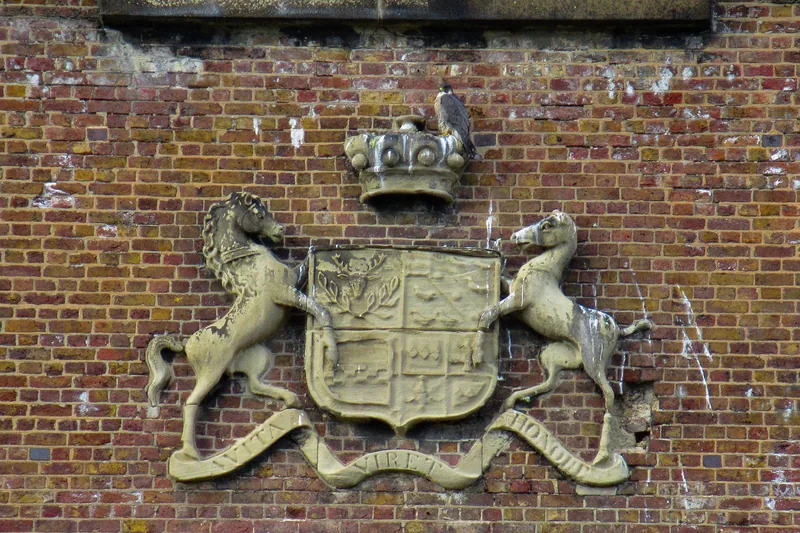
Photo: AndyScott · CC BY-SA 4.0 · Wikimedia Commons · resized
The Hanwell lock flight, which is a scheduled monument
Eleven minutes' walk from Hanwell station, the Grand Union Canal climbs out of the Brent valley through a flight of locks beside the long brick boundary wall of the former county asylum. The Canal & River Trust calls it a flight of seven locks; other accounts give six, and we are not going to arbitrate. What is not in dispute is that the flight and the asylum's brick boundary wall together form a scheduled monument, protected since February 1975 — a rare status for a working navigation.
The towpath is open all the time and it is free. Two details from the Trust's own description are worth knowing because you can see both: there are lock keeper's cottages along the flight, and there is a ramp built into the bank to get horses out of the canal when they fell in. At the top of the flight there is a dry dock, a water point and visitor moorings.
If you follow the canal west from the top of the locks for twenty minutes you reach the Three Bridges at Windmill Lane, Brunel's 1859 arrangement of canal over railway over road, one above the other in a single cutting. That is over the boundary in Southall, and it is the other great piece of engineering in this corner of London. Our guide to the Paddington Arm of the Grand Union covers the canal's route into central London.
Hanwell's two best things are a four-minute walk apart and both free. Come out of the station, go down to the Brent for the viaduct and Brent Lodge Park, then up onto the towpath for the locks, and back to the station. That is ninety minutes, costs £3.60 off-peak from Zone 1, and there is no ticket office involved at any point.
The London Transport Museum Depot, and the days it opens
Three minutes from Acton Town station, on Gunnersbury Lane, is a large shed that is the working store of the London Transport Museum. It holds part of a collection of more than 320,000 objects: Tube stock, buses, trams, signs, ticket machines, moquette, engineering drawings, and the poster collection. It is normally closed to the public.
It opens in two ways. There are pre-booked guided tours through the year, and there are Depot open days, three times a year, in April, July and September — festival-style weekends with talks, tours and activities, at which the London Transport Miniature Railway runs on the Saturday and Sunday only. The last open days of 2026 ran from Friday 25 to Sunday 27 September, 10:00 to 17:00, with a SEND-friendly hour first thing on the Saturday. The 2027 dates follow the same April, July and September pattern; check them before you plan a trip, because they sell out.
Our guide to the London Transport Museum covers the main museum in Covent Garden, which is open every day; this is the other half of the same institution, and for anyone seriously interested in the Underground it is the better half.
Two listed railway buildings are within a few minutes of the depot. Acton Town station is listed grade II, with its shopping parade, and is one of the 1930s Underground stations of the Charles Holden period — our guide to Holden's Underground stations explains what to look for. And on Bollo Lane, between Acton Town and South Acton, is Bollo Lane Junction Signal Box, listed grade II in 1998: probably 1878, a London and South Western Railway Type 2 box, and per Historic England "believed to be the only surviving example" of that type anywhere.
Seven stations, and which to use
Acton's seven stations are not a curiosity, they are a planning problem, because they serve completely different places. Acton Main Line is the Elizabeth line, eight minutes to Paddington and the fastest thing here. Acton Town is District and Piccadilly, twenty-two minutes to Piccadilly Circus, and the junction where the Piccadilly line splits for Heathrow and Uxbridge — our Piccadilly line guide explains the branches. East, North and West Acton are on the Central line, and North Acton is where the Central line's own branches divide. Acton Central and South Acton are on the Mildmay line, the Overground route from Richmond to Stratford, which is the one to use for Kew or for Hackney without going through the centre.
Look at which station your destination is actually near, because Acton Main Line and East Acton are a thirty-minute walk apart. Our guide to the Elizabeth line covers the fastest of them.
Brent Lodge Park, Wormwood Scrubs and the green bits
Hanwell's park is Brent Lodge Park, known locally as the Bunny Park, which runs down to the river under the viaduct and has a small animal centre in it run by the council, a maze and a café. The animal centre charges; the park does not. It is the reason local families come here and it works well with small children.
Acton's green space is at the other extreme: Wormwood Scrubs, by East Acton, is about 200 acres of rough grass and scrub with no flowerbeds, no gates on most sides and a prison on its northern edge. It is a genuine piece of unimproved common inside London, good for birds and pointless for a picnic. Gunnersbury Park, on the Acton-Chiswick boundary, is the grand one: a registered park at grade II* with two listed mansions, a museum and a great deal of Rothschild landscaping, and it is free.
Eating, and what Acton actually has
Acton High Street is long and functional. The food that makes the trip worth it is Middle Eastern, North African and Eastern European: this stretch of west London, running out towards Ealing, has one of the strongest Iranian and Afghan concentrations in Britain. Our guides to Persian food in London and Moroccan and North African food name places we have checked, several of them within a mile of Acton Town.
The listed pub on the high street is the George and Dragon at 183 High Street, grade II and listed in 1980, which now houses a Thai kitchen; the bar and the kitchen are separately registered with the Food Standards Agency and held ratings of 4 (February 2025) and 3 (March 2026). In Hanwell, the Grosvenor at 127 Oaklands Road was listed grade II as recently as August 2018 and held a rating of 4 at an inspection in January 2026. We checked one other well-known Hanwell pub and it was rated 2 in April 2026, so it is not named here.
Frequently asked questions
Does Acton really have seven stations?
Yes: Acton Town, Acton Main Line, Acton Central, South Acton, East Acton, North Acton and West Acton, on five different lines between them. They are spread across two or three miles and are not interchangeable — Acton Main Line and East Acton are about half an hour apart on foot — so check which one is near where you are going.
When can you visit the London Transport Museum Depot in Acton?
On three open weekends a year, in April, July and September, and otherwise only on pre-booked guided tours. The last open days of 2026 ran from Friday 25 to Sunday 27 September, 10:00 to 17:00. The depot is three minutes from Acton Town station and holds part of a collection of more than 320,000 objects. Tickets sell out, so book as soon as dates are published.
Can you see Brunel's Wharncliffe Viaduct up close?
Yes, free and at any time. It carries the Great Western main line over the River Brent at Hanwell and there is a public footpath underneath it through Brent Lodge Park, four minutes from Hanwell station. It is listed grade I, was built in 1836-37, was the first railway viaduct to use hollow piers and was the first major engineering work finished on the Great Western.
How many locks are there at Hanwell?
The Canal & River Trust's own page calls it a flight of seven; other accounts say six. We cannot resolve the difference, so we give you both. What is certain is that the flight and the adjoining brick boundary wall of the former asylum together form a scheduled monument, protected since 1975, and that the towpath is open at all times and free.
Is Acton a good place to stay in London?
For value, yes: it is Zone 3, eight minutes from Paddington on the Elizabeth line, and hotel and short-let prices are well below anywhere central. For anything else, no — there is nothing to walk to in the evening, and the sights are all somewhere else. Treat it as a base rather than a destination.
Sources
- Historic England - National Heritage List for England open data and list entries (Wharncliffe Viaduct 1358811; Hanwell station 1358787; Hanwell flight of locks scheduled monument 1001963; Acton Town station 1263471; Bollo Lane Junction Signal Box 1323687; George and Dragon 1358766; The Grosvenor 1457610; Acton Town Hall 1390770; Gunnersbury Park 1000808) (checked September 2026)
- London Transport Museum - Depot open days, the three-a-year pattern, the September 2026 dates and the miniature railway (the museum's site blocks automated requests; read on an Internet Archive copy of 9 July 2026) (checked September 2026)
- Canal & River Trust - Hanwell Lock Flight, the number of locks, the horse ramp and the towpath (checked September 2026)
- Transport for London Journey Planner - measured Acton and Hanwell journey times (checked September 2026)
- Transport for London - Single Fare Finder, for the Acton and Hanwell fares and zones (checked September 2026)
- Food Standards Agency - food hygiene rating search (George & Dragon (Bar Only), 183 High Street Acton W3 9DJ, rated 4 in February 2025; Sabai @ George & Dragon, same address, rated 3 in March 2026; Grosvenor Public House, 127 Oaklands Road Hanwell W7 2DT, rated 4 in January 2026) (checked September 2026)