
On a first trip to London, go to the British Museum. It holds more objects you have already heard of than anywhere else in Britain, and two well-spent hours there leave you with something to show for them. The V&A is the better museum to come back to, the better one on a Friday evening, and the right choice if design, dress or sculpture is what you came for.
Both are free, both are far too big to finish, and both sit inside grand buildings with a courtyard in the middle. Our detailed guides cover them room by room: the collection in Bloomsbury and the one on Cromwell Road. This page is only about which of them deserves your morning.
The real difference is what each museum is trying to tell you. One arranges the world by civilisation, so you walk from Egypt to Assyria to Greece and the story is chronological and political. The other arranges it by material and craft, so a room of glass sits near a room of silver, and the story is about how things were made. The first is easier to follow on a single visit. The second is more rewarding once you stop trying to follow it at all.
Bloomsbury against South Kensington, September 2026
- British Museum
- Free. Daily 10am to 5pm, Fridays to 8.30pm. Free timed ticket advised. Great Russell Street, WC1B 3DG, with a second door on Montague Place.
- V&A South Kensington
- Free. Daily 10am to 5.45pm, Fridays to 10pm. No booking needed at all. Cromwell Road, SW7 2RL.
- Nearest station
- Tottenham Court Road, about five minutes, for the British Museum. South Kensington, about five minutes, for the V&A.
- Step-free entry
- Both V&A entrances are step-free. South Kensington station is not; Knightsbridge and Earl's Court are.
- Big paid shows this season
- The Bayeux Tapestry at the British Museum, £33 standard or £27 off-peak, in Room 30 until 11 July 2027. Schiaparelli at the V&A, £28 midweek and £30 at weekends, until 8 November 2026.
- Distance apart
- Roughly four and a half kilometres. Not a pairing.
What the first two hours buy you
At the British Museum, two hours is enough for a coherent visit: the Egyptian sculpture gallery, the Assyrian rooms beside it, the Parthenon marbles, then upstairs for the mummies and the Sutton Hoo helmet. You come out having seen five famous things and understood roughly why they matter. The building helps, because the layout is broadly a loop around one covered courtyard.
At the V&A, two hours gets you the Cast Courts, the Raphael Cartoons and perhaps two more galleries, and you will leave knowing you saw a fraction. That is not a criticism. It is simply a different bargain: the museum describes its South Kensington galleries as seven miles long, and it is laid out as a set of rooms rather than a route.
If you have one morning in London and want the sense of having done something, take Bloomsbury. If you have three days and a tolerance for wandering, the V&A gives more per hour.
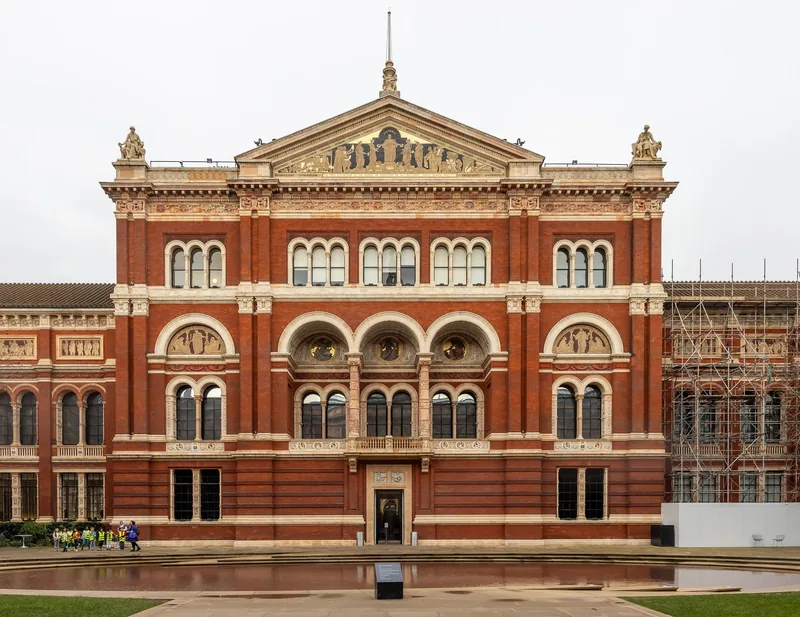
Photograph by Mike Peel (www.mikepeel.net) · CC BY-SA 4.0 · Wikimedia Commons · resized
Free, until it is not
Neither museum charges for its permanent collection, so the choice only costs money if a temporary exhibition pulls you in, and at the moment both have one that will.
The Bayeux Tapestry is at the British Museum in Room 30 until 11 July 2027, at £33 for an adult standard ticket or £27 off-peak. For two adults that is £66 for a single room, on top of a museum that is otherwise free. We would pay it only if the tapestry is a reason for the trip in its own right. The museum's Korea exhibition runs from 1 October 2026 to 31 January 2027 and is priced separately.
At the V&A, Schiaparelli: Fashion Becomes Art is priced at £28 midweek, rising to £30 on Saturdays and Sundays, and closes on 8 November 2026. Rising Voices runs to 10 January 2027 at £17. A small free display on the Burberry trench, opened on 21 September 2026, matters more than it sounds, because the permanent dress rooms are shut.
An exhibition ticket at the British Museum doubles as a queue pass. Buying one gives you entry to the permanent collection as well, so if you were going to pay for the Bayeux Tapestry anyway, you do not also need a free general admission slot.
Arriving: the suitcase rule that decides some visits
If you are visiting on a travel day, this is not a small detail.
| At the door | British Museum | V&A |
|---|---|---|
| Wheeled suitcases | Refused, at any size | Not allowed in the galleries, but the cloakroom takes a cabin bag |
| Maximum bag | 40 x 40 x 50 cm, and no heavier than 8 kg | Roughly cabin size, 56 by 45 by 21 cm, in the galleries |
| Cloakroom | £4 for a bag to 4 kg, £6 from 4 to 8 kg, £3 a coat, £2 an umbrella; last deposit one hour before closing | £3 a coat or small bag, £5 a cabin bag, £7 for anything larger |
| Booking | Free timed ticket advised; walk-ups admitted daily | Nothing to book for general admission |
Bags are checked at both front doors, and in Bloomsbury it is that check, not the ticket desk, that creates the wait. The queue moves; British queues generally do, and our note on how queuing works here explains why nobody will thank you for edging forward. If you are between hotels, leave the case at a station instead: our left-luggage guide lists the options near both museums.
With children, and the option nobody mentions
The British Museum works with children if you treat it as three rooms rather than a museum, and it has a Families Desk and a young visitors' centre that open at weekends and during Camden's school holidays only. Outside those times you are on your own with the map.
The V&A is honestly thin for under-tens. Cast Courts aside, a room of Renaissance silver asks more of a six-year-old than a mummy does. The answer is not to force it: the museum runs a separate free site for children, Young V&A, out in Bethnal Green, and the family-friendly member of the group in east London is the Storehouse at Hackney Wick, where you look down on the stored collection from walkways. Our wider family guide to London and our page on what works at fourteen both go further on this.
Friday evening settles it more often than anything else
Both museums open late on Fridays, but not equally late. The British Museum runs to 8.30pm, with galleries cleared ten minutes before they close and the Great Court cafés serving until 8pm. The V&A runs to 10pm, which is the latest regular opening of any major London collection, although a number of its galleries shut after 5.45pm.
For an evening that starts after dinner, the V&A is the only one of the two that still works at half past eight. For an evening that starts straight from work at six, either is fine, and the British Museum's free twenty-minute spotlight talks make it the more sociable of the two. Our comparison of London's weekly museum late openings sets the pair against Trafalgar Square and Bankside.
What is shut, and how each museum handles it
This is where the two institutions differ most and where visitors are most often caught out.
The V&A has taken whole subjects off display for years at a time. The Fashion Gallery in Room 40 is closed until autumn 2028, the South Asia gallery until spring 2028 and the Korea gallery until December 2026. If any of those is your reason for going, the museum cannot help you and no amount of timing will fix it.
The British Museum does the opposite: it closes a rotating handful of rooms for a fortnight at a time, all year. Room 4, with the Rosetta Stone, is shut from 11 to 22 January 2027. The Islamic world and European rooms close from 12 to 23 October 2026, the Greek and Roman rooms from 2 to 13 November, and China and South Asia from 30 November to 11 December. Seven rooms, numbered 7, 9, 10, 19, 20, 57 and 58, are staffed for four hours only, from 11am until 3pm.
Two Mondays and Wednesdays in late September 2026 end early in Bloomsbury. The British Museum closes at 4pm on Monday 28 and Wednesday 30 September because of private events, and on the 28th, Bayeux Tapestry ticket holders must use the Montague Place entrance from 3.20pm. Check the museum's planned closures page the day before you go.
Doing both on the same day
You can, and we would not. Four and a half kilometres separate them, and you would be covering it underground, not on foot. From Holborn, the Piccadilly line runs to South Kensington without a change, which is the reason people attempt it at all; our Underground guide has the rest of the network.
Two enormous museums in one day produces the same fatigue as two enormous meals. If you want a pair that genuinely works, put the British Museum with something small and nearby, such as Sir John Soane's house or a walk through Bloomsbury, and give the V&A a separate morning with the rest of its own quarter.
Lunch, and the one café that is itself an exhibit
The V&A wins this without argument. Its main eating room is the set of original refreshment rooms from the 1860s, so ornate that most people photograph them before ordering, and a packed lunch is allowed in the courtyard garden outside. The British Museum's Great Court cafés are functional and busy, and there is nowhere on site to sit with your own sandwiches.
Our round-up of museum and gallery cafés worth a detour covers both, including the one at the National Gallery on Trafalgar Square. For a very different London building that opens only a few weeks a year and charges nothing, see Two Temple Place. And if the museum argument you are actually having is about South Kensington, we have settled the other one on that street separately. Both of these giants appear in our list of London museums that cost nothing.
Frequently asked questions
Is the British Museum or the V&A better for a first-time visitor?
The British Museum. Its famous objects are the ones most visitors have already read about, and the building's layout makes a short visit feel complete. The V&A is larger, harder to navigate on a first attempt, and better appreciated once you have stopped trying to see all of it.
Are the British Museum and the V&A both free?
Yes, for their permanent collections. You pay only for temporary exhibitions, such as the Bayeux Tapestry in Bloomsbury or Schiaparelli in South Kensington, and for the cloakroom. Donation boxes are visible at both, but nobody will ask you for money at the door.
Can you see the British Museum and the V&A in one day?
Physically yes, sensibly no. They are about four and a half kilometres apart and each deserves at least two hours. If you must, take the Piccadilly line between Holborn and South Kensington and accept that you will see a quarter of each. A better plan is one museum plus something small near it.
Which has more for children, the British Museum or the V&A?
The British Museum, mainly because of the Egyptian mummies and the Sutton Hoo finds. Its Families Desk and young visitors' centre open at weekends and during Camden school holidays only. For younger children the V&A's own answer is Young V&A in Bethnal Green, a separate free museum designed for them.
Which stays open latest on a Friday?
The V&A, until 10pm, although some of its galleries close after 5.45pm. The British Museum runs to 8.30pm on Fridays and begins clearing galleries ten minutes before closing. Both are free, and both are much quieter after about 6pm than at midday.
Sources
- The British Museum – Visit, opening hours and planned gallery closures (checked September 2026)
- V&A – Plan your visit to V&A South Kensington (checked September 2026)
- V&A – What's On: exhibitions and displays (checked September 2026)
- V&A – Visit V&A East Storehouse (checked September 2026)