
Three hours is the right answer for a first visit, and it is the museum's own answer too: its published highlights trail is timed at about three hours. One hour gets you four or five famous objects. A full day gets you tired.
The British Museum holds eight million objects and shows them across more than fifty galleries on three floors. Nobody sees it all, and the people who try tend to leave remembering nothing in particular. The useful question is not how much you can cover but what each length of visit actually buys.
Our main guide to the British Museum covers the entrances, the free ticket, the bag rules and where the famous objects are. This page is only about the clock: the hours the doors are open, the hours some rooms are not, and how much of your day the building will take if you let it.
The clock at Great Russell Street
- Open
- Daily 10:00–17:00, last entry 16:45
- Friday
- Until 20:30, last entry 20:15, last booked slot 19:00
- Rooms with short hours
- Seven rooms open only between 11:00 and 15:00 (see below)
- Museum's own trails
- One hour, and about three hours
- Sensible first visit
- Three hours, including a twenty-minute break
- Visitors in 2025
- 6,440,120, the second-busiest attraction in Britain
The four-hour museum inside the seven-hour museum
The doors open at 10:00 and close at 17:00, which looks like seven hours. In practice the usable window is shorter at both ends, and a group of important rooms is only open for four hours in the middle.
Seven rooms keep shorter hours than the building: 7, 9, 10, 19 and 20 on the ground floor, and 57 and 58 upstairs. Each opens at 11:00 and shuts again at 15:00. That is the Assyrian sequence, including the lion hunt reliefs in Room 10, two of the Greek rooms, and part of the Ancient Levant display upstairs. Arrive at 10:00 for a ninety-minute visit and you will walk past locked doors without knowing what is behind them. Arrive at 15:30 and the same is true.
So if your visit is short, the single most useful decision is to start it between 11:00 and 13:00. Everything is open then, the free tickets are in full flow, and you still have the afternoon in front of you.
The Assyrian reliefs are shut for half the opening day. Seven rooms run on a four-hour clock in the middle of the day. A visit planned entirely before 11:00, or entirely after 15:00, misses every one of them.
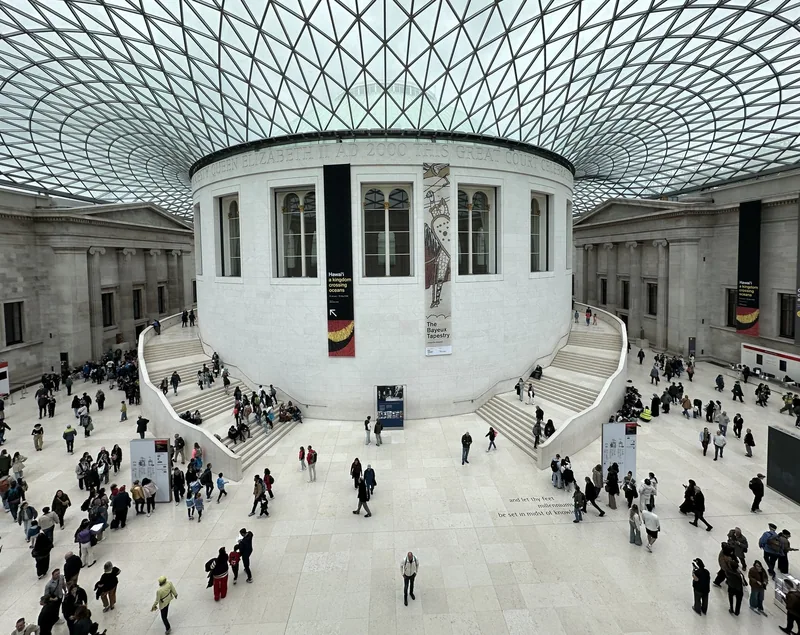
Photo: APK · CC BY 4.0 · Wikimedia Commons · resized
One hour: four objects and the Great Court
An hour is enough if you treat it as a deliberate raid rather than a tour. The museum publishes a trail called One hour at the Museum, which it describes as a whirlwind tour of the history of the world, and following it is far better than wandering.
On your own, the realistic list is Room 4, which holds both the Rosetta Stone and the colossal bust of Ramesses II; Room 18, for the Parthenon marbles; and Room 41 upstairs, for the Sutton Hoo helmet. That is roughly forty minutes of walking and looking, plus the ten minutes you will lose to the bag check at the door and the ten you will lose to the shop on the way out.
Two warnings for the one-hour visit. Room 41 is on the upper floor, and the stairs from the Great Court are the slow part; take the lift if the queue for it is short. And a single object can absorb the whole hour if the crowd around the Rosetta Stone is three deep, which it usually is between 11:00 and 15:00.
Three hours: the museum's own route, and where it slows down
The Three hours at the Museum trail runs from the Sloane Astrolabe in Room 1 through the Holy Thorn Reliquary, the lion hunt reliefs, the Parthenon marbles, the Rosetta Stone, the Ramesses bust and the Ife Head, and on into the upper floors. It is the museum's own selection of its most popular objects, and it works because it moves in a line rather than doubling back.
Three hours is also about the point at which most adults stop taking anything in. Museum fatigue is real, it arrives sooner in crowded rooms, and the Egyptian sculpture gallery on a wet Saturday is as crowded as any room in London. Plan a sit-down at the ninety-minute mark rather than pushing through.
Where the three hours slip is predictable: the mummies in Rooms 62 and 63, where the route narrows and stops; Room 4, where everyone photographs the same stone; and the Great Court itself, which is pleasant enough that people linger in it twice.
A full day, and why it usually ends at lunchtime
People do spend whole days here, and a few of them enjoy it. If you want to, the way to make it work is to leave in the middle. Go out at 13:00, eat somewhere that is not the museum, and come back at 14:30 to a building that feels new again; our guide to eating near the British Museum covers the streets where lunch costs less than it does inside, and our round-up of museum and gallery cafés explains which London museums are worth staying in for.
Re-entry is not a problem: the ticket is free and walk-up entry is available every day. What is a problem is trying to do six hours in one stretch with children, or after a long flight, or on the first day of a short trip. A three-hour visit followed by an hour in the streets of Bloomsbury is a better use of the same six hours.
Where a whole day is set aside for museums rather than for this one, spend the second half elsewhere. Sir John Soane's Museum is free, fifteen minutes' walk away and takes under an hour, and the National Gallery is twenty minutes on foot. Our page weighing this museum against the V&A covers the other obvious pairing, which does not work in a day.
Friday evening: the three hours almost nobody uses
On Friday the museum carries on after 17:00 and shuts its doors at 20:30. The final bookable slot is 19:00, and nobody is admitted after 20:15. Galleries run on until 20:20, the shops close a few minutes earlier, and the Court cafés stop serving at 20:00. None of it costs anything.
This is the best three-hour block in the week. The school groups have gone, the coach tours have gone, and the rooms that fill up by noon are empty again. Free spotlight tours of twenty minutes run during the evening, covering four parts of the collection, one of them the Parthenon marbles.
The catch is that the limited-hours rooms are already shut by 15:00 and do not reopen, and the Friday gallery list is shorter than the daytime one. If your priority is the Assyrian rooms, Friday evening is the wrong visit. If your priority is Egypt, Greece, Sutton Hoo or the Islamic world, it is the right one. Our guide to evening openings at London's museums sets Friday here against the other late nights in the city.
Adding the Bayeux Tapestry to your timing
Room 30 holds the Bayeux Tapestry until 11 July 2027, and unlike the permanent galleries it is ticketed: £33 for an adult at standard times and £27 off-peak (September 2026). Prices and availability change, so check the museum's exhibition page before booking.
Treat it as a separate visit bolted onto the free one. Entry is by timed slot, the display is long and narrow, and the crowd moves at the pace of the slowest person in it. Allow an hour for the tapestry itself and do not schedule anything tight afterwards. A three-hour general visit plus the tapestry is a five-hour day once you add the break, which is more museum than most people want.
What is shut this autumn, and the two days it closes early
The museum closes individual rooms for maintenance throughout the year and publishes the dates in advance. In late September and October 2026 the affected rooms include Room 3 on 30 September, and Rooms 53, 54 and 55 from 28 September to 9 October. The Reading Room is closed on 25 September, 29 and 30 September and 20 November 2026. Further ahead, Room 4 — the Rosetta Stone room — closes from 11 to 22 January 2027.
There are also two early closures. On Monday 28 and Wednesday 30 September 2026 the museum closes at 16:00 for private events, and on the 28th Bayeux Tapestry ticket holders are sent to the Montague Place entrance from 15:20. An afternoon visit on either day is an hour shorter than you think.
Two Mondays and Wednesdays in September close at 16:00, not 17:00. Check the museum's planned closures page for the date you are going; rooms are also shut at short notice, and the museum says it cannot always warn visitors in advance.
How long children last
Less time than you hope, and the museum knows it: its family trail is called Twelve objects to see with children, not fifty. Ninety minutes is a realistic target for primary-school children, two hours if you build the visit around mummies and armour and accept that everything else is scenery.
Teenagers are different and often last longer, particularly in the Egyptian and Greek rooms; our page on London museums that work for teenagers explains which rooms hold attention at fourteen. For younger children, our family guide to London has the wider list of what to pair a short museum visit with.
One practical point on timing with children: the galleries are warm, the Great Court is not, and stepping out into it for ten minutes resets almost everybody.
Fitting it into a short trip
On a three-day trip, give the British Museum one morning and nothing else that morning. Our three-day itinerary puts it in that slot for exactly this reason. Two of London's big free museums in one day is possible; three is a long queue followed by a headache.
If you are choosing between the large free museums on a wet day, the timing differs more than people expect. Our pages on how long the Natural History Museum takes and on Tate Modern against Tate Britain answer the same question for those buildings, and our guide to how long the Tower of London takes does it for the big paid attraction. Our list of free museums in London and our page on what to do in London when it rains cover the rest.
Frequently asked questions
How many hours should you spend at the British Museum?
Three hours for a first visit, including a break. That matches the museum's own highlights trail, which is timed at about three hours. In a single hour you can reach Room 4, Room 18 and the Sutton Hoo helmet in Room 41, provided you walk past everything else.
What is the best time of day to visit the British Museum?
Aim to walk in at about 11:30 on a weekday, or come for the Friday evening session after 17:00. Several rooms have not opened before 11:00, and Friday nights are the calmest stretch of the week, with the galleries running until 20:20.
Can you see the British Museum in an hour?
You can see four or five of its famous objects in an hour, which is a real visit if you plan the route. The museum publishes a one-hour trail for exactly this. Add ten minutes at the door for the security check before the hour starts.
Which British Museum rooms are only open part of the day?
Seven of them: 7, 9, 10, 19 and 20 downstairs, plus 57 and 58 on the upper floor. All seven open at 11:00 and close again at 15:00, and between them they hold the Assyrian reliefs and part of the Greek and Ancient Levant displays.
Is the British Museum worth a whole day?
Only if you break it in the middle. Entry is free and you can leave and come back, so three hours in the morning, lunch outside the building and a shorter second visit works far better than six continuous hours in the galleries.
Sources
- British Museum – Plan your visit: opening times, tickets and planned gallery closures (checked September 2026)
- British Museum – Late opening on Fridays (checked September 2026)
- British Museum – Object trails, including the one-hour and three-hour trails (checked September 2026)
- British Museum – Three hours at the Museum trail (checked September 2026)
- British Museum – About us (collection size) (checked September 2026)
- Association of Leading Visitor Attractions – 2025 visitor figures (checked September 2026)