
Pick the Natural History Museum. It is free from the front door to the exit, the building is the better half of the visit, and for children under about ten nothing in the Science Museum beats the dinosaur gallery. Choose the Science Museum instead if your group is older, if you are happy to pay for Wonderlab or Power Up, or if you want a two-hour visit rather than a three-hour one.
The two museums are back to back on the same block, five minutes from the same Tube station, and both cost nothing to walk into. That is exactly why people get stuck choosing. We cover each one gallery by gallery elsewhere: what is in the museum on Cromwell Road, and what is in its neighbour on Exhibition Road. This page is only about deciding between them.
The honest difference is not the subject matter. It is money, stamina and the age of whoever you are bringing. One of these museums can be done for free in three hours and leaves children talking about a whale. The other is free to enter but sells the two galleries children will ask for, and works better in two concentrated hours than in a long morning.
The two side by side, September 2026
- Natural History Museum
- Free. Open daily 10am to 5.50pm, last entry 5.30pm. Shut for one day on 9 October 2026. Cromwell Road, SW7 5BD.
- Science Museum
- Free, though the museum wants you to reserve a slot. Open daily 10am to 6pm, last entry 5.15pm. Shut for one day on 11 November 2026, and closing early at 5pm on 26 November. Exhibition Road, SW7 2DD.
- Cost of the extras
- Natural History Museum: nothing except ticketed exhibitions. Science Museum: Wonderlab day pass from £13.50, Power Up from £10.00, IMAX films priced separately.
- Realistic visit
- Natural History Museum about three hours. Science Museum about two, or half a day with a paid gallery booked.
- Nearest station
- South Kensington for both, about five minutes on foot. The station is not step-free.
What each building is really for
The Natural History Museum is about the living world and the planet under it: fossils, animals, rocks, minerals, meteorites. The Science Museum is about what people have built: engines, aircraft, spacecraft, computers, medicine. Neither description helps much, because a seven-year-old does not choose a museum by subject.
What does decide it is the shape of the visit. In Cromwell Road you walk into a single enormous Victorian hall with a whale skeleton over your head, and the museum announces itself in the first ten seconds. The Science Museum opens into a much plainer entrance hall and asks you to go looking. That difference matters more than any object list when you have a tired child and ninety minutes.
It also cuts the other way. The Science Museum's galleries are quieter, flatter and easier to walk around with a pushchair, and the things in them do not have a queue snaking past them. If the point of your morning is a calm couple of hours indoors rather than a spectacle, Exhibition Road wins.
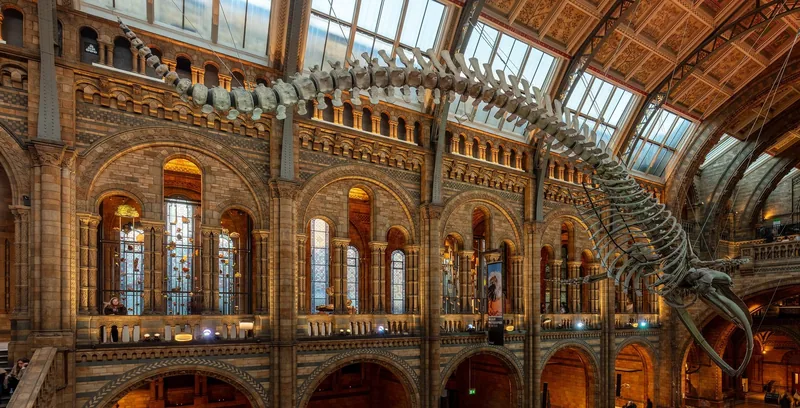
Photo: Diego Delso · CC BY-SA 4.0 · Wikimedia Commons · resized
The money, once the children have seen what is behind the glass door
This is the part that catches families out. Both museums are free, but only one of them stays free.
The Science Museum's two most popular galleries are ticketed. Wonderlab, the hands-on gallery on level 3, sells a day pass starting at £13.50; everyone over three pays the same, and under-threes go in free. Power Up, the games gallery on level -1, is a day pass from £10.00. Both museums list a family discount that is easy to miss: for a group of three to five visitors with no more than two adults, the museum takes £3 off each Wonderlab pass and £2 off each Power Up pass. Two adults and two children therefore pay from about £42 for Wonderlab and from about £32 for Power Up, before the IMAX. Annual passes are £29 for Wonderlab and £26 for Power Up, which pays for itself on a second visit and is worth a thought if you are in London for a week.
The Natural History Museum charges for its temporary exhibitions and nothing else. The dinosaurs, the earthquake simulator, the minerals and the whale are all included. You can spend a whole day there and pay only for lunch.
The family discount on Wonderlab is not applied automatically at every step. The Science Museum lists it as a price reduction for groups of three to five with a maximum of two adults, so select the family option when you book rather than adding four separate day passes. Prices also fall for the earliest and latest slots if you book at least a day ahead.
Tickets and what happens at the door
The two museums handle arrivals differently, and getting this wrong costs you the first half hour.
| Natural History Museum | Science Museum | |
|---|---|---|
| Do you need to book? | No, but a free entry ticket lets you skip the queue | Yes in practice: the museum wants a slot reserved |
| Turning up without one | Allowed, and this is where the outdoor queue forms | Allowed every day, with a longer wait when numbers are high |
| If you hold a paid ticket | An exhibition ticket takes you past the entry queue too | A Wonderlab or IMAX ticket does not replace the free one |
| Bags | Searched on arrival; cloakrooms available | Searched; card-only lockers on level -1 at £3, £5 and £7 |
The practical conclusion is the same at both: book. It costs nothing at either museum, and at the Natural History Museum it is the single difference between walking in and standing on Cromwell Road behind a school group. The museum says plainly that ticket holders and members go past the queue.
How long you will actually stay
The Science Museum's own figure for an average visit is around two hours, and with an older group that is about right. Add a Wonderlab slot and you are into a half day, because you need roughly fifteen minutes just to walk from the entrance up to level 3.
The Natural History Museum takes longer whether you plan it or not. Three hours is a fair estimate for the dinosaurs, the main hall, the mammals and the volcano gallery, and much of that time goes on moving between wings rather than looking at anything. With children under five, cut it to two hours and finish in the gardens.
That difference is the real argument for choosing one. A three-hour museum and a two-hour museum in the same day is a five-hour day of walking on hard floors, plus lunch.
Which child suits which museum
Rough ages, based on what holds attention rather than what a museum says it is for.
Go to the Natural History Museum if
- Your children are between about four and ten
- Dinosaurs are the reason for the trip at all
- You want a day that costs nothing beyond food
- Someone in the group cares about Victorian architecture
- You have a pushchair and want gardens to escape into
Go to the Science Museum if
- Your children are ten or older
- You have a mixed-age group including adults
- You would rather pay £13.50 than queue
- You want to be out again in two hours
- Aircraft, space or computers are the pull
For anyone travelling with teenagers, our page on museums that hold up at fourteen goes further and reaches a firmer conclusion than we would for younger children. Families planning a whole trip should also read our family guide to London, and check which children pay nothing on London transport before buying anything.
Doing both in one day
It is possible, because the back of one building is a two-minute walk from the front of the other. We would still advise against it for most groups, and we would certainly not add the V&A across the road as a third.
If you are determined, the version that works is a half of each rather than two full visits. Be on Cromwell Road for 10am, go straight to the dinosaurs before that gallery fills, add the great hall and the mammals, and leave by half past twelve. Eat, then take the Science Museum from 1.30pm with one pre-booked paid gallery and nothing else. You will have seen four things properly instead of twelve badly.
Check the one-off closure dates before you fix a South Kensington day. The Natural History Museum is shut all day on Friday 9 October 2026, and the Science Museum on Wednesday 11 November 2026, closing early at 5pm on Thursday 26 November. Both also close from 24 to 26 December.
Rain, half term and the days to avoid
Wet weekends fill both buildings, and in each case the queue waits outdoors. If the forecast is poor and you have not booked, the Science Museum is the safer bet simply because its paid galleries hold children for a fixed slot, which the free ones cannot. Our wider list of wet-weather options across the city has the alternatives, and indoor days for children covers the options beyond South Kensington.
Saturday and Sunday afternoons are the worst at both, as is every weekday of the English school holidays. Term-time mornings before noon are far calmer. Our calendar of London during the school holidays lists the dates that matter.
One weather point applies to Cromwell Road alone. The museum's own access pages admit that its Victorian halls are not air-conditioned, so on a hot afternoon it is the more tiring of the two.
Lunch, luggage and getting there
Neither museum has a café worth planning a day around, though both are adequate; our round-up of the better museum cafés in London explains which ones are the exception. You can carry a packed lunch into the Natural History Museum's gardens in decent weather, which is the cheapest option on Exhibition Road.
South Kensington station has no lifts to the platforms. Wheelchair users, and anyone pushing a buggy, should plan the journey with our step-free transport guide first. A pedestrian subway runs from inside the station towards both museums, which is genuinely useful in rain. Ten minutes north, Hyde Park and Kensington Gardens give children somewhere to run afterwards, and our guide to the area covers the streets, the bakeries and the rest of Albertopolis.
If the answer to this comparison is "neither, today", both appear in our survey of museums that charge nothing alongside forty others. Two very different small museums worth a detour are the Brunel Museum in Rotherhithe and, for a harder choice between two giants, the British Museum and the V&A.
Frequently asked questions
Can you visit the Natural History Museum and the Science Museum on the same day?
Yes. They stand back to back and the walk between the entrances takes two or three minutes. The problem is stamina rather than distance: one takes about three hours and the other about two, so a full visit to both is a long day. Half of each, with lunch between, is the version that works.
Which is better for a five-year-old, the Natural History Museum or the Science Museum?
The Natural History Museum, comfortably. The dinosaur gallery, the blue whale skeleton in the main hall and the gardens outside all work at that age, and none of them costs anything. The Science Museum's best galleries for young children, Wonderlab and the play areas, are aimed slightly older and Wonderlab is a paid ticket.
Is a booking compulsory at the Science Museum?
No, although the museum would prefer one. Everyone is invited to reserve a free slot online, and its own FAQ confirms that people who simply turn up are let in daily, with a longer wait when numbers are high. The reservation costs nothing, so there is little reason to skip it.
How much does a family of four pay at the Science Museum?
Nothing to enter. Wonderlab is a day pass from £13.50 each with £3 off per pass for a group of three to five including no more than two adults, so two adults and two children start from around £42. Power Up starts from £10.00 each with £2 off per pass. Prices change by date and time, so check the museum's own pages before booking.
Is the Natural History Museum completely free?
The galleries are, including the dinosaurs, Hintze Hall and the earthquake simulator. You pay only for temporary exhibitions, special events such as the overnight sleepovers, food and the shop. A free entry ticket is optional but lets you walk past the queue at busy times.
Sources
- Natural History Museum – Tickets and visitor information (checked September 2026)
- Natural History Museum – Getting here (checked September 2026)
- Science Museum – Visit (checked September 2026)
- Science Museum – Wonderlab tickets and prices (checked September 2026)
- Science Museum – Power Up tickets and prices (checked September 2026)