
If you only do one, do the Golden Hinde. It costs £6 for everybody over three, it takes about forty-five minutes, and it is a full-size ship. The Clink Prison Museum, a minute's walk away, costs £10 for an adult and £8 for a child, and it is a small dark cellar with instruments of torture in it. Both are open daily.
They sit on the same short stretch of Bankside behind Southwark Cathedral: the Clink Prison Museum on Clink Street, SE1 9DG, and the Golden Hinde in St Mary Overie Dock off Cathedral Street, SE1 9DE. London Bridge station serves both, and the walk between them is under two minutes. Our guide to Southwark and Bankside covers the whole street, including the free ruin of Winchester Palace next door.
Between them they will absorb about two hours and £49 for a family of four. That is the honest frame, and the rest of this page is about whether either is worth it.
| September 2026 | Golden Hinde | Clink Prison Museum |
|---|---|---|
| Adult | £6 | £10 |
| Child | £6 (3–16); under 3 free | £8 (under 16) |
| Family | £20 (family of 4) | £29 (2 adults, 2 children) |
| Concession | £6 | £8 (student, OAP, disabled, ID required) |
| Hours | Daily 10:00–18:00 (April to October); 10:00–17:00 (November to March) | Daily 10:00–18:00, all year; closed Christmas Day |
| Last admission | 30 minutes before closing | 30 minutes before closing |
| How long | 40 to 60 minutes | 30 to 45 minutes |
| Step-free | No | No |
The Golden Hinde: what £6 buys
A full-scale reconstruction of the Elizabethan galleon in which Francis Drake completed the first English circumnavigation between 1577 and 1580. It has sat in St Mary Overie Dock since 1996, and 2026 is its thirtieth year there. Admission includes an audio guide in English and Spanish, and you are free to explore the ship on your own all year with crew on hand; there is no need to book, though a crew-led guided journey through the ship can be arranged instead.
The ship calls itself a museum of two histories four hundred years apart, and that is the interesting part. The reconstruction made ocean voyages of its own in the 20th century, which almost nobody realises when they look at it from the quay. The other thing nobody realises until they are aboard is how small it is. That is the point: this is the size of vessel in which Drake crossed the Pacific.
Forty-five minutes is right. An hour if you take the audio guide seriously or a crew member starts talking, which they usually do.
Check the ship's closure list, not just its opening hours. The Golden Hinde is hired out for private events and publishes a list of part-day closures, often from mid-afternoon. In October 2026 it listed eleven such afternoons. The headline "open daily 10:00 to 18:00" is true and still not enough to plan on.
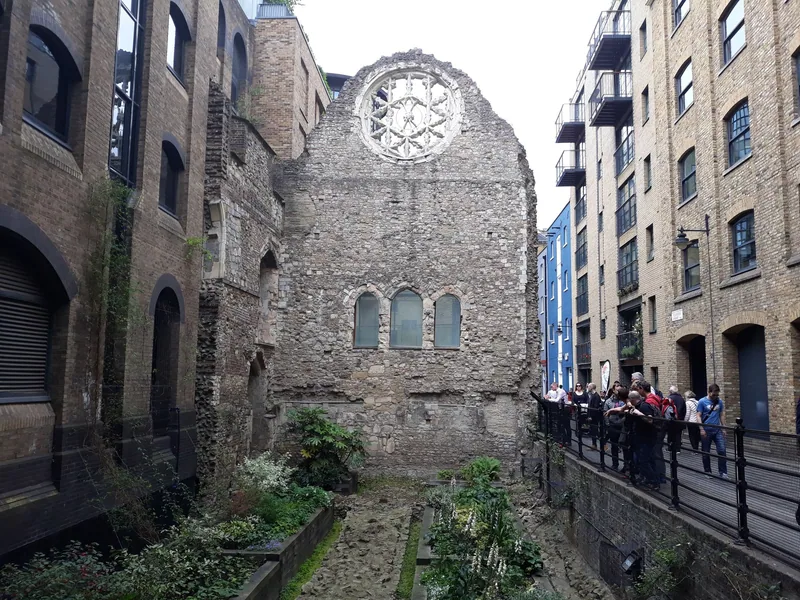
Photo: Simon Burchell · CC BY-SA 4.0 · Wikimedia Commons · resized
Restoration work, and what is currently shut aboard
The ship says it is carrying out essential restoration work, that it is "not looking our best", and that access to areas aboard is affected. It does not say which areas or for how long. If a particular deck or the great cabin is the reason you are going, ask before you buy.
That is not a reason to skip it at £6. It is a reason to keep expectations modest and not to promise a child the full run of the ship.
Five steps up, four levels, and no toilet
The access situation is stated plainly by the operator and is worth reading before you commit. Getting aboard means five steps from street level and there is no step-free access. On board there are four levels connected by steep stairs or vertical ladders, with narrow passages, low ceilings and uneven wooden floors. And there are no public toilets or changing facilities for general visitors at all.
That last point decides it for some families. Use the facilities in Borough Market or at London Bridge station first. Anyone with limited mobility, a pushchair or a fear of ladders should treat this as a look from the quayside, which is free. Our guide to accessible London covers the alternatives on this stretch of river.
The Clink Prison Museum: a cellar for £10
The museum occupies a cellar on the site of the bishop of Winchester's prison. It is a hands-on, deliberately theatrical presentation: archaeological artefacts in cases, recorded sound, a smell, and torture devices you are invited to handle. The museum's own summary promises the sights, sounds and smells of the prison and the tales of its inmates, and that is a fair description of what is delivered.
Two things to be clear about. It is small; thirty to forty-five minutes covers it. And it is not wheelchair accessible, which the museum states on every page of its own site.
Who it suits: a child roughly between eight and twelve who enjoys the gruesome, on a wet afternoon, for half an hour. Who it does not: anyone expecting a museum of the calibre of the free national collections, and anyone who has already booked the London Dungeon, which does the same thing at far greater length and expense.
The history underneath it, which is better than the display
This is the part worth knowing before you go in, because it is what makes the site interesting rather than the props. Winchester Palace, the Thames-side residence of the bishop of Winchester, was completed in 1144 for Henry of Blois, brother of King Stephen and grandson of William the Conqueror. It contained two prisons in its grounds, one for men and one for women, and the whole district fell under the bishop's jurisdiction, later called the Liberty of the Clink.
The prison operated from 1144 until 1780. The name attached to it in the 14th century; the museum offers two derivations, the sound of a blacksmith's hammer closing irons around a prisoner's wrists, and the Flemish word klink, meaning a latch. Either way it is the reason English-speakers say "in the clink" about any prison at all.
It was destroyed and rebuilt twice in rebellions, in the Peasants' Revolt of 1381 and Jack Cade's rebellion of 1450; the rebuilding after 1450 produced the two-storey men's prison whose site the museum occupies. It ended in the Gordon Riots of 1780. Prisoners over the centuries included Sir Thomas Wyatt the Younger, who rebelled against Mary I, and John Rogers, who translated the Bible into English in her reign.
Why American visitors come here
In 1586 a group of Separatists, Protestants who wanted to worship outside the Church of England, were sent to the Clink for refusing to obey Elizabeth I's religious laws. Their leaders, the clergyman John Greenwood and the lawyer Henry Barrowe, founded a church inside the prison: the first Separatist English church began in this building. Given a temporary reprieve in 1592 they met in a house on Deadman's Place in the Borough and founded the Southwark Independent Church. Both were executed at Northampton on 6 April 1593, and another Southwark Separatist, William Penry, was hanged beside the Old Kent Road on 29 May that year.
Later Puritans held here went on to sail as Pilgrim Fathers. That is the thread the museum pulls on for its American visitors, and it is a genuine one. If it is the reason you are in Southwark, the surviving rose window of Winchester Palace's great hall stands in the open air a few steps away, free, and is arguably the better object.
Ghost hunts, which are not run by the museum
Overnight ghost-hunting sessions take place at the Clink, with vigils, séances and Ouija boards, but they are run by an outside company rather than by the museum and are booked separately. They are not part of the £10 daytime ticket and they are not suitable for children. Our guide to ghost tours in London sets out what these evenings involve and what they generally cost.
A family of four, and the better £49
Both together cost £49 for two adults and two children, and take roughly two hours including the walk. For the same money and the same two hours on the same street you could instead see Southwark Cathedral and the Winchester Palace ruin for nothing, the Old Operating Theatre Museum for a modest ticket, and put the rest into lunch.
Our recommendation for a family with limited time: the Golden Hinde at £20, and skip the Clink. For a family with a child who has asked specifically for the dungeon-and-torture experience and is too young for the real Dungeon, the Clink at £29 is the cheaper and shorter substitute. Doing both back to back is the one combination we would not suggest, because the second one always disappoints after the first.
Getting there, and what else is within five minutes
London Bridge is the nearest Underground and mainline station for both, and our station guide explains which exit to use; Borough and Monument are also walkable. By river, the Uber Boat river bus stops at London Bridge City Pier, about six minutes from the ship, and Bankside Pier, about eight. There is no useful parking.
Within five minutes on foot: the market, Shakespeare's Globe, the Millennium Bridge, and HMS Belfast, which is a real warship and a fair comparison to make before you pay for a replica galleon. Our pages on Borough and Bermondsey and the South Bank cover the walk in both directions, and London with kids puts these two in the context of everything else on offer.
Frequently asked questions
How much does the Clink Prison Museum cost?
£10.00 for an adult, £8.00 for a child under 16, £8.00 concession for students, older visitors and disabled visitors with ID, and £29.00 for a family of two adults and two children. It is open daily from 10:00 to 18:00 all year except Christmas Day, with last admission half an hour before closing.
How much does the Golden Hinde cost?
£6 for adults and £6 for children aged 3 to 16, with under-3s free and a family of four for £20. An audio guide in English and Spanish is included. Tickets can be booked online, where a booking fee applies, or bought at the gangway.
Is the Golden Hinde wheelchair accessible?
No. There are five steps up from street level and no step-free access, and once aboard there are four levels linked by steep stairs and vertical ladders, with low ceilings and uneven floors. There are also no public toilets for general visitors. The ship can be seen and photographed from the dock for nothing.
Is the Clink Prison Museum worth it?
For half an hour with a child who enjoys the gruesome, yes. As a piece of history it is thin compared with the free rose window of Winchester Palace a few steps away, and at £10 an adult it is expensive for its size. It is not wheelchair accessible and it is not a substitute for a museum.
Can I do both the Clink and the Golden Hinde in one visit?
Yes, they are under two minutes apart and about two hours all in, at £49 for a family of four. We would not recommend it: the two overlap in tone and the second always feels like the lesser one. Pick the ship, and spend the saving on the rest of Bankside.
Sources
- Clink Prison Museum - Plan your visit: prices, hours and directions (checked September 2026)
- Clink Prison Museum - The history of the Clink Prison (checked September 2026)
- Clink Prison Museum - The Southwark Separatists and the Mayflower (checked September 2026)
- The Golden Hinde - Plan your visit: prices, hours, closures and accessibility (checked September 2026)
- The Golden Hinde - Opening times and general admission (checked September 2026)