
Choose Tate Modern. For a first visit to London it is the better half-day, because the building, the river and the free view give you something even if the art leaves you cold. Go to Tate Britain instead if you want Turner, older painting, or quiet.
The two galleries share a name, a director and a collection, and almost nothing else. Tate Modern shows international art from roughly 1900 onwards, inside a disused power station facing the river at Bankside. Tate Britain covers British art from the Tudors to the present, in a Victorian gallery at Millbank in Pimlico. Both are free, neither needs booking, and a boat runs between them.
Our separate guides cover what is inside each one: Tate Modern room by room and Tate Britain and the Turner wing. This page is only about the choice, and about the four or five things that should actually decide it.
The two galleries side by side
- Tate Modern
- Free. Sunday to Thursday 10:00–18:00, Friday and Saturday 10:00–21:00. Bankside SE1
- Tate Britain
- Free. Daily 10:00–18:00. Millbank SW1, enter on Atterbury Street
- Visitors in 2025
- Tate Modern 4,514,266; Tate Britain 1,149,325
- Free guided tours
- Three a day at Tate Modern from noon; four at Tate Britain, the last at 15:00
- Time needed
- Tate Modern about two hours; Tate Britain about 90 minutes
- Travel from Leicester Square
- Roughly the same: about 20 minutes door to door to either
The verdict, and the four people it is wrong for
Tate Modern wins the common case by a wide margin, and not mainly because of the art. It is the only one of the two where the building is itself the reason to come, it sits on a stretch of riverside you would walk along anyway, and its top-floor viewing level costs nothing. If someone in your group is indifferent to modern art, they still get a view of St Paul's.
It is the wrong choice for four kinds of visitor. If you want Turner, go to Tate Britain, which holds more of his work than anywhere else. If you like painting that stops around 1900, go to Tate Britain. If crowds spoil galleries for you, go to Tate Britain. And if you are already spending the day at Westminster, go to Tate Britain, because it is ten minutes' walk along the river from Parliament and Tate Modern is not.
Pick Tate Modern if
- It is your first visit to London
- You want a free view over the Thames
- You are walking the South Bank anyway
- You want a gallery open until 21:00 on a Friday or Saturday
- You have teenagers who would rather see installations than portraits
Pick Tate Britain if
- Turner, the Pre-Raphaelites or Victorian painting are the draw
- You want to look at art without queueing to stand in front of it
- Your day is built around Westminster or Pimlico
- You want the headline works to be free rather than ticketed
- You have 90 minutes rather than three hours
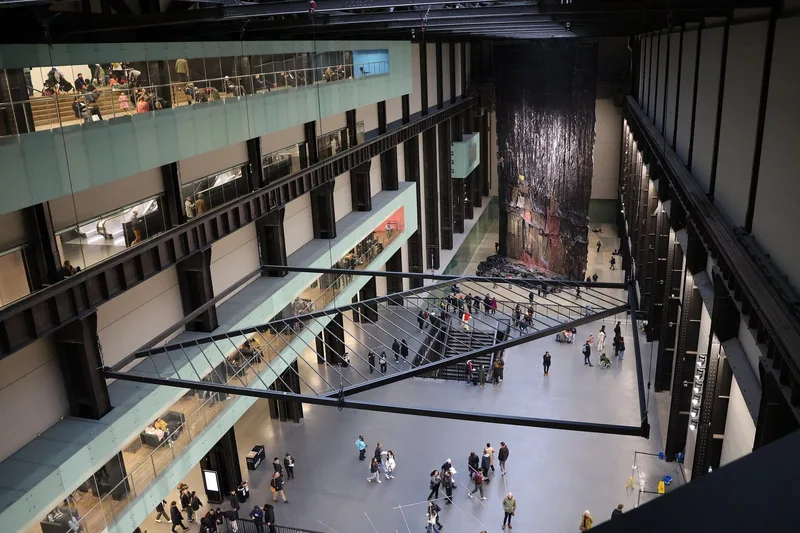
Photo: DiscoA340 · CC BY-SA 4.0 · Wikimedia Commons · resized
Four visitors to one: what the crowd figures mean in practice
In 2025 Tate Modern took 4,514,266 visits and Tate Britain took 1,149,325. That is roughly four to one, in buildings that are not four times different in size. Tate Modern was the fourth most-visited attraction in Britain that year; Tate Britain was thirtieth.
You feel this immediately. At Tate Modern you queue for the lifts, you share the viewing level with a hundred other people, and the popular rooms on Level 2 have a steady flow through them. At Tate Britain you can stand in front of a painting for five minutes on a Tuesday afternoon with nobody behind you.
Neither is better. They are different experiences of looking at pictures, and which you prefer is worth knowing about yourself before you choose.
Getting there: the answer is not what people assume
The common assumption is that Tate Modern is central and Tate Britain is out of the way. The journey times say otherwise. From Leicester Square, TfL's journey planner gives 11 to 13 minutes on the Tube to Pimlico, for Tate Britain, and 12 to 13 minutes to Southwark, for Tate Modern. Both stations are about 600 metres from their gallery. Door to door, the two are within a couple of minutes of each other.
What differs is what surrounds them. Tate Modern stands among things: St Paul's Cathedral across the Millennium Bridge, Shakespeare's Globe next door, Borough Market fifteen minutes east, and the whole South Bank walk to the west. Tate Britain stands almost alone in a residential district; our guide to Pimlico and Victoria covers what little else is nearby, and the nearest major sight is Westminster Abbey, a fifteen-minute walk north.
That is the real difference. One gallery is a stop on a day; the other is the day.
What each costs a family of four
Neither collection charges and neither needs a ticket, so the honest answer is that this decision costs nothing. Two adults and two children walk into either building on any open day without paying anything or booking ahead.
The difference sits in the temporary exhibitions. Tate Modern's headline shows are ticketed; in September 2026 those were Frida: The Making of an Icon, Julio Le Parc and Ana Mendieta, with prices set per exhibition on Tate's own pages. Tate Britain's two headline installations carried no charge at all: the 2026 commission by Zineb Sedira, which fills the Duveens until 17 January 2027, and Chris Ofili's Requiem above the North Stairs.
So if you want the big show, Tate Modern will cost you. If you want the biggest thing in the building to be free, Tate Britain currently delivers that. Check current prices on each exhibition's page before you go, because they change with every show.
The boat between them, and why the ticket desk is the expensive way to buy
The Tate Boat links Millbank Pier, in front of one gallery, with Bankside Pier, next to the other, and runs every 20 to 30 minutes while both are open. It is the RB1 river bus service on weekdays and RB2 at weekends, operated by Uber Boat by Thames Clippers.
There are two prices for the same seat, and the gap is large.
| How you pay | Adult single | Child 5–15 |
|---|---|---|
| Bought from Tate, a pier machine or a ticket office | £14.40 | £7.20 |
| Same, with a TfL Travelcard | £9.60 | £4.80 |
| Contactless or Oyster, central zone | £9.90 off-peak, £11.90 peak | 50% off for 5–15s on a Zip or Young Visitor card |
For two adults and two children aged between 5 and 15, a one-way trip bought at the pier comes to £43.20. That is more than the rest of the day costs, given that both galleries are free. Tapping in with contactless is cheaper for adults, and the daily fare cap ignores river journeys whichever way you pay; our page on the Thames river bus explains how the piers work. Under-fives travel free, and a companion travelling with a disabled passenger goes free.
The Tube is the cheap alternative. Up to four children under 11 ride the Tube at no charge alongside each fare-paying adult, and the Zones 1–2 daily cap stops at £8.90; our page on what children pay to travel here sets out which ages pay what. A new river fare table takes effect once October 2026 ends, so check the published prices before you budget.
Tapping in beats buying a Tate Boat ticket at the pier. The published single from Tate is £14.40 for an adult, against £9.90 or £11.90 on contactless in the central river zone. The boat is the same boat.
How long each one takes
Tate Modern takes about two hours for a first visit: the Turbine Hall, two floors of free displays and the viewing level. Tate Britain takes about 90 minutes, because the collection runs in date order along a single circuit and the Turner wing is a self-contained detour off it.
The free guided tours are the efficient way to use either building. Tate Modern runs three most days, on the hour from noon; Tate Britain runs a fourth at 15:00. Each covers one part of the gallery rather than the whole thing, which is exactly why they work.
If you have half a day and want the shape of a London museum schedule, our pages on how long the British Museum takes and how long the Natural History Museum takes apply the same arithmetic to the two biggest free museums in the city.
Bad weather, evenings and other things that change the answer
In heavy rain, Tate Modern is the better bet, because you can arrive under cover from Blackfriars and because the building itself is worth an hour. On a wet Sunday in the school holidays it also fills up, which is the trade-off. Our guide to a wet day in the city lists the alternatives when both are busy.
On a Friday or Saturday evening the answer is Tate Modern by default, because Tate Britain has already closed at 18:00 and Tate Modern stays open until 21:00. The late hours are the quietest good time to see the collection, and the view from the top is better once the lights come on; see our round-up of free viewpoints in London and our guide to London after dark.
Two access notes. Tate Britain's grand steps facing the river are shut until 2027 while a garden goes in, so everyone now enters from Atterbury Street round the corner, through the Manton doors. And Millbank Pier lost its step-free status temporarily during 2026, which matters if you meant to arrive by water.
Doing both in one day
It is possible and it is a long day. The workable version is Tate Britain at 10:00, when it is at its emptiest, the boat or the Tube at about 11:45, and Tate Modern from 12:30 with the free tour at 13:00. That gives you 90 minutes at one and two and a half hours at the other, with lunch in between.
Doing it the other way round does not work as well, because Tate Britain closes at 18:00 and you will arrive tired at the quieter gallery, which is the one that rewards attention. If you only have the energy for one and a half galleries, do Tate Britain properly and treat Tate Modern as a stop for the great hall and the top-floor outlook.
For the wider picture, both appear on our roll-call of London museums that charge nothing, and the National Gallery holds the Turners that never came to Millbank. Our comparison of the British Museum and the V&A answers the same kind of question for the other pair people struggle to choose between.
Frequently asked questions
Is Tate Modern or Tate Britain better for a first visit to London?
Tate Modern, for most people. The converted power station, the Turbine Hall and the free view across the river give you a reason to be there even if modern art is not your thing, and it sits on the South Bank next to several other sights.
Are both Tate galleries free?
Yes. The collection displays at both galleries are free to walk into, with no ticket needed. Only the large temporary shows charge, and in September 2026 the two biggest works at Tate Britain cost nothing to see.
How long does it take to get between Tate Britain and Tate Modern?
The boat between Millbank Pier and Bankside Pier runs every 20 to 30 minutes during gallery hours and takes around half an hour with stops. The Tube, changing at Victoria and again in the centre, is quicker but has no view.
Which Tate gallery has the Turners?
Tate Britain. It holds more work by J.M.W. Turner than any other collection, shown free in the Clore wing. Several of his best-known canvases hang instead in Trafalgar Square, at the National Gallery.
Which Tate is quieter?
Tate Britain, by a long way. In 2025 it recorded 1,149,325 visits against 4,514,266 at Tate Modern. Weekday afternoons at Millbank are among the calmest hours in any major London gallery.
Sources
- Tate – Visit Tate Modern: opening times and free tours (checked September 2026)
- Tate – Visit Tate Britain: opening times, free tours and current displays (checked September 2026)
- Tate – Tate Boat service and standard single fares (checked September 2026)
- Association of Leading Visitor Attractions – 2025 visitor figures (checked September 2026)
- Transport for London – River bus fares (checked September 2026)
- Transport for London – Journey Planner (Tube times, sample 22 September 2026) (checked September 2026)