
The Inner Temple Garden is a private three-acre garden belonging to one of the barristers' Inns of Court, between Fleet Street and the Thames, and the public may walk in on weekdays from 12.30pm to 3pm, free and without booking. It is shut at weekends, on bank holidays, for private events and whenever strong winds are forecast.
The rest of the day the gates are locked and only barristers, residents and staff with an electronic fob can get in. Our page on Temple Church and the Inns of Court explains the Temple as a whole: what an Inn is, the church, the lanes and the gates. This page is about the garden: how to get through the right gate at the right time, why it is sometimes shut when it should be open, and what you are looking at once you are in.
Inner Temple Garden at a glance (checked November 2026)
- Public opening
- Monday to Friday, 12.30pm to 3pm. Not on bank holidays
- Price
- Free; no booking
- Entrance
- Main garden gate on Crown Office Row, opposite the Treasury Office
- Closes for
- Forecast gusts of Force 8 (38mph) or more; sometimes Force 7; private hire; repairs
- Where to check closures
- The garden's Instagram account, @innertemplegarden
- Size
- Three acres
- Open days in 2026
- A plant fair (31 May, £5), London Open Gardens (7 June) and Open House (13 September, free). 2027 dates are posted on the Inner Temple website
- Nearest stations
- Temple (District and Circle lines); Blackfriars (District, Circle, Thameslink)
Finding the gate on Crown Office Row
The garden lies at the bottom of the Temple, between the chambers and the Victoria Embankment. The garden runs right along the Embankment behind tall railings and stone gate piers, but the Inn names only one public entrance, and it is not there. It is the main gate on Crown Office Row, the terrace of chambers along the garden's top edge, opposite the Inner Temple's Treasury Office.
From Fleet Street, go in through the Inner Temple gatehouse, the archway opposite Chancery Lane, and walk down Inner Temple Lane past Temple Church, keeping downhill until the lane opens out by the garden. Our page on St Bride's and the churches of Fleet Street covers the street you have just left. From Temple station on the Embankment, walk east along the river and go in by Middle Temple Lane. Either way it is a five- to ten-minute walk, and the lanes are open on foot during the working day.
Note the timing problem. The Temple's lanes close to the public after 8.30pm and at weekends, apart from the Tudor Street gate, but the garden's own window is far narrower: two and a half hours around lunch. Arriving at 12.15pm means waiting outside; arriving at 3pm means a locked gate.
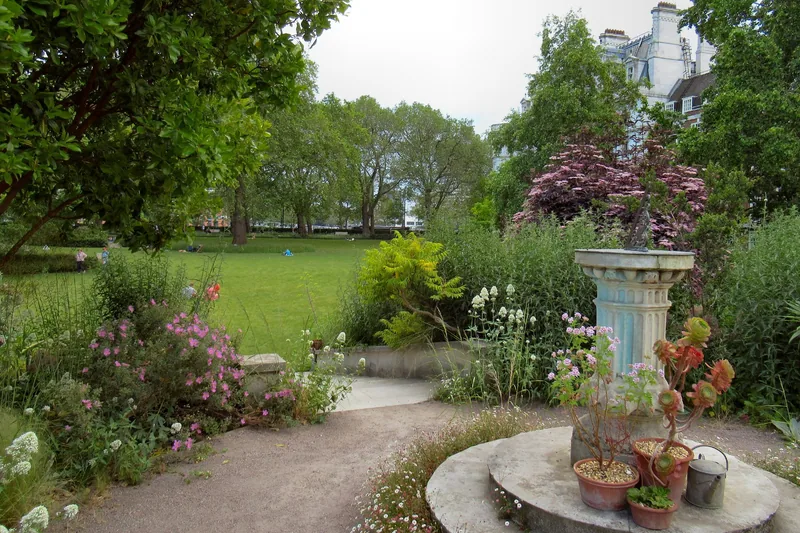
Photo: AndyScott · CC BY-SA 4.0 · Wikimedia Commons · resized
Why it is shut on a fine day: the wind policy
This is the part most visitors never hear about. The Inner Temple publishes a wind policy, drawn up with a tree consultant, and it is strict. If the Met Office forecasts gusts of Force 8 (38mph or more), the garden closes, even if the gusts never reach it. At Force 7 (32 to 38mph) it may close, depending on the wind direction (the prevailing wind is south-westerly, and anything else worries the gardeners more), how wet the ground is, the time of year and when the trees were last inspected.
The reason is the London plane trees. They carry Massaria, a fungal disease that can make branches drop, and the Inn inspects for it three times a year. The policy says the risk is highest from April to July, when the trees are in full leaf and weaker than in autumn. A bright, breezy day in May is exactly the kind of day you may find the gate shut.
A windy forecast closes the Inner Temple Garden even under blue sky. When the garden closes for wind, staff put notices on all the gates and post on the garden's Instagram account if the closure runs into public hours. Check that account before you build a lunch around it, and on a gusty day have a fallback: Lincoln's Inn Fields, ten minutes north, is a public square open through the day.
The garden also closes for private hire (it is let for weddings and garden parties) and, afterwards, for repairs to the lawn. The Inn points visitors to Instagram for these closures rather than listing them on its website.
What you will see: borders, planes and an old orchard
The Inn describes its garden as a plantsperson's garden, and that is accurate. The head gardener, Sean Harkin, came from the Royal Horticultural Society, the National Trust and Kensington Palace in 2018, and the planting has become experimental and dense. The long borders, the Highborder and Longborder, are at their best from late spring until the end of the year: giant fennel, tree dahlias, the Chinese rice-paper plant and ornamental grasses mixed with salvias and self-seeding plants.
Look for these as you walk round:
- The London planes. Three on the main lawn date from the early 1770s, and an avenue lines the Broad Walk along the Embankment side, planted in the 1870s.
- The old orchard. A large-fruiting walnut, a quince and a black mulberry recall the medieval orchard recorded on the site.
- A Queen Anne sundial and decorated iron gates from about 1730.
- The Peony Garden, a small enclosed corner under a wisteria, best in late spring.
- The spring meadow, with snake's-head fritillaries and bulbs among China roses, and a pond garden.
November is a good month for the borders, with the late dahlias and grasses still standing.
Seven hundred years of garden, briefly
A garden here is older than the Inn. The Inner Temple's records name its first gardener in 1307, and by the 14th century its roses were known; Shakespeare set the scene in which rival nobles pick red and white roses, the start of the Wars of the Roses, in the Temple garden. A formal layout with a terrace and walks came in 1591, and an enclosed Dutch-style design with three rectangular lawns in the early 18th century.
The biggest change came with Joseph Bazalgette's Victoria Embankment, opened in July 1870. The garden lost its direct access to the river but gained land reclaimed from it, and Bazalgette designed the wall, railings and carriage gates along its southern edge. Historic England lists the five Portland stone gate piers, with iron gates carrying the winged horse of the Inner Temple, and the whole garden is on the Register of Parks and Gardens at Grade II. The landscape designer Robert Marnock then laid out the lines of planes, chosen because they could stand London's soot.
Where the Chelsea Flower Show began
In the smoky Victorian city the Inner Temple became a host of flower shows, starting with an annual chrysanthemum show. In 1888 the Royal Horticultural Society chose the garden for its Spring Flower Show, and came back every year until 1911, when the show had grown too big and moved to the grounds of the Royal Hospital Chelsea. That show is today's Chelsea Flower Show. In the Second World War the borders became allotments and the upper garden a dump for Blitz rubble.
The house rules, and who may bring a dog
The Inn publishes garden usage guidelines, and they are not the rules of a public park. During public hours there is no alcohol, no barbecue and no ball games. Keep off the flower beds, the meadow and the long grass, and take your litter with you; bins are under the cloisters in Church Court and outside Mitre Court. Children must be supervised and may not climb the trees. Bicycles stay outside on the racks.
Visitors may not bring dogs: only dogs belonging to residents of the Inner and Middle Temple, and assistance dogs, are allowed. Groups of more than twelve are generally not permitted, and you should not hold a bench by leaving a bag on it, because unattended belongings are removed.
A lunch hour in the Temple
The garden is made for a picnic lunch, and on a sunny weekday it fills up with people from the chambers and offices around. Buy something on Fleet Street or along the Strand first; our week of lunches in London has ideas, and picnic supplies and self-catering covers the supermarkets. Give yourself half an hour inside, which is enough for a slow circuit and a bench.
Before or after, Two Temple Place and Cleopatra's Needle are a few minutes west along the Embankment, and the Royal Courts of Justice are across Fleet Street.
The Aldwych and the Strand guide covers the streets to the west, and for more of the City's small green corners, see the City of London's small gardens.
Frequently asked questions
When is the Inner Temple Garden open to the public?
Monday to Friday from 12.30pm to 3pm, not on bank holidays. It is free and you do not need to book. It closes at weekends, for private hire, for repairs and when strong winds are forecast, and closures are posted on the garden's Instagram account.
Why is the Inner Temple Garden closed today?
The most likely reasons are wind, a private event or a bank holiday. Under the Inn's wind policy, the garden shuts if the Met Office forecasts gusts of 38mph or more, and it may shut from 32mph, because diseased plane trees can drop branches.
How do you get into the Inner Temple Garden?
Through the main garden gate on Crown Office Row, opposite the Treasury Office, inside the Temple. Walk in from Fleet Street through the Inner Temple gatehouse and down Inner Temple Lane, or from Temple station on the Embankment. The gates on the Embankment itself are not a public entrance.
Can you take a dog into the Inner Temple Garden?
No, unless it is an assistance dog. The Inn's guidelines allow only dogs belonging to residents of the Inner and Middle Temple, plus assistance dogs.
Was the Chelsea Flower Show held at the Inner Temple?
Its forerunner was. The Royal Horticultural Society held its Spring Flower Show in the Inner Temple Garden every year from 1888 to 1911, then moved it to the Royal Hospital Chelsea when it outgrew the site.
Sources
- The Inner Temple - Visiting the Garden (checked November 2026)
- The Inner Temple - Wind Policy (PDF) (checked November 2026)
- The Inner Temple - Garden Usage Guidelines and Dog Policy (PDF) (checked November 2026)
- The Inner Temple - History of the Garden (checked November 2026)
- The Inner Temple - Plants, Trees and Climate (checked November 2026)
- The Inner Temple - Open Days (checked November 2026)
- Historic England - Five gate piers to Inner Temple Garden, list entry 1079104 (checked November 2026)
- Historic England - Inner Temple, Register of Parks and Gardens, list entry 1000842 (checked November 2026)