
Aldwych is the crescent-shaped street that loops off the eastern end of the Strand, between Covent Garden and Fleet Street. It was built in the early 1900s by cutting through a district of old, narrow streets, and the shape of the crescent, with two churches left standing in the middle of the road, is the clearest trace of what was there before.
The Strand is the long, straight road that runs from Trafalgar Square to the edge of the City, parallel to the river. Its western half belongs to the theatres and hotels of Covent Garden; this page covers the eastern end, where the Strand and Aldwych meet. Our guide to Holborn stops at Kingsway, which is where this one begins. Almost everything here can be seen from the pavement in an hour, and it costs nothing.
Aldwych and the Strand at a glance
- Where
- WC2, City of Westminster, between Waterloo Bridge and the Royal Courts of Justice
- Nearest Tube
- Temple (District and Circle lines), Covent Garden or Holborn (Piccadilly line), all five to ten minutes' walk
- Buses
- Many routes along the Strand and round Aldwych, including the 15 and the N9 night bus to Heathrow
- St Clement Danes
- Free; open Wednesday to Friday 10:30-15:30, Saturday and Sunday 10:00-15:00 (checked November 2026)
- Aldwych station
- Closed in 1994; open only on Hidden London tours
- Time needed
- An hour on foot, more with Somerset House or the Courtauld
A crescent drawn over a lost neighbourhood
Until the end of the 19th century, the land north of the Strand here was a tangle of small streets and courts around Clare Market. Two of them ran roughly where Aldwych now curves. Holywell Street was narrow and lined with old timber-framed houses whose upper floors leaned out over the pavement, and it was known for its booksellers and print shops, including those selling material the Victorians considered obscene. Wych Street, just to the north-west, had a similar character and a similar reputation.
The London County Council, London's new elected government, wanted a wide road north from the Strand to Holborn, and it saw a chance to clear what it regarded as slums at the same time. The result was Kingsway, running north, and Aldwych, the crescent that connects it to the Strand at both ends. The clearances took place in the first years of the 1900s, and King Edward VII opened the new streets in October 1905. Whole streets of old frontages went with them.
Nothing of Holywell Street survives. Australia House now stands roughly across the line where it ran. If you want to picture it, look at the narrow alleys that still lead off the Strand further west, and imagine one running for several hundred metres, with no traffic and the houses almost touching overhead.
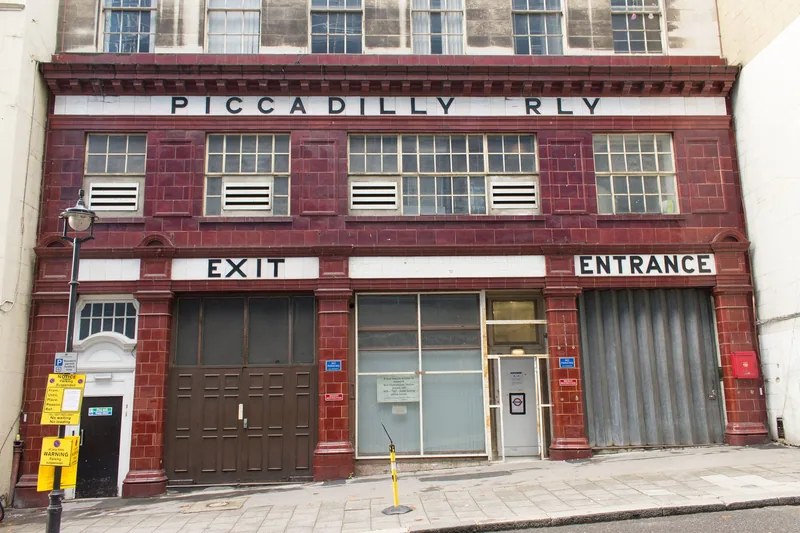
Photo: Chris Roberts · CC BY-SA 4.0 · Wikimedia Commons · resized
Two churches on islands
The new road was laid out around two churches that were too important to demolish, and so both ended up on islands with traffic flowing past on either side. Since the stretch of the Strand outside Somerset House and King's College was closed to traffic, St Mary le Strand stands at the edge of a pedestrian space rather than in a stream of cars, but St Clement Danes is still an island.
St Mary le Strand, at the western end, is small, elegant and built of Portland stone. It was designed by James Gibbs and built in 1714 to 1717, and Historic England lists it at Grade I, praising its "exceptional treatment of island site" and the influence of the Baroque churches Gibbs had seen in Rome. It is a working parish church, open at limited times; check its own website if you want to go in, because access depends on volunteers.
St Clement Danes, at the eastern end in front of the Royal Courts of Justice, is the larger of the two. Sir Christopher Wren rebuilt it in 1680 to 1682, and James Gibbs added the steeple in 1719. It was gutted by bombing in the Second World War and restored in the 1950s as the Central Church of the Royal Air Force. Inside, the church holds the RAF's Books of Remembrance, listing those who have died in service, and displays objects from the service's history alongside treasures of the old parish. It is also one of two London churches that lay claim to the "Oranges and Lemons" nursery rhyme. Outside the east end stands a statue of Samuel Johnson, listed in its own right.
St Clement Danes is closed on Mondays and Tuesdays. The church opens to visitors Wednesday to Friday from 10:30 to 15:30 and at weekends from 10:00 to 15:00, with Sunday services at 11:00 (checked November 2026). It sometimes closes at short notice for RAF events, so email the church before making a special journey.
Australia House: the first of the new buildings
The wedge-shaped block between Aldwych and the Strand, at the eastern end of the crescent, is Australia House, the Australian High Commission. According to the High Commission, King George V laid the foundation stone in 1913 and opened the finished building on 3 August 1918, the war having slowed construction. It is the oldest Australian diplomatic mission and the longest continuously occupied foreign mission in London.
Historic England describes it as "Monumental Beaux Arts - Imperial Baroque", in Portland stone, with the main entrance at the sharp eastern point of the site. Look up above the doorway for the large bronze group of the sun god Apollo driving four horses rising from the sea. The grand marble hall inside was used as the interior of Gringotts bank in the Harry Potter films; it is a working office, and our Harry Potter locations guide explains what you can and cannot see.
Bush House and the BBC World Service
At the centre of the crescent, closing the view south down Kingsway, stands Bush House, with a tall columned niche and two male figures on top. It was built from 1925 to 1935 for an Anglo-American trading company headed by Irving T. Bush, which is where the name comes from. The inscription over the entrance reads "To the friendship of English-speaking peoples".
For most of the 20th century the name meant one thing to radio listeners around the world. The BBC's history of the building records that its European services moved in during 1940, after being bombed out of Oxford Street, and that the World Service broadcast from Bush House until 2012, when it moved to New Broadcasting House. King's College London took over the building in 2016 and uses it as part of its Strand campus. The public cannot wander in, but the entrance portico, with its statues by the American sculptor Malvina Hoffman, is on the street.
Epstein's figures on Zimbabwe House
Walk west along the Strand to the corner of Agar Street, opposite the Charing Cross end, and look up at the second floor of Zimbabwe House, number 429. The building was designed by Charles Holden, later the architect of many Underground stations, and built in 1906 to 1908 for the British Medical Association. In the niches between its windows stand a row of weathered, broken stone figures. They are the remains of a series of figures carved by the young Jacob Epstein, which were controversial from the start.
Historic England's list entry, which grades the building II*, calls them "the contentious and subsequently mutilated standing figures". The projecting parts were later cut back, and what you see now are the damaged remains of the originals. Few people walking along the Strand notice them, which makes them one of the better small discoveries in central London. If you like Holden's work, our page on Holden's Underground stations shows where he went next.
Somerset House, King's College and the river side
The south side of the Strand at this point is filled by Somerset House, the great 18th-century government building that now holds galleries, a courtyard with fountains in summer and an ice rink in winter. Our pages on Somerset House and the Courtauld Gallery inside it cover the visit. Next door to the east is King's College London's original building.
Between them, Strand Lane, a narrow passage running down towards the river, leads to one of the area's oddities, an old plunge bath once claimed as Roman. Further east, past St Clement Danes, the Strand becomes Fleet Street at the Temple Bar memorial, the boundary of the City of London, opposite the Royal Courts of Justice.
Aldwych station and the theatres
At the corner of the Strand and Surrey Street is the dark red tiled front of the former Aldwych station, which opened as Strand station. It was the end of a short Piccadilly line branch from Holborn and closed in 1994. It is now used for filming and opened to the public only on Hidden London tours, which sell out quickly.
The crescent also has three theatres. The Aldwych Theatre and the Novello Theatre stand as a pair at the western end of the crescent, and the Lyceum is just north of the Strand on Wellington Street. They are part of the West End, and our West End theatre guide explains how to book.
Eating, tea and the oldest shop
The eastern Strand is not a place for a special meal. It is office and university territory, with sandwich chains, cafés and a few pubs that fill at lunchtime and after work. The one shop everybody mentions is Twinings at 216 Strand, which has sold tea on the same site since the 18th century and is described on our page about London's oldest shops. For a meal, walk ten minutes west into Covent Garden or north to the streets behind Lincoln's Inn Fields. If you pick somewhere, check its food hygiene rating on the Food Standards Agency register by name and postcode.
Getting there and getting around
There is no Tube station on Aldwych itself. Temple station, on the District and Circle lines, is the closest, on the Embankment just below the Strand; Covent Garden and Holborn are each about ten minutes' walk. Buses are the easiest option, though the section of the Strand outside Somerset House is now for pedestrians and cyclists only, so buses use the Aldwych side of the crescent there; Aldwych is the terminus for several, including the N9 night bus, which runs every night through the West End to Heathrow. Route 15 runs along the Strand and Fleet Street towards St Paul's and the Tower, and our route 15 guide describes the ride.
Frequently asked questions
Why is Aldwych shaped like a crescent?
It was laid out by the London County Council in the early 1900s to connect the new Kingsway with the Strand at both ends, after the narrow old streets in the area, including Holywell Street and Wych Street, were demolished. The two churches in the road were kept and left on islands.
Can you go inside Australia House?
Not as a tourist. Australia House is the working Australian High Commission, and its marble hall, used for Gringotts in the Harry Potter films, is not open for casual visits. The outside, with its large bronze sculpture over the entrance, can be seen from the street.
Is St Clement Danes open to visitors?
Yes, free of charge, from Wednesday to Friday 10:30 to 15:30 and at weekends 10:00 to 15:00 (checked November 2026). It is the Central Church of the RAF and may close at short notice for services and ceremonies.
What happened to the BBC at Bush House?
Bush House was home to the BBC's foreign-language services from 1940 and became the headquarters of the World Service. The last broadcast from the building was in 2012, when the World Service moved to New Broadcasting House. King's College London now uses Bush House.
Can you visit Aldwych tube station?
Only on a guided Hidden London tour run by London Transport Museum. The station closed in 1994 and the tours, which take you down to the platforms, are released in batches and often sell out.
Sources
- Historic England - Church of St Mary le Strand, list entry 1236753 (checked November 2026)
- Historic England - Church of St Clement Danes, list entry 1237099 (checked November 2026)
- Historic England - Australia House and Government of Victoria Offices, list entry 1357166 (checked November 2026)
- Historic England - Zimbabwe House, 429 Strand, list entry 1237039 (checked November 2026)
- Historic England - Bush House Centre Block, list entry 1066492 (checked November 2026)
- Australian High Commission - The History of Australia House (checked November 2026)
- BBC - History of the BBC: Bush House (checked November 2026)
- St Clement Danes - The Central Church of the RAF (checked November 2026)