
Iranian restaurants in London cluster in two places: the western end of Kensington High Street and the streets around Earl's Court, and a second, cheaper belt running out through Acton to Ealing. The meal to order first is chelo kabab: grilled meat with saffron rice, a grilled tomato and a small dish of sumac to shake over it.
Persian cooking is not the chilli-hot food many visitors expect from the region. It is built on rice, fresh herbs, sour fruit and slow-cooked lamb, and it is seasoned with saffron, dried lime, turmeric and cinnamon rather than heat. If you have eaten the Lebanese and Syrian food described in our guide to the grills and bakeries of Edgware Road, this is a different tradition again: fewer small plates, longer cooking, and rice at the centre of everything.
Almost all of it is halal, though the restaurants rarely advertise the fact in the window; our page on halal eating in London explains how to check. What follows is where the community actually is, what to ask for, and the parts of the menu most visitors never reach.
Iranian London in brief
- Kensington
- High Street Kensington (Zone 1, Circle and District lines) and the western end of the road towards Olympia
- Earl's Court
- Earl's Court Road, Zone 1 and 2, District and Piccadilly lines
- West London
- Acton Town (Zone 3) out to Ealing Broadway (Zone 3), plus pockets in Hammersmith and Shepherd's Bush
- North London
- Finchley Road and the Golders Green corridor
- Order first
- Chelo kabab koobideh, with sumac and a grilled tomato
- Licensing
- Many restaurants are unlicensed. Some allow you to bring your own wine for a corkage fee
- Best day
- Friday and Saturday evenings are family nights and get loud; weekday lunch is quiet
Why the restaurants are in Kensington and Ealing
Iranians came to Britain in large numbers after 1979, and many of the first arrivals were already familiar with west London, where Iranian students had studied and Iranian families had holidayed through the 1960s and 1970s. They settled around Kensington, Chelsea and Hammersmith, and the restaurants, bookshops, hairdressers and travel agents followed.
As rents in Zone 1 rose, the shops spread west along the Piccadilly and District lines. Acton and Ealing now carry the everyday version: supermarkets with sacks of rice by the door, butchers who will mince lamb for kabab while you wait, and restaurants where a family of five eats for what two people pay in Kensington. Our guides to Earl's Court and to Ealing and west London cover both ends of that line.
The practical consequence for a visitor is simple. If you are sightseeing in South Kensington and want one Persian meal, walk north. If Persian food is the reason for the trip, take the District or Piccadilly line west for twenty minutes and eat better for less. Fares out to Zone 3 count towards the same daily cap as a day of Tube journeys in the centre, which our page on London's travel zones explains.
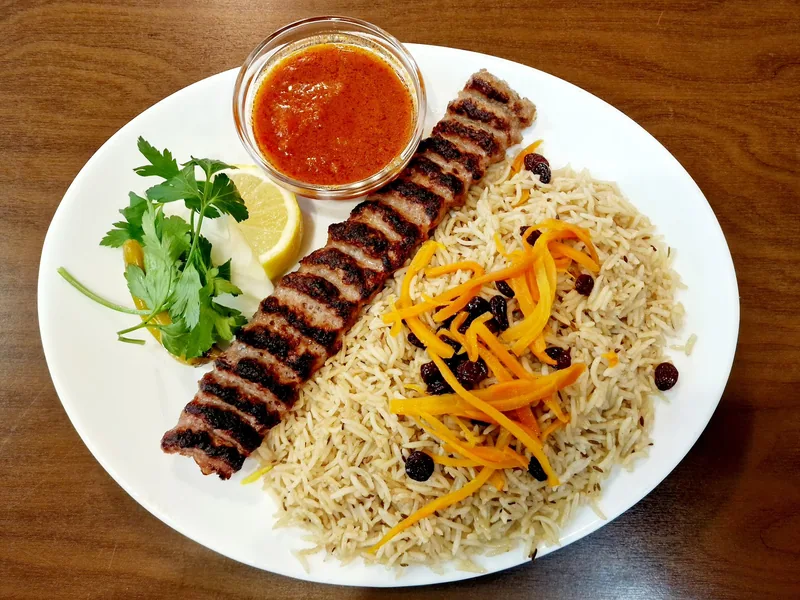
Photo: Anagoria · CC BY-SA 4.0 · Wikimedia Commons · resized
The kabab menu, decoded
Almost every Iranian restaurant in London runs the same core list of grilled meats. They are ordered by the skewer, and the word chelo in front of a name means the dish comes with a mound of steamed saffron rice.
| Name | What it is | Who it suits |
|---|---|---|
| Koobideh | Minced lamb or beef, seasoned with onion, pressed onto a wide flat skewer | The default first order. Two skewers is a normal portion |
| Barg | A thin, flattened fillet of lamb or beef, marinated in saffron and onion juice | Leaner, more expensive, easy to overcook |
| Joojeh | Chicken marinated in saffron, lemon and onion; on or off the bone | The safest choice for children and for anyone unsure |
| Soltani | One koobideh and one barg on the same plate | The order for people who cannot decide |
| Chenjeh | Chunks of marinated lamb, grilled rare in the middle | Ask for it if the menu offers it; not every kitchen does |
| Shishlik | Lamb cutlets, the rib bones left on | The most expensive thing on most menus, and usually the best |
Three things arrive with the meat and all three are part of the dish. The grilled tomato is squashed into the rice. The knob of butter on top of the rice is stirred through while it is still hot. The small shaker of dark red powder is sumac, a dried ground berry that tastes sour rather than hot, and it goes on the meat, not the rice.
Sumac is the seasoning most first-timers leave untouched. The koobideh is deliberately under-salted because the sumac is meant to finish it. Shake it over the meat generously, taste, then add more. A plate of kabab eaten without it is the commonest reason visitors come away thinking Persian food is bland.
Rice, and the crust at the bottom of the pot
Rice is cooked twice in Persian kitchens: parboiled, drained, then steamed slowly under a cloth-wrapped lid until each grain separates. Plain steamed rice is chelo. Rice cooked with something folded through it is polo, and the versions worth ordering are baghali polo, with dill and broad beans, usually served with a lamb shank, and zereshk polo, studded with sharp red barberries and served with chicken.
The crust that forms at the bottom of the pot is tahdig, and it is the single best thing in the cuisine. Some restaurants bring a piece with the rice; most sell it as a side dish, sometimes made with potato or flatbread rather than rice. It is worth asking for by name, and it is worth ordering one portion for the table even if nobody has asked for it.
The stews, which are what Iranians actually eat at home
Kabab is restaurant food. The khoresh, or stew, is home food, and the restaurants that cook it well are usually the small ones. A khoresh is served beside a plate of rice rather than on top of it, and you mix as you go.
- Ghormeh sabzi: lamb with a heavy mass of fried herbs, kidney beans and dried lime. Dark green, sour, and the dish Iranians will ask whether you have tried.
- Gheymeh: lamb and yellow split peas in a tomato and dried-lime sauce, topped with thin fried potatoes.
- Fesenjan: chicken or duck in a thick sauce of ground walnuts and pomegranate molasses. Sweet, sour and very rich; order it for the table rather than for yourself.
- Khoresh-e bademjan: aubergine and lamb with tomato and sour grape juice.
- Ash reshteh: not a stew but a thick soup of noodles, herbs, beans and whey. A meal in itself in winter.
Start with kashk-e bademjan, a warm dip of fried aubergine, whey, mint and fried onion, or mast-o khiar, yoghurt with cucumber and dried mint. Salad shirazi, finely diced cucumber, tomato and onion with lime, cuts through everything else on the table.
Bakeries, sandwiches and the cheap end
The Iranian bakeries of Acton, Ealing and Finchley Road bake to order through the morning, and the bread is what draws people back. Nan-e barbari is a long, thick, seeded flatbread that is best within an hour of leaving the oven. Sangak is thinner, baked on a bed of hot pebbles, and sometimes still has a stone or two clinging to the underside, which you knock off rather than bite. Lavash is the thin sheet used for wrapping.
The sandwich shops are the cheapest way into the cuisine. Look for kotlet, a flat lamb and potato patty in bread with herbs and pickles, and olivieh, a chicken and potato salad packed into a roll, which is the Iranian picnic sandwich. A sandwich and a drink stays well under the cost of a restaurant main course, and our page on eating cheaply in London puts that in context. The bread is sold by the piece at the same counters, which makes these shops a useful stop if you have a kitchen; see our guide to London's bakeries for the wider picture.
What to drink, and whether the restaurant is licensed
Doogh is the drink that belongs with kabab: salted yoghurt thinned with water, often carbonated and flavoured with dried mint. It divides people on the first mouthful and wins most of them over by the third. Sharbat, a sweet cordial of sour cherry, rose or lime diluted with water, is the alternative.
Tea is black, brewed strong and diluted at the table from a second pot of hot water, and served in a small glass called an estekan. It is not drunk with milk. A cube of sugar or a stick of saffron rock sugar is held in the mouth or stirred in; asking for milk marks you out instantly, though nobody minds.
A significant number of Iranian restaurants in London do not serve alcohol. Some will let you bring a bottle and charge corkage, and some simply prefer you did not. Settle it on the telephone when you reserve, not once you are sitting down. Our page on alcohol rules in London explains the licensing background, and there is no awkwardness in ordering doogh or tea instead.
Nowruz, and the two weeks either side of it
Nowruz, the Iranian new year, falls at the spring equinox, on or about 20 March, and it is inscribed on UNESCO's list of intangible cultural heritage as a festival shared across a wide region. In London it is when the Persian supermarkets are at their most interesting: sprouted wheatgrass for the haft-sin table, dried fruit and nuts by the kilo, fresh herbs in quantities that only make sense if you are cooking for twenty.
The thirteenth day after Nowruz is sizdah bedar, when families are supposed to spend the day outdoors. Iranian families picnic in numbers in the big London parks on that day, Hyde Park and Kensington Gardens among them. The restaurants are quiet; the parks are not.
The supermarkets are cheaper than the restaurants for taking food home. Iranian grocers in Acton, Ealing and on Finchley Road sell saffron by the gram, dried limes, barberries, pomegranate molasses, pistachios and rose water at a fraction of what a delicatessen in the centre charges for the same jars. Saffron is the one to buy: it is sold in sealed boxes with a producer's name, and the price per gram is printed on the shelf.
Sweets, ice cream and the end of the meal
Bastani is saffron and rosewater ice cream, thick with clotted cream and studded with pistachio, often served pressed between two thin wafers. Faloodeh, which frequently sits next to it, is frozen strands of starch noodle in rose syrup, eaten with lime squeezed over the top; it tastes far better than the description suggests.
The pastry shops sell gaz, a chewy nougat with pistachio from Isfahan, sohan, a brittle saffron toffee, and boxes of dried mulberries. These travel well and make better presents than most things sold as souvenirs. For where else in London to end an evening with something sweet, see our guide to desserts, ice cream and chocolate.
Vegetarians, allergies and eating with children
Persian food treats vegetables well but very little of it is cooked without meat. The dips, salads, ash reshteh and some aubergine dishes are the reliable options, and kashk, the whey used in several of them, is a dairy product rather than a vegan one. Ask before assuming; our page on vegan and vegetarian London covers the wider question.
Nuts are a genuine issue. Walnuts are ground into fesenjan, pistachios go into rice dishes, sweets and ice cream, and almond flour appears in pastries. Wheat is in every bread on the table. Anyone with a serious allergy should say so at the point of booking, not when the food arrives; our page on eating without gluten in London sets out how UK allergen rules work in restaurants.
These are good restaurants for children. Nothing is chilli-hot, joojeh kabab and plain rice suit cautious eaters, and nobody objects to a long table with several generations at it. Our family guide to London has more on eating out with children.
Where it sits among London's other immigrant kitchens
Persian, Turkish and Georgian cooking share a border and very little else. If you have had a good evening on Kensington High Street, the natural next steps are the hearths and ocakbasi counters in our guide to Turkish food in London, and the cheese breads and dumplings in our page on Georgian and Central Asian bakeries. For a cuisine that has arrived in London much more recently, see Filipino food.
Frequently asked questions
What should I order on a first visit to a Persian restaurant?
Chelo kabab koobideh: minced lamb on a flat skewer with saffron rice, a grilled tomato and butter. Add a portion of tahdig for the table and a bowl of mast-o khiar to start. Shake the sumac over the meat, and stir the butter through the rice while it is hot.
Is Persian food spicy?
No. It is seasoned with saffron, turmeric, cinnamon, dried lime and sumac, which give sourness and fragrance rather than heat. Chilli barely appears. Few cuisines in the city are easier for children, or for an adult who dislikes hot food.
Where are the Iranian restaurants in London?
The two main clusters are the western end of Kensington High Street with the streets around Earl's Court Road, and a longer, cheaper strip running through Acton and Shepherd's Bush out to Ealing. There is a third concentration along Finchley Road in north London.
Do Persian restaurants in London serve alcohol?
Many do not. Some hold a licence, some allow you to bring your own bottle and charge corkage, and some serve no alcohol at all. Ask when you book. Doogh, a salted yoghurt drink, and black tea served in small glasses are the traditional accompaniments.
What is tahdig and can I order it separately?
Tahdig is the crisp golden crust from the bottom of the rice pot, sometimes made with rice alone, sometimes with potato or flatbread. Most London restaurants sell it as a side dish rather than including it, so order it by name when the rest of the food is ordered.
Sources
- UNESCO Intangible Cultural Heritage - Nowruz on the Representative List (checked September 2026)
- Transport for London - Fare capping (checked September 2026)
- Food Standards Agency - Food allergy and intolerance advice for consumers (checked September 2026)
- Food Standards Agency - Food hygiene ratings search (checked September 2026)
- GOV.UK - Alcohol and young people (checked September 2026)