
London's Latin American food is Colombian and Ecuadorian before it is Peruvian, and it is sold from two markets rather than from restaurants: the reopened Seven Sisters Market in Tottenham, and a scattering of counters, shops and a Saturday street market around Elephant and Castle. Peruvian cooking is the one that reached the centre, and it is the one to try first if you want a proper sit-down meal.
The communities arrived in stages. Chileans came as political exiles in the 1970s; Colombians and Ecuadorians came in far larger numbers from the 1980s onwards, many of them through the cleaning and hospitality trades; Venezuelans and Brazilians came most recently. Their food followed them to two unglamorous parts of London, and our guide to London's food markets has the overview of where such trade tends to end up.
One warning before anything else: much of the printed advice about where to eat this food in London is out of date, because both of its centres have been rebuilt in the last six years. What follows is where the traders actually are now.
The two Latin American centres
- Seven Sisters Market
- Wards Corner, by Seven Sisters station, Zone 3. Reopened in 2025 with temporary indoor and outdoor market spaces after five years closed
- Seven Sisters station
- Victoria line and the Weaver line of the London Overground, plus Greater Anglia trains from Liverpool Street
- Elephant and Castle
- Zone 1 and 2, Bakerloo and Northern lines and Thameslink. The old shopping centre has gone; the traders are spread around Walworth Road and the railway arches
- Elephant Passage
- A Latin American street market on Liverpool Grove, SE17, on Saturdays, with a run of small businesses at 331-333 Walworth Road
- Peruvian restaurants
- Fitzrovia, Soho and Bayswater, at central London prices
- Order first
- Ceviche at lunchtime; an arepa or an empanada at a market counter
- Payment
- Cards are normal, but carry some cash for market stalls
What happened to the Elephant and Castle shopping centre
For thirty years the ugly red shopping centre at Elephant and Castle held the largest concentration of Latin American businesses in Britain: bakeries, money transfer desks, hairdressers, a first-floor food court where whole families ate on a Sunday. It closed in 2020 and was demolished as part of the rebuilding of the area.
Some traders moved into Castle Square, a temporary parade of units beside the station. Others took units in the Elephant Arcade. Some could not afford the new rents and stopped trading altogether. A newer Latin American street market, Elephant Passage, now runs on Saturdays on Liverpool Grove off Walworth Road, with a group of small Latin American businesses in shop units on Walworth Road itself.
The practical effect for a visitor is that there is no longer one building to walk into. You are looking at a short walk between the station, Walworth Road and the railway arches, and it repays going on a Saturday. The Imperial War Museum is ten minutes away on foot, which makes a reasonable morning-and-lunch pairing, and our guide to Southwark and Bankside covers the wider area.
Guidebooks still send people to a shopping centre that no longer exists. The Elephant and Castle shopping centre closed in 2020 and has been demolished. If a printed guide or an older blog tells you to go to the food court on the first floor, it is describing something that was taken down. Look for the arches, Walworth Road and the Saturday market on Liverpool Grove instead.
Seven Sisters Market, and its five missing years
The indoor market at Wards Corner, beside Seven Sisters station, has been Latin American since the 1990s and is widely known by the name of its best-known stall arrangement, El Pueblito Paisa. It closed in March 2020 because of the condition of the building and stayed shut for years while its future was fought over.
It reopened in 2025, in a temporary form: an indoor market in units beside the old site and an outdoor market on an adjoining plot, run in partnership between the traders, Haringey Council and Places for London. Between them they hold food stalls, a butcher, hairdressers, money transfer desks and a bar. The atmosphere is closer to a small town square than to a food hall.
Seven Sisters is on the Victoria line, which makes it about fifteen minutes from Oxford Circus, and on the Weaver line of the Overground; our page on the Overground's line names explains the network's newer labels. Go at lunchtime or on a Saturday. Several stalls close early in the evening.
Colombian and Ecuadorian food, which is most of what is sold
This is home cooking sold from counters, and the portions are built for people who have done a day's work.
- Bandeja paisa. A tray, not a plate: red beans, rice, minced beef, chorizo, crisp pork belly, a fried egg, half an avocado, fried plantain and an arepa. One is enough for two moderate appetites.
- Arepas. Colombian ones are thin maize cakes, often with cheese in or on them. Venezuelan ones are thick and split open like a bun and stuffed; reina pepiada, with chicken and avocado, is the one to start with.
- Empanadas. Deep-fried maize pastries with potato and meat, eaten with a squeeze of lime and ají, the green herb and chilli sauce on every counter.
- Sancocho. A big soup of chicken or beef with maize, yuca and plantain. Sunday food.
- Encebollado. The Ecuadorian one: tuna and yuca in a broth with pickled red onion. Eaten for breakfast and, traditionally, for a hangover.
- Pandebono and almojábana. Cheese breads, warm, best within an hour of baking.
- Obleas. Two thin wafers with caramel arequipe between them. The children's order.
To drink: aguapanela, unrefined cane sugar dissolved in hot water with lime; Colombiana, a sweet red soft drink; and coffee that is usually served small, sweet and without ceremony, which our guide to coffee in London will tell you is not how the rest of the city does it.
Peruvian food, and why it tastes like three cuisines
Peru had significant Chinese and Japanese immigration in the nineteenth and twentieth centuries, and its cooking absorbed both. A chifa restaurant is a Peruvian-Chinese one; Nikkei cooking is the Peruvian-Japanese strand. Lomo saltado, strips of beef stir-fried with onion, tomato and soy and served with both rice and chips, is a Chinese dish with a Peruvian accent, and it is the most ordered thing on any Peruvian menu in London.
| Dish | What it is | Note |
|---|---|---|
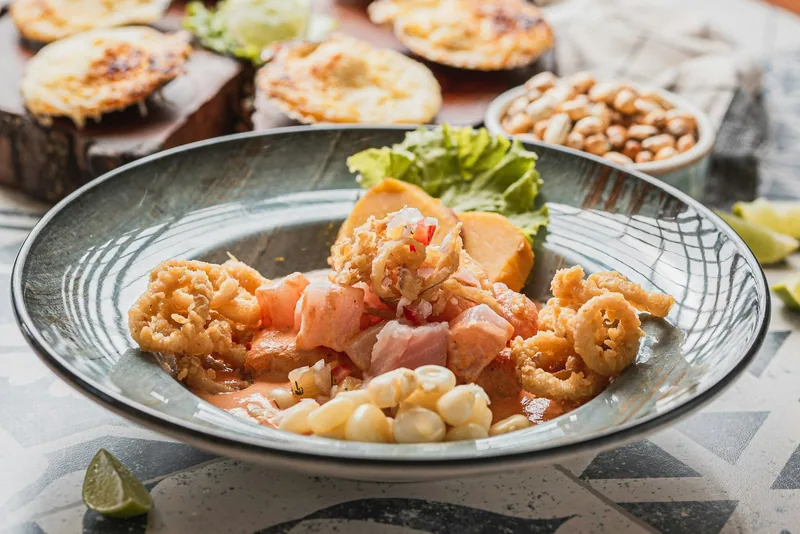
| Ceviche | Raw fish cured in lime juice with chilli and red onion, served with sweet potato and large-kernel corn | Cured for minutes, not hours. The marinade left in the bowl is leche de tigre and is drunk |
| Tiradito | The same fish sliced thin, without onion, with the sauce poured over | Closer to sashimi. The Nikkei dish |
| Lomo saltado | Beef stir-fried with onion, tomato, soy and vinegar, with rice and chips together | The gateway dish. Never hot |
| Ají de gallina | Shredded chicken in a mild yellow chilli and walnut sauce | Creamy, gentle, good for children |
| Anticuchos | Skewers of marinated beef heart, grilled over charcoal | Far better than it sounds; the classic street order |
| Causa | Cold pressed yellow potato layered with chicken or crab and avocado | A starter, served in a neat block |
| Pollo a la brasa | Whole chicken marinated and spit-roasted, with chips and three sauces | The Sunday family order |
Inca Kola is the national soft drink, bright yellow and tasting distinctly of bubblegum. Chicha morada, made from purple maize boiled with pineapple skin and cinnamon, is the better choice. Pisco sour is the cocktail, made with grape brandy, lime, sugar, egg white and bitters; our guide to cocktail bars in London covers where the city makes them well.
Eat ceviche at lunchtime. In Peru, ceviche is a midday dish because the fish is bought that morning and the shops that sell it close in the afternoon. London restaurants keep the same habit, and the ceviche served at one o'clock is usually better than the ceviche served at nine. If a menu offers a lunch ceviche special, it exists for this reason rather than as a discount.
Where the restaurants are, and what they cost
Peruvian cooking arrived in central London around 2012 and became briefly fashionable, and a cluster of restaurants remains in Fitzrovia, Soho and Bayswater. These are proper restaurants with wine lists and booking systems, and they are priced accordingly; several have held serious recognition, which our page on Michelin-starred restaurants in London puts in context. That scene has also turned over a good deal, so check that a place is still trading before you plan an evening around it.
The market counters at Seven Sisters and around Walworth Road are a different proposition: a full plate for a fraction of the price, eaten at a plastic table, with the television on. Both are worth doing. Our guide to cheap eats in London covers the second sort, and money and contactless in London the fact that some stalls still prefer cash.
Brixton Village has a handful of Colombian and Ecuadorian counters as well, in a much more visited setting; see our guide to Brixton.
Vegetarians, allergies and children
Arepas with cheese, patacones, yuca, beans and rice, causa without the chicken and several potato dishes give vegetarians a reasonable meal, though stocks and sauces frequently contain meat or fish. Peruvian sauces often carry walnuts, cheese or evaporated milk; see vegan and vegetarian London.
The allergens worth naming are fish and shellfish in ceviche and encebollado, nuts in ají de gallina, egg in a pisco sour, and wheat in the pastries. Maize, not wheat, is the base of arepas and most empanadas, which makes this an easier cuisine than most for people avoiding gluten, although shared fryers are a real risk; see gluten-free eating in London.
Children eat well here: plantain, cheese arepas, rice, roast chicken and obleas cover almost everything, and none of it is hot. Our family guide to London has more.
Where to go from here
The Portuguese-speaking half of Latin London is a separate story, and our guide to Portuguese and Brazilian food covers the churrascarias and the Stockwell cafes. For raw fish at the other end of the city's price range, see seafood and oysters in London, and for another cuisine whose London home is a single unfashionable high street, Filipino food in Earl's Court.
Frequently asked questions
Is the Latin American market at Elephant and Castle still there?
Not in its old form. The shopping centre that housed it closed in 2020 and was demolished. Traders are now spread between units near the station, shops on Walworth Road and a Saturday Latin American street market on Liverpool Grove, with more businesses in the railway arches nearby.
Has Seven Sisters Market reopened?
Yes. The market at Wards Corner, beside Seven Sisters station, reopened in 2025 after five years closed, in temporary indoor and outdoor spaces run with Haringey Council and Places for London. It holds food stalls, a butcher, salons and money transfer desks, mostly Colombian and Ecuadorian.
What should I order in a Peruvian restaurant in London?
Ceviche at lunchtime, or lomo saltado at any hour: beef stir-fried with onion, tomato and soy, served with rice and chips together. Ají de gallina suits anyone who wants something mild, and anticuchos, grilled beef heart skewers, are better than their description.
What is the difference between a Colombian and a Venezuelan arepa?
A Colombian arepa is a thin maize cake, often griddled with cheese in or on it, and eaten alongside other food. A Venezuelan arepa is thick, split open like a bread roll and stuffed, most commonly with shredded chicken and avocado or with black beans and cheese.
How do I get to Seven Sisters Market?
Seven Sisters station is in Zone 3 on the Victoria line, about fifteen minutes from Oxford Circus, and is also served by the Weaver line of the London Overground and by Greater Anglia trains. The market is at Wards Corner, next to the station. Go at lunchtime or on a Saturday.
Sources
- Haringey Council - Seven Sisters Market (checked September 2026)
- Haringey Council - Official re-opening of Seven Sisters Market (checked September 2026)
- Elephant Passage - Latin American market, Liverpool Grove and Walworth Road (checked September 2026)
- Transport for London - Fare capping (checked September 2026)
- Food Standards Agency - Food allergy and intolerance advice for consumers (checked September 2026)
- Food Standards Agency - Food hygiene ratings search (checked September 2026)