
Harrow-on-the-Hill is about 20 minutes from Baker Street on a Metropolitan line train, in Zone 5, and the station has four lifts. From the ticket barriers it is a ten-minute walk uphill to the High Street: take the left exit, turn left again at the end of the service road, then the first right up Grove Hill. Everything worth seeing is on the summit.
What is up there is a hill that rises sharply out of the suburbs, with a medieval church and a famous school on it, a High Street of Georgian and Victorian brick that looks like a country town, and a view over west and north London from the churchyard. The school owns most of the buildings, which is why the place has not been rebuilt: Harrow School has been on this hill since Elizabeth I granted John Lyon his charter, and it is still formally the Free Grammar School of John Lyon within the Town of Harrow-on-the-Hill.
Two warnings before you set off. Nothing on the hill has a turnstile: the school is a working boarding school, not a museum. And the hill is a hill, so the walk up is genuinely steep and the alternatives are a taxi or a bus.
Harrow on the Hill at a glance
- Where
- North-west London, HA1, in the borough of Harrow
- Station
- Harrow-on-the-Hill (Metropolitan line and Chiltern Railways), Zone 5, four lifts
- From Baker Street
- About 20 minutes on the Metropolitan line
- Walk from the station
- Ten minutes, uphill and steep
- Buses to the school
- 258 (Watford Junction to South Harrow) and H17 (Harrow Bus Station to Wembley Central), every 15 to 20 minutes
- Parking
- School car park at the bottom of Garlands Lane, HA1 3GF, then a steep ten-minute walk up
- Cost
- Nothing. There is no admission charge to anything on the hill
- Time needed
- Two hours for the hill, half a day with Headstone Manor
Getting up the hill without a wasted twenty minutes
The station sits at the bottom of the hill in the modern town centre, and the exit you choose matters. The school's own directions are specific: for the walk, take the left-hand exit after the barriers, go to the end of the service road, turn left, then take the first right up Grove Hill. For a taxi, take the right-hand exit, where there is a rank.
If you take a taxi, say Harrow School on top of the Hill. The school warns visitors to stress this, because Harrow High School is a different place in a different part of the town and drivers take people there.
The buses are the answer if the climb is a problem. The 258 and the H17 both stop at Harrow School itself, roughly every 15 to 20 minutes, so you can ride up and walk down, which is the right way round. The H17 also runs to Wembley Central, which makes it a direct link to the area covered in our guide to getting to Wembley Stadium.
South Harrow, on the Piccadilly line, is 20 minutes' walk from the school and the school notes that taxis rarely wait there. Two Superloop express bus routes also serve the town, the SL9 from Heathrow and the SL10 out to North Finchley, and our guide to the Superloop and outer London explains what those are for.
Harrow-on-the-Hill has four lifts, which is unusual this far out. TfL's station dataset shows lifts from street level to the ticket hall and from the footbridge down to the Metropolitan line and main-line platforms, so the station itself is straightforward. The hill above it is not: there is no step-free route to the summit, and the bus is the only realistic way up. Our guide to step-free transport in London explains how to check a route before you travel.
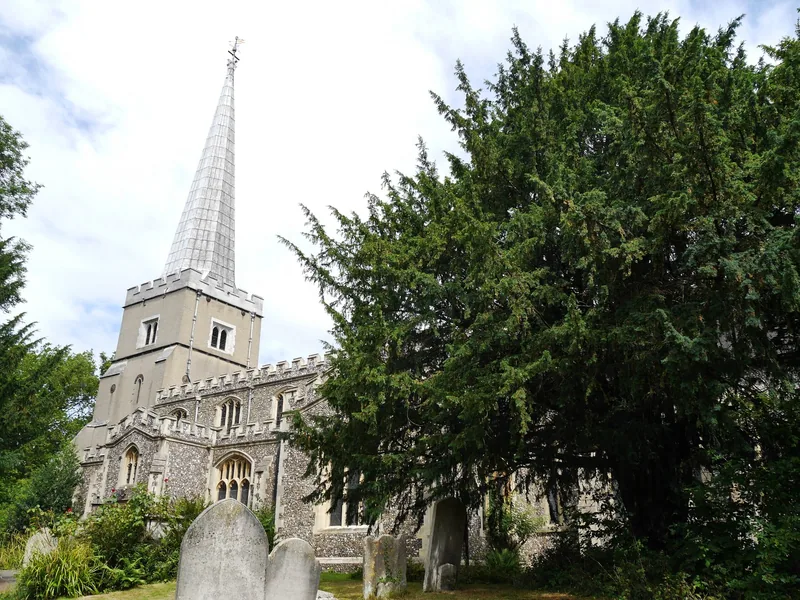
Photo: Edwardx · CC BY-SA 4.0 · Wikimedia Commons · resized
The High Street, which is the real reason to come
Harrow's High Street runs along the ridge and is the best-preserved village street in this part of London. It is narrow, it bends, the pavements are uneven, and the buildings are a mixture of seventeenth-century brick, Georgian fronts and Victorian school buildings in an emphatic Gothic.
Most of it belongs to the school, and that is visible: boys in uniform crossing between houses, boards showing where the sports teams are playing, a bookshop and an outfitter serving the school rather than the public. The school's own visitor reception is in the Bursary, just off the High Street through a passage called Obadiah Slope, and there are public lavatories in the Bursary, the Sports Centre and the Shepherd Churchill Building.
Walking the street takes twenty minutes; doing it properly, with the side lanes and the churchyard, takes an hour. Few places in London reward simply looking at buildings this well without asking you to go inside any of them.
What a visitor can and cannot see of the school
This needs saying plainly, because the internet is vague about it. Harrow School is a boarding school with boys living on the site. There is no general public tour, no ticket office and no set visiting hours for the buildings. You can walk the public roads and paths through the school's grounds, which is how most of the hill works, and you can look at the outside of everything.
The school does hold a collection, the Old Speech Room Gallery, with objects ranging from antiquities to manuscripts and the school's own archive. Its website describes the collection but publishes no public opening hours for it, so anyone who wants to see it should contact the school through its visitor information page rather than turning up.
What is genuinely open is the arts programme. The school publishes an arts calendar each term with concerts and drama in its own venues, and these are the occasions when an outsider can legitimately be inside the buildings. Check the current term's calendar before you plan an evening around it.
St Mary's and the view
The church at the top of the hill is medieval, and its tall lead spire is the thing you see from miles away across west London: it is the marker that tells you which hill is Harrow. The churchyard is the best free viewpoint in this part of the city, and it is the reason to make the climb even if the school means nothing to you; our survey of London's best free viewpoints ranks it against the ones in the centre.
From the western and northern edges of the churchyard the ground drops away sharply and the view runs out across the suburbs. On a clear day you can pick out the arch at Wembley to the south-east and the cluster of towers in the City beyond it, with the Chiltern ridge on the north-western horizon. The traditional description is a view across three counties, which is a Victorian formula rather than a modern one, since Middlesex no longer exists as a county.
The churchyard also holds a flat tombstone that is pointed out as the one the schoolboy Byron used to lie on, looking at the view. Treat that as tradition rather than documented fact, which is how the school treats it too. Either way it is a good place to sit.
Headstone Manor, which is not on the hill
The borough's museum is two and a half miles north-west and it is free. Headstone Manor holds a medieval manor house inside a moat that still has water in it, a great barn, and Harrow Museum in the buildings around them. Entry to the site and the museum costs nothing.
It opens Tuesday to Sunday from 10am to 4pm, closed Monday, with last entry half an hour before closing, and the Moat Café keeps the same hours. Winter hours have applied since 2 November 2026 and last until 14 February 2027: the museum opens Thursday and Friday from 10am to 3pm and Saturday and Sunday from 11am to 3pm, and the café Thursday to Sunday from 11am to 4pm.
It is a different trip rather than an extension of the hill, because it needs a bus or a train and the two sites are not within walking distance of each other. If you have a full day in Harrow, do the hill in the morning and the manor after lunch.
Eating and drinking on the hill
A handful of cafes, pubs and restaurants sit along the High Street and the lanes off it; the school's visitor information names them for parents. It is a short list that turns over, so we do not copy it here.
What is worth knowing is the pattern. The hill is busy at lunchtime on weekdays in term and much quieter at weekends and in the holidays, which is the reverse of most of London. Arrive on a Sunday in August and you may find a closed door where a pub was shown as open, so check before you climb rather than after.
The larger choice is at the bottom of the hill in the modern town centre, around the station and the shopping centre, where Harrow's South Asian and East African communities have left a strong run of South Indian, Gujarati and Sri Lankan food. Our guide to curry in London explains how to read that kind of menu, Sri Lankan and Tamil food covers the southern end of it, and Southall is the larger version of the same thing further west.
Postcodes, and why Harrow is not "London"
Harrow is inside Greater London, is served by the Underground and sits in fare Zone 5, but its postal address is not London: letters go to Harrow, Middlesex, in the HA postcode area. That inconsistency confuses visitors booking accommodation, because a hotel listed as "London" may be nowhere near here and one listed as Harrow may be twenty minutes from Baker Street.
Our guide to London postcodes explained sets out which addresses inside Greater London are not posted as London, and why the numbers in a London postcode are not rings around the centre.
The practical version for a day trip: the Zone 5 fare matters more than the postcode. A journey from Zone 1 to Zone 5 and back is covered by the daily cap, which is £15.30 for Zones 1 to 5, so Harrow plus a second outer trip in the same day costs no more than Harrow alone. Our page on London travel zones explains how the zones are laid out.
Who it is for
Come if
- You like looking at buildings and do not need a ticket to enjoy a place
- You want the best free view in north-west London
- You have a week in London and have done the centre twice
- You are interested in English schools and how they shaped the country
- You want somewhere quiet on a Sunday
Skip it if
- Steep hills are a problem and you will not take the bus up
- You expected a tour of the school, because there is not one
- You have three days in London or fewer
- You want shops, museums or anything indoors
If you are collecting the outer edges of London, Wembley is fifteen minutes away on the H17 and is the natural pair. Further out on the same Metropolitan line, the countryside starts surprisingly quickly, and our guide to the Metropolitan and Hammersmith & City lines explains how far that line actually goes.
Frequently asked questions
Can you visit Harrow School?
Not as a ticketed attraction. It is a working boarding school with no public tour, no box office and no set visiting hours for its buildings. You can walk the public roads and paths across the hill and look at everything from the outside, and the school's termly arts calendar lists concerts and plays that outsiders can attend.
How long does it take to get to Harrow on the Hill from central London?
About 20 minutes from Baker Street on a Metropolitan line train, and the station is in Zone 5. Add ten minutes for the steep walk up to the High Street, or take the 258 or H17 bus, which stop at the school itself every 15 to 20 minutes.
Is Harrow on the Hill worth visiting?
For two hours, if a village High Street of Georgian and Victorian brick, a medieval church and a long view interest you, and all of it is free. It is a poor choice on a short first trip to London, where the same two hours buys you far more in the centre.
Is Harrow-on-the-Hill station step-free?
The station has four lifts in TfL's station dataset, covering street to ticket hall and footbridge to platforms. The hill above it is a different matter: there is no step-free route to the summit, so use the bus if the climb is not possible.
What can you see from Harrow Hill?
From the churchyard at the top, the suburbs of north-west London, with the arch at Wembley and the towers of the City visible on a clear day and the Chiltern hills on the north-western skyline. Victorian guidebooks described it as a view across three counties, which no longer reflects how England is divided.
Sources
- Harrow School - Visitor information, directions, parking and buses (checked September 2026)
- Headstone Manor and Museum - Visit, opening times and winter hours (checked September 2026)
- Transport for London - detailed station data (lifts and step-free routes) (checked September 2026)
- Transport for London - Capping (checked September 2026)
- Transport for London - Journey Planner (sample journeys, Thursday 1 October 2026, 11:00) (checked September 2026)