
Kennington is a quiet residential district of Georgian terraces just south of the Thames, ten minutes from Westminster on the Northern line, and it is worth an hour or two for three things: Kennington Park, the old common where the Chartists gathered in April 1848; the neo-Georgian cottages the Duchy of Cornwall built before the First World War; and Cleaver Square, the earliest square south of the river.
For almost seven hundred years Kennington has belonged, in part, to the Duchy of Cornwall, the estate that funds the heir to the throne. Edward III gave the manor to his son the Black Prince in 1337, and the street names still show it: Black Prince Road, Chester Way, Duchy Street. There are no big sights. What you come for is the streets, a park with an unusually political past, and a sense of how inner London looked before the tower blocks.
Two neighbours own the busiest parts. The cricket ground at the Oval, which is also Duchy land, has its own page on watching cricket at Lord's and the Oval, and the traffic and nightlife to the west belong to our guide to Vauxhall and Oval. This page covers what lies between them.
Kennington at a glance
- Where
- Borough of Lambeth, SE11, between Vauxhall, Elephant and Castle and the Oval
- Stations
- Kennington and Oval (both Northern line); Lambeth North (Bakerloo line) for the north end
- Kennington Park
- Kennington Park Road SE11 4BE. Normally open 7.30am until 15 minutes before sunset (Lambeth Council, checked November 2026)
- Cost
- Everything on this page is free to see from the street or the park
- Time needed
- One to two hours on foot (our estimate)
- Best for
- Architecture, social history, a quiet walk after the Imperial War Museum
Kennington Common: speeches, gallows and the 1848 rally
Before it was a park, Kennington Park was Kennington Common, open land where local people grazed their animals. It lay outside the City of London and its stricter rules, and so, as Lambeth Council puts it, it became a gathering place for demonstrations, protests and speeches. It was also the place of execution for the county of Surrey. The gallows stood at the southern tip of the common, where St Mark's Church now stands.
Its most notorious executions came after the Jacobite rising of 1745. On 30 July 1746, officers of the Manchester Regiment, the English unit that had marched south with Charles Edward Stuart, were executed here, among them their colonel, Francis Towneley.
Its most famous day came a century later. On 10 April 1848 the Chartists, a mass movement demanding the vote for working men, met on the common before a planned march on Parliament with a petition they said carried two million signatures. That spring revolutions were breaking out across Europe, and the government was frightened. Troops were placed across London, the royal family was sent to Osborne House on the Isle of Wight, and Lambeth Council's history says more than 80,000 special constables were sworn in. Estimates of the crowd vary widely; the council's park page says over 25,000.
In the end the leaders accepted a compromise. The march was called off, a small delegation took the petition to Parliament, and the day passed peacefully. Soon afterwards the common was abolished and turned into a public park, one of the first in London, which Lambeth dates to 1852.
The meeting is one of the earliest photographs of a crowd. The photographer William Edward Kilburn took two daguerreotypes of the Chartist meeting, and Prince Albert bought both in 1848. They are in the Royal Collection, which describes the platform for speakers, the banners and a tall factory chimney behind the crowd. You can see them on the Royal Collection's website, not in the park.
What to look at in Kennington Park today
The park is now a Grade II registered historic park, and the Victorian layout is still there under the sports pitches. Enter from Kennington Park Road and look for three things.
- Prince Consort Lodge, just inside the entrance, is a model house for working families designed by Henry Roberts for Prince Albert and shown at the Great Exhibition in Hyde Park in 1851. It was rebuilt here afterwards. Historic England lists it at Grade II* and notes that, to reduce the risk of fire, no wood was used in its main structure: the ceilings are brick vaults and the stairs are slate.
- The terracotta column on the west side of the park started life as a drinking fountain, made by Doulton of Lambeth for the International Exhibition of 1869. Its bowl was removed after war damage. On top is a family group by George Tinworth called "The Pilgrimage of Life".
- The Flower Garden at the heart of the park, an old English formal garden recently restored with lottery money, is the best place to sit.
The park also has a café, toilets, a playground, tennis courts and the Bee Urban beekeeping centre. The extension on the far side of the road, added in 1951, is used for cricket. Opening hours run from 7.30am until a quarter of an hour before sunset, so on a winter afternoon the gates shut before 4pm.
The Duchy of Cornwall estate, and how much of it is left
The Duchy did little to control building here for most of the 19th century. That changed in the early 20th, when it decided to rebuild part of its Kennington land as model housing for its tenants. The architects Adshead and Ramsey designed Courtenay Square, Courtenay Street and Cardigan Street in 1913 to 1914: two-storey cottages in yellow stock brick with wooden trellis porches, curved lead hoods over the doors and low iron railings. Lambeth's conservation area statement says the scheme recalls the best town planning of the 18th century.
Walk down Courtenay Street and look up at the rainwater heads on Nos 22 to 30: they carry the Prince of Wales's feathers, the badge of the Duchy. The same architects designed the Regency-style shopping parade on Kennington Lane for the Duchy in the same years. Denny Crescent nearby was also built by the Duchy, and several of these terraces are listed at Grade II.
It is often said that the Duchy still owns all of this. It does not. The Duchy's own page describes its Kennington holding today as a mix of 40 homes and more than 15 commercial properties, plus the Oval cricket ground, which it has leased to Surrey County Cricket Club since 1845. Most of the houses you are looking at are now privately owned. In November 2026 the Duchy had submitted plans for 351 new homes on the former Archbishop Tenison's School site at 55 Kennington Oval (checked November 2026).
Cleaver Square, the oldest square south of the river
Cleaver Square, off Kennington Park Road, was laid out in 1789, and Lambeth's conservation area statement describes it as the earliest square south of the Thames. It was called Princes Square until 1937. The houses round it are terraces of three storeys and a basement from the late 18th and early 19th centuries, in stock brick with round-arched doorways and fanlights, much rebuilt over the years and listed for their value as a group.
The centre was a grassed plot as early as 1791. Lambeth Council bought it in 1927 to stop it being built on, and it is also protected under the London Squares Preservation Act 1931, which means it cannot be used for anything other than an open garden. It is an easy, peaceful place to stop. Do not expect grandeur on the scale of the Bloomsbury squares: this is a small residential square, and its charm is how intact it is.
Kennington Road, and Charlie Chaplin's childhood
Kennington Road is the spine of the area, a straight Georgian road running south from Lambeth North. The long terrace at Nos 233 to 291, on the east side, is a late 18th-century row with pediment and arcaded ground floors, listed at Grade II and partly rebuilt after bomb damage.
Charlie Chaplin spent most of his childhood in Lambeth, moving between rented rooms and, at times, the workhouse. Lambeth's conservation area statement names two of his Kennington addresses, 39 Methley Street and 287 Kennington Road, both of which carry commemorative plaques. The official English Heritage blue plaque is a short walk south, at 15 Glenshaw Mansions on Brixton Road, the top-floor flat he shared with his brother Sydney from 1908 to 1910, which he later remembered as his first real home.
The workhouse Chaplin entered as a child survives in part as the Cinema Museum, ten minutes east of Kennington Park. It opens only for tours and events, so check before you walk over.
A walk that links it all, in about 90 minutes
- Start at Kennington station. Cross Kennington Park Road into Kennington Park: Prince Consort Lodge, the Doulton column, the Flower Garden.
- Leave by the southern corner for St Mark's Church, on the site of the old gallows, with its First World War memorial cross in front.
- Walk north up Kennington Park Road to Cleaver Square.
- Continue west through the back streets to Courtenay Square and Courtenay Street for the Duchy cottages and the feathered rainwater heads.
- Finish on Kennington Road, then either walk north towards Lambeth North and the Imperial War Museum, or south-west to the Oval.
It is a flat walk of roughly two miles (our estimate). The district has several pubs and cafés on Kennington Road and Kennington Lane; check any you choose on the Food Standards Agency register first, as our guide to food hygiene ratings explains.
Is Kennington worth a detour?
For most first-time visitors, only as part of something else. It has no museum of its own apart from the Cinema Museum's occasional openings, and the streets, though handsome, are quiet and residential. If you are staying near the South Bank or have tickets for the Oval, it is a pleasant extra hour. If you are interested in the history of democracy, housing or Chaplin, it is genuinely worth the Tube ride.
Combine it with the Imperial War Museum to the north, or with Elephant and Castle to the east. South of the Oval, Brixton Road leads on to Brixton, a much livelier place for an evening.
Getting there and getting around
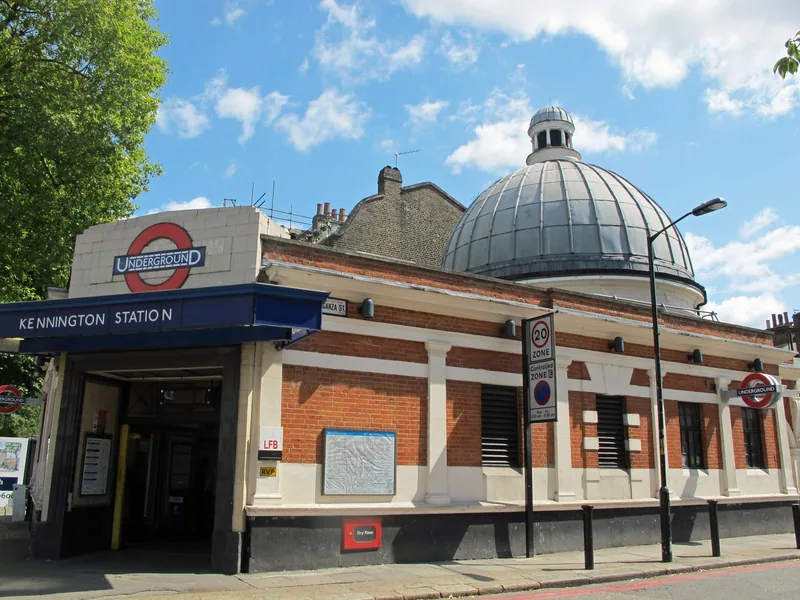
Kennington station is on the Northern line, and it is where the line's Charing Cross and Bank branches meet, so trains from both come through. From Charing Cross or Embankment it takes a few minutes. Oval, one stop south, is closer to the cricket. Lambeth North on the Bakerloo line serves the northern end of Kennington Road.
Many buses run along Kennington Road and Kennington Park Road between central London and Brixton or Camberwell. The area is flat and easy on foot; Westminster Bridge is about a 25-minute walk from Kennington Park (our estimate).
Frequently asked questions
What happened on Kennington Common in 1848?
On 10 April 1848 the Chartists held a mass meeting there before a planned march to Parliament with a petition demanding the vote for working men. The government brought troops into London and swore in tens of thousands of special constables, but the march was called off and the petition was taken to Parliament by a small delegation.
Does the Duchy of Cornwall still own Kennington?
Only a small part. The Duchy has held land in Kennington since 1337 and still owns the Oval cricket ground, but its own figures give its holding as about 40 homes and more than 15 commercial properties. Most of the houses in the area are now privately owned.
Where did Charlie Chaplin live in Kennington?
Lambeth Council names 39 Methley Street and 287 Kennington Road among his childhood addresses, both with commemorative plaques. English Heritage's blue plaque is at 15 Glenshaw Mansions on Brixton Road, where he lived with his brother Sydney from 1908 to 1910.
Is Kennington a nice area to visit?
It is a pleasant, quiet residential area with fine Georgian terraces and a historic park, best for an hour or two on foot. It has few sights of its own, so most visitors combine it with the Imperial War Museum, the Oval or the South Bank.
Sources
- Lambeth Council - Kennington Park (checked November 2026)
- Lambeth Council - Commemorate 1848's Chartist rally on Kennington Common (checked November 2026)
- Lambeth Council - Kennington Conservation Area Statement 2012 (checked November 2026)
- Royal Collection Trust - The Chartist Meeting on Kennington Common, 10 April 1848 (checked November 2026)
- Duchy of Cornwall - London estate (checked November 2026)
- English Heritage - Blue plaque: Charlie Chaplin (checked November 2026)
- Historic England - Lodge at entrance to Kennington Park, list entry 1185790, Grade II* (checked November 2026)
- Historic England - 1-15 Courtenay Square, list entry 1299968, Grade II (checked November 2026)