
Vauxhall looks like nothing from Vauxhall Bridge: a one-way traffic system, a bus station under a folded steel roof, a railway viaduct and a very tall block of flats. Walk two hundred metres south into it and there is an eighteenth-century pleasure garden with a city farm in it, a park with a lavender field, London's Portuguese high street, and a cricket ground where Test matches have been played since 1880. None of that is visible from the bridge, which is why almost nobody stops.
Oval is the next station south on the Northern line, and the two belong together: one junction, one cricket ground, one long railway viaduct with clubs under it, and a residential grid of Georgian and Victorian terraces behind.
This is a place to stay in rather than a place to visit, and it is good at that. Vauxhall is seven minutes from Oxford Circus on the Victoria line, it is in fare zones 1 and 2, and the hotels are cheaper than anything the same distance north of the river.
Vauxhall and Oval at a glance
- Where
- Lambeth, SE11 and SW8, north bank of nothing: this is the south bank of the Thames
- Vauxhall station
- Victoria line, South Western Railway, bus station, taxi rank. Fare zones 1 and 2
- Oval station
- Northern line, Zone 2. TfL's station data records no lifts, so it is not step-free
- To Oxford Circus
- 7 minutes from Vauxhall, £3.10 peak or £3.00 off-peak. About 14 minutes from Oval with a change, £3.60 or £3.10
- Best free thing
- Vauxhall Pleasure Gardens, Tyers Street SE11 5HL, open 24 hours
- After dark
- Two separate crowds: a club crowd around the arches and a quiet residential one everywhere else
The gyratory, and the scheme that has not happened
The junction at Vauxhall Cross is a one-way system built for traffic, with the bus station sitting on an island in the middle of it and four main roads feeding in. It is loud, it is confusing on foot, and the pedestrian crossings take you the long way round.
It is also supposed to be going. Transport for London has a scheme to return Parry Street, Wandsworth Road, Kennington Lane and South Lambeth Road to two-way working, put in segregated cycle lanes and rebuild the bus station to suit the new layout. Lambeth Council approved planning permission for the bus station buildings in February 2018. TfL's own project page, read in September 2026, refers to a public consultation that closed in January 2016 and gives no construction dates at all.
The practical effect for a visitor is this: the interchange works, the bus station has shelter, toilets and information, and it is not about to change. Vauxhall is a genuinely good bus hub, with routes fanning out across south London, and our guide to London night buses explains why that matters more here than the Tube does after midnight.
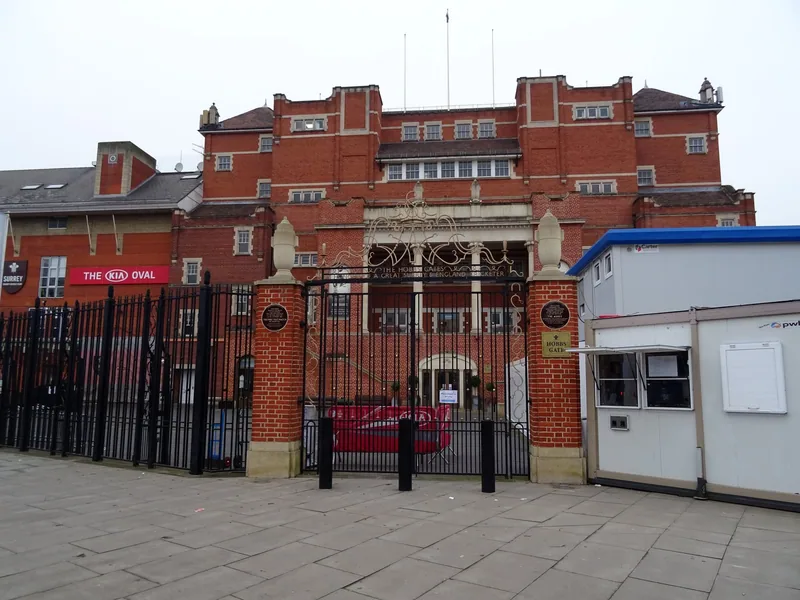
Photo: Spudgun67 · CC BY-SA 4.0 · Wikimedia Commons · resized
Vauxhall Pleasure Gardens, which is older than it looks
The single best thing here is a park most visitors walk past. The Vauxhall Pleasure Gardens on Tyers Street occupy part of the site of the original gardens, established as a private entertainment venue in 1661 and running until 1859: planted walks, supper boxes, orchestras, fireworks and balloon ascents, with Handel and Casanova among the people who came. The site was built over with terraced housing, cleared after the Second World War and laid out as a public park.
Lambeth has invested in it recently: a multi-use games area, new tree planting, meadow grassland with spring bulbs, and entrance columns topped with figures in seventeenth-century dress, which are the clearest signal of what the ground used to be. It is a designated Site of Importance for Nature Conservation, it has won a Green Flag Award and London In Bloom's Park of the Year, and it is open 24 hours a day.
On its eastern side is Vauxhall City Farm, with paddocks for horses and livestock spilling into the park itself. Lambeth's page confirms the farm and its paddocks; for the opening days, the suggested £4 donation and the last-entry time, see our guide to city farms and playgrounds, which checked them with the farm and warns that the farm describes its own days as typical rather than fixed.
Vauxhall City Farm and the Pleasure Gardens together are the best free hour with children in this part of London. The farm has a riding school, the park next to it has a games area and a meadow, and both are five minutes from the station. Self-organised groups of families meeting up are asked to book as a group, so turn up as separate families or contact the farm first. Check the farm's own days before travelling.
Vauxhall Park and the lavender
Ten minutes south-east, on Fentiman Road, is a second and quite different park. Vauxhall Park has a large playground, tennis and basketball courts, a cafe, an orchard and a dog exercise area, and it is normally open from 07:30 until fifteen minutes before sunset.
Its oddity is a lavender garden, planted in 2003 on the site of the old bowling green to mark the centenary of the Vauxhall Motor Company, which began in this district before moving to Luton. In late June and July it is genuinely worth the walk. Both parks are better places to eat than anything in the gyratory, and our guide to picnic supplies and self-catering covers what to buy and the rules on barbecues and alcohol, which differ by borough.
The Oval, and the cricket
The Oval is one of the two Test grounds in London and has staged international cricket since 1880. It is the home of Surrey County Cricket Club, it traditionally hosts the final Test of the English summer, and it sits directly beside Oval station in a residential street pattern that makes match days unmistakable: 25,000 people walking out of a Tube station designed for a few thousand.
Tickets, tours and what a day at the cricket actually involves are in our guide to watching cricket at Lord's and The Oval. Two practical notes belong here. Oval station has no lifts recorded in TfL's station data, so it is stairs from platform to street, and on a match day the queues at the barriers are long; our page on step-free travel in London explains the alternatives. And Vauxhall, ten minutes' walk away on the Victoria line, is the better station for getting home afterwards.
The gasholders behind the ground, long a part of every television shot of The Oval, are the other thing people notice. The site around them is being redeveloped, so the skyline behind the cricket is changing.
The arches, and the two nights of Vauxhall
The railway viaduct that carries every train into Waterloo runs through Vauxhall on brick arches, and for forty years those arches have held clubs. Vauxhall is one of the two historic centres of LGBTQ+ nightlife in London, alongside Soho, and the club nights here run later than almost anywhere else in the city.
The Victorian tavern on Kennington Lane is the institution, known for cabaret, drag and club nights rather than for food, and it is covered properly in our guide to LGBTQ+ London. We mention it as a landmark rather than as a place to eat.
Door policies, ticketing and getting home are in our guide to London nightlife. The Victoria line runs all night on Friday and Saturday, which is the single reason Vauxhall works as a club district.
The other Vauxhall, on the same streets on a Tuesday, is a quiet residential district of Georgian terraces, garden squares and a very large number of people walking dogs. Bonnington Square, five minutes east of the station, is the clearest example: a square of 1870s houses with a community-run garden in the middle, saved from demolition by its residents, and almost completely unvisited.
South Lambeth Road, which is Portuguese
The stretch of South Lambeth Road running south from Vauxhall towards Stockwell is the centre of Portuguese London: cafes with custard tarts and pastel-coloured tiles, delicatessens, a couple of restaurants and a betting shop showing Primeira Liga football. It is not a tourist street and it does not present itself as one.
Our guide to Portuguese and Brazilian food in London covers it properly, including which of the cafes are worth stopping at and what to order. A coffee and a pastel de nata standing at the counter is the cheapest good ten minutes in Vauxhall.
Where to eat, and the Georgian house in the traffic
Vauxhall has never had many restaurants, and the gyratory is the reason: there is no high street, only roads. Three places are worth knowing.
The strangest is a Georgian house at 30 Wandsworth Road, stranded on the edge of the junction and filled with architectural salvage, chandeliers and mismatched furniture, with a restaurant running through the ground floor. It was rated 5 for hygiene in January 2026, and it is the one place here that people cross London for. Booking is sensible.
Beyond that, the arches and the new blocks along Albert Embankment hold a scattering of cafes and bars aimed at office workers and residents.
For a proper dinner, walk. Pimlico is over the bridge in ten minutes and Nine Elms and Battersea Power Station are fifteen minutes west along the river, with far more choice than anything here.
The riverside walk west from Vauxhall Bridge is the best way out of the junction. Fifteen minutes on the Thames Path takes you past the new American embassy at Nine Elms, which opened in 2018 and is the one building in the district anybody photographs, and on to Battersea Power Station. Walking east instead brings you to Tate Britain across the bridge in about twelve minutes, and it is free.
Getting in and out
Vauxhall is on the Victoria line, which is the fastest line in London and reaches Oxford Circus in seven minutes and King's Cross in about twelve. South Western Railway trains from the same station serve Clapham Junction, Richmond, Kingston and Windsor, so you can be at a mainline platform without going into Waterloo. TfL's station data records lifts to both the Victoria line platforms and the National Rail platforms.
Oval is on the Northern line, in Zone 2, about fourteen minutes from Oxford Circus with a change. Two stops north on the same line is Elephant and Castle, which has the latest-opening food hall in London and is the obvious place to eat if Vauxhall has nothing you want. The river bus calls at St George Wharf Pier beside Vauxhall Bridge on the weekend Battersea route; our guide to the Uber Boat river bus explains that its fares sit outside the daily cap.
Vauxhall Bridge itself is worth the crossing on foot for the eight bronze statues on its piers, which face outwards over the water and are almost impossible to see from the pavement; our walking guide to London's bridges covers them.
Frequently asked questions
Is Vauxhall a good place to stay in London?
For value, yes. It is in fare zones 1 and 2, seven minutes from Oxford Circus on the Victoria line, and hotel prices are lower than in comparable areas north of the river. The drawbacks are real: no high street, few restaurants, and a large one-way traffic system in the middle of it.
What is there to see in Vauxhall?
The Pleasure Gardens on Tyers Street, on the site of the eighteenth-century gardens and open 24 hours; Vauxhall City Farm beside them; Vauxhall Park's lavender garden ten minutes south-east; the Portuguese cafes on South Lambeth Road; and The Oval cricket ground. Tate Britain is twelve minutes over the bridge. Newport Street Gallery, Damien Hirst's free gallery on the back streets towards Lambeth North, is closed with no reopening date, so check before you walk over.
Is Oval station step-free?
No. Transport for London's detailed station data records no lifts at Oval, so it is stairs between the Northern line platforms and the street. Vauxhall, about ten minutes' walk away, has lifts to both its Victoria line and National Rail platforms and is the better choice if steps are a problem.
Why is Vauxhall known for nightlife?
The railway arches under the viaduct have held clubs for decades, and Vauxhall is one of the two historic centres of LGBTQ+ nightlife in London alongside Soho. The Victoria line's all-night Friday and Saturday service is what makes it work, since many of the nights run into the morning.
How long does it take to walk from Vauxhall to Battersea Power Station?
About fifteen minutes west along the Thames Path, passing the American embassy at Nine Elms on the way. It is flat, paved and well lit, and it is a considerably more pleasant route than the parallel roads through the Nine Elms building sites.
Sources
- Lambeth Council - Vauxhall Pleasure Gardens: address, 24-hour opening, history and the city farm (checked September 2026)
- Lambeth Council - Vauxhall Park: facilities, opening hours and the 2003 lavender garden (checked September 2026)
- Transport for London - Vauxhall gyratory scheme (status as published, September 2026) (checked September 2026)
- Transport for London - detailed station data (lifts, platforms and fare zones at Vauxhall and Oval) (checked September 2026)
- Transport for London - Single Fare Finder (checked September 2026)
- Food Standards Agency - Food hygiene rating search (checked September 2026, for every business referred to here and for the inspection dates given)