
Cutty Sark is the only tea clipper left in the world: a three-masted sailing ship built in Scotland in 1869, now standing in a dry dock beside the Thames in Greenwich, raised three metres off the ground so that you can walk under her hull. An adult ticket is £22 and a child's £11, and the ship opens every day from 10am to 5pm, with last entry at 4.15pm.
A clipper was a narrow, fast merchant ship with an enormous spread of sail, built to win races home with the first tea of the season. Cutty Sark carried tea from China for eight years and wool from Australia for twelve more, then spent half a century as a Portuguese cargo ship and a training ship before she came to rest in Greenwich in 1954.
With the Royal Observatory on the hill shut since 2 November 2026, Cutty Sark is the one Royal Museums Greenwich site you pay for that is open at all. Our guide to Greenwich covers the whole town; this page is about the ship, what a visit involves and how to fit it into a day.
Cutty Sark at a glance
- Where
- King William Walk, Greenwich SE10, two minutes from Cutty Sark DLR station
- Opening hours
- Daily 10am to 5pm, last entry 4.15pm (Royal Museums Greenwich, checked November 2026)
- Adult (16+)
- £22
- Child (4-15)
- £11 on the ticket card and booking panel; £12 in the price table further down the same page (November 2026)
- Student
- £16.50 on the ticket card; £18 in the price table (November 2026)
- Under 4
- Free
- Early closures
- 13 November and 10 December 2026, whole ship closes at 4pm for private events (checked November 2026)
- Sea Shanty Festival
- Saturday 21 November 2026, 10am to 6pm, free with a ship ticket (checked November 2026)
- Time needed
- About 60 to 90 minutes (our estimate, November 2026)
A ship built for a race that the Suez Canal ended
Cutty Sark was built at Dumbarton on the Clyde for the London shipowner John "Jock" Willis, to a design by Hercules Linton, and named at her launch on 22 November 1869. Her home port was London. On her first voyage she left the Thames in February 1870 with wine, spirits, beer and manufactured goods, reached China at the end of May, and came back from Shanghai with 1,305,812 pounds of tea, docking in London on 13 October.
The timing was terrible. The Suez Canal opened in the same week as her launch, and it cut more than 3,000 miles off the voyage to China. Steamships could use the short cut; for a sailing ship the winds in the Mediterranean and the canal were difficult and the tolls expensive. Steamers could now get the tea to London at least ten days sooner, and after eight voyages a ship designed for nothing else was out of work.
Her best years came afterwards. From 1883 she carried wool from Australia, and on her first wool voyage she reached London at least 25 days ahead of her rivals. Captain Richard Woodget, who took command in 1885, brought her from Sydney to London in a record 73 days in 1886. The wool years are where her reputation as the fastest ship of her day was earned.
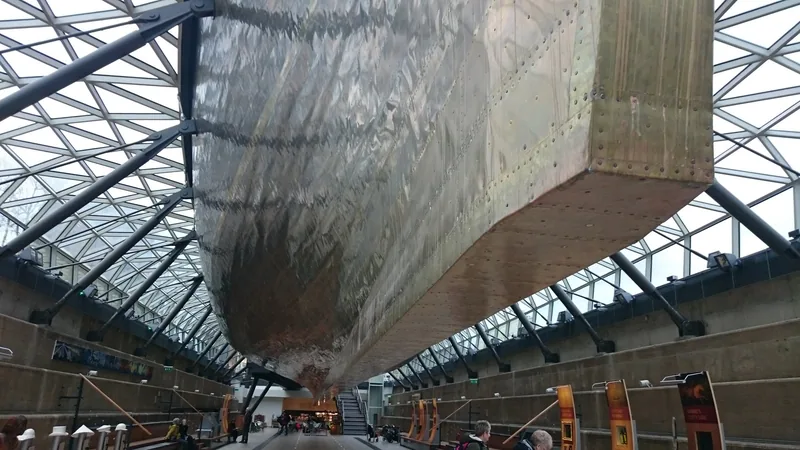
Photo: LondonHistoryatHome · CC BY-SA 4.0 · Wikimedia Commons · resized
How she ended up in a hole in the ground at Greenwich
In 1895 Willis sold her to a Portuguese firm. Renamed Ferreira, she worked for almost thirty years as a general cargo ship between Portugal and its colonies, and came through the German submarine campaign of the First World War undamaged. In the early 1920s, damaged by bad weather, she put into Falmouth in Cornwall, where a retired sea captain, Wilfred Dowman, recognised her. He had watched her overtake his own ship as an apprentice. He paid £3,500, more than she had been worth in 1895, and gave her back her old name in 1923.
The Dowmans restored her as a cadet training ship at Falmouth, and after his death his widow, Catharine, gave her to the Incorporated Thames Nautical College at Greenhithe in Kent, where she trained cadets until the end of the Second World War. After the war the Cutty Sark Preservation Society, backed by the Duke of Edinburgh, raised the money for a permanent dock.
On 10 December 1954 she was floated into a dock dug specially for her beside the river at Greenwich, through a channel cut in the river wall, with 45 centimetres of water under her keel. She has not floated since. Queen Elizabeth II opened her to the public in 1957. She had never once docked at Greenwich in her working life. The London County Council had offered the site to an older warship, HMS Implacable, which was sunk at sea instead.
The 2007 fire and why the hull now hangs in the air
By the 1990s it was clear that the ship would not survive into a third century without major work. A conservation project began in 2006, and in May 2007 a fire tore through all three decks.
The timing, this time, was lucky. Because the work was already under way, the original masts and many of the hull planks had been taken off and put into storage before the fire. Royal Museums Greenwich says that about 90 per cent of the ship you see today is original fabric. The fire made the project 18 months longer and £10 million dearer than planned.
The rebuild is what makes the visit unusual. To preserve the shape of the hull, the ship was lifted three metres and held on new props that spread her weight evenly, the keel, main deck and sheathing were replaced, and a glass roof was built around her at the old waterline, so that everything below it is indoors and out of the weather. The Queen reopened the ship on 25 April 2012, almost 55 years after she had first done so.
The new Nannie on the bow is a 2021 carving. The figurehead, a witch called Nannie from Robert Burns's poem Tam o' Shanter, was replaced after the previous one was found to be rotting. The new carving, by Andy Peters, was lifted into place on 11 June 2021 and follows a design by Linton that came to light later. In the poem a "cutty sark" is a short shift, the only garment Nannie wears while chasing Tam.
The route through the ship, deck by deck
There is a set route, and it goes from the bottom up and then underneath.
- Lower Hold. You enter at the bottom of the ship, among stacks of tea chests. It is dim, it smells of tea, and the narrowest point is 80 centimetres wide. The cargo story is told here: tea, wool, even pianos.
- 'Tween Deck. Twelve steps up (or a lift). This is the deck with the most to touch. Somewhere on board there is also a hands-on exhibit in which you try to steer the ship from Sydney to London, along with films, old photographs and interactive ship plans.
- Main Deck. Another twelve steps or the lift, and you are outside among the masts and rigging. The master's cabin, the sailors' cabin and the fo'c'sle (the crew's quarters at the bow) are here, and a five-step staircase leads to the anchor deck and Liverpool House. Costumed characters playing Willis, the ship's cook or Captain Woodget appear on board, and volunteer explainers are around through the week.
- Under the hull. You cross a small bridge and take a lift, or 61 steps, down to the dry berth beneath the ship. You can reach up and touch the metal sheathing. This is also where the café is, and the display on Black and Asian sailors who served on Cutty Sark and other British ships.
The ship is compact. An hour is enough to see everything without hurrying; ninety minutes is more realistic with children who want to play the steering game twice, or if you follow the free audio guide, which has 22 chapters on the Smartify app. Bring your own headphones for it.
Children of about five to twelve get the most from it, with something to touch on every deck; our family travel guide has more for that age. If one historic ship in your life was enough, admire this one free from the riverside, where the rigging and the figurehead are seen best anyway.
Steps, lifts and the one-wheelchair-per-deck rule
The 2012 rebuild made wheelchair access a priority, and there are five lifts: two platform lifts in the dry berth, one inside the ship, and two larger ones in the access tower linking street level, the main deck and the level under the hull. Two limits matter. Only one wheelchair user can be on each deck at any one time, and staff cannot help wheelchair users around the site. A small number of wheelchairs can be booked free in advance by telephone, but they cannot be taken off the ship. The anchor deck, up its five steps, has no lift. The access page also maps which parts are dark, loud or strong-smelling.
What a visit costs, and the discounts
The prices at the top of this page are the ones Royal Museums Greenwich shows on its ticket cards and booking panel. Its own price table, lower on the same page, still gives £12 for a child and £18 for a student. The booking stage is what you will actually pay, so check it there.
| Who | Cost (November 2026) |
|---|---|
| Two adults | £44 |
| Two adults and two children aged 4 to 15 | £66 at £11 a child (£68 at the table's £12) |
| Two adults, one child of 8, one toddler under 4 | £55 |
| Carer accompanying a disabled visitor | Free |
| Visitors on Universal Credit and other listed benefits | £3 each |
The £3 tickets cover Universal Credit and several other UK benefits listed on the ticket page. There are also discounts with an Art Pass, Museums Association membership and English Heritage membership, and 10 per cent off with a Max Card. Royal Museums Greenwich members go free.
Tickets are sold with an entry time, and the museum recommends booking online to be sure of getting in. Tickets on the day depend on availability; we would book ahead for a Saturday or a school-holiday week. The afternoon tea served under the hull includes entry to the ship; the museum's pages gave two different sets of prices for it in November 2026, so take the figure from the booking page. Our page on afternoon tea in London puts it in context.
The rest of Maritime Greenwich costs nothing. With the Observatory shut, the ship is the only Royal Museums Greenwich site with an entry charge in November 2026. The National Maritime Museum and the Queen's House are free (only special exhibitions and shows cost extra), so a family day need cost no more than the £66 for the ship.
Planning Greenwich while the Observatory is shut
The standard Greenwich day used to be the ship in the morning and the Royal Observatory in the afternoon. The whole Observatory site closed on 2 November 2026 for the First Light rebuilding project, and the only reopening Royal Museums Greenwich has announced is for the Meridian Courtyard, in summer 2027. Do not walk up the hill expecting to stand on the Prime Meridian line. Our page on Greenwich while the Royal Observatory is closed sets out the alternatives in full.
A day that works now: Cutty Sark when it opens at 10am, then a short walk to the National Maritime Museum, where the Observatory's astronomers and the planetarium shows have moved for the duration. After lunch, cross to the Queen's House, or pay for the Painted Hall at the Old Royal Naval College, which is run separately and is not covered by your ship ticket. Greenwich Park is still open for a walk; only the Observatory enclosure at the top is shut.
Food is the easy part: the ship's own café is for ticket holders only, and our Greenwich eating guide covers the town around it. On a weekend, the covered market is three minutes away. Our older page on the Royal Observatory and Cutty Sark has the Observatory's background.
Getting there by DLR, train or river
The quickest way is the DLR to Cutty Sark (for Maritime Greenwich) station, which comes up two minutes from the ship. Lewisham-branch trains run there directly from Bank and Canary Wharf; sit at the front, as our page on riding the DLR in the front seat explains.
Trains from London Bridge and Cannon Street stop at Greenwich, the closest main-line station to the ship; it is a walk of roughly ten minutes (our estimate). The prettiest arrival is by river: the Uber Boat stops at Greenwich Pier, which is right beside the ship, and our river bus guide covers fares and routes. And if you are coming from the north bank, the foot tunnel under the Thames comes up in the domed brick building a few metres from the bow.
Frequently asked questions
How much does it cost to go on the Cutty Sark?
An adult ticket costs £22 and a child's ticket £11 for ages 4 to 15, according to the ticket cards on the Royal Museums Greenwich website in November 2026; the price table on the same page still says £12. Under-4s go free, and carers of disabled visitors go free.
How long do you need at the Cutty Sark?
Plan on 60 to 90 minutes. The ship is compact and the route is set, from the hold up to the main deck and then down under the hull. Families who stop for every hands-on exhibit and the costumed characters will need the longer end of that.
Is the Cutty Sark worth visiting while the Royal Observatory is closed?
Yes, and it is now the main paid sight in Maritime Greenwich. Pair it with the free National Maritime Museum, where the Observatory's astronomers and planetarium shows have moved, and the free Queen's House, and you still have a full day.
Why is the Cutty Sark raised off the ground?
Resting on her keel was making the old hull sag. During the restoration that followed the 2007 fire, the ship was lifted three metres and supported from the sides, which preserves the shape of the hull and lets visitors walk underneath it.
Sources
- Royal Museums Greenwich - Cutty Sark (checked November 2026)
- Royal Museums Greenwich - Tickets and prices (checked November 2026)
- Royal Museums Greenwich - Cutty Sark history (checked November 2026)
- Royal Museums Greenwich - The Cutty Sark fire and conservation (checked November 2026)
- Royal Museums Greenwich - How Cutty Sark came to Greenwich (checked November 2026)
- Royal Museums Greenwich - A history of Cutty Sark in 10 pictures (checked November 2026)
- Royal Museums Greenwich - Accessibility at Cutty Sark (checked November 2026)
- Royal Museums Greenwich - Cutty Sark closures (checked November 2026)