
Walk down almost any London high street and you will pass the same twenty or thirty shopfronts you passed on the last one. Some are bakeries, some are coffee shops, some are sit-down restaurants, and several are pubs that look independent but belong to large companies. This page explains what each kind of name actually is, so you can tell at a glance whether you are looking at a £4 lunch or a £40 dinner.
None of this is a recommendation. Chains are chains: they exist to be predictable, and a visitor who is tired, cold and travelling with children has a perfectly good reason to want something predictable. The point here is simply to remove the guesswork, because the names mean nothing to anyone who has not grown up with them.
If what you want is genuinely cheap food rather than familiar food, our guide to cheap eats in London covers markets, supermarket meal deals and set lunches, and is the better starting point. This page is about the shopfronts.
How to read a London high street
- Cheapest hot food
- The bakery chains, by a wide margin
- Fastest lunch
- Counter-service shops: you pay first, then take a bag or a tray
- Sit-down, table service
- Usually £12 to £20 for a main course outside the centre; more in the West End
- The cheapest sit-down meal
- A pub chain, where the same menu runs all day
- Always dearer
- The same brand inside a station, an airport or a big attraction
- Eat in or take away
- Eating in adds 20% VAT to cold food that would otherwise carry none
The five kinds of chain, and how to tell them apart
Almost every familiar London shopfront belongs to one of five groups. Once you can place a name in the right group, you know roughly what it costs and how long it will take.
- Bakery chains. Hot savoury pastries, sandwiches, sausage rolls, coffee. Order at the counter, pay, leave. The cheapest hot food anywhere on the street.
- Coffee chains. Coffee, tea, cake, some sandwiches. Seats, plug sockets, toilets, and no pressure to leave quickly.
- Counter-service food shops. Salads, sushi, rice bowls, burritos, soup. You queue, choose from a fridge or a hot counter, and eat in or take away.
- Casual dining restaurants. Waiter service, a printed menu, a bill at the end with a service charge on it. Pizza, pasta, burgers, curry, Asian noodles.
- Pub companies. Pubs with different names and the same owner behind them, usually serving food from a central menu.
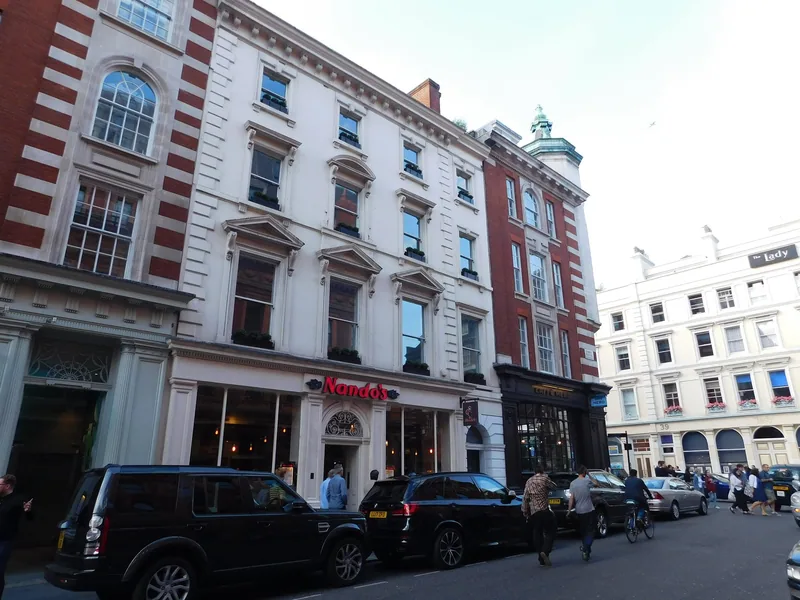
Photo: Paul the Archivist · CC BY-SA 4.0 · Wikimedia Commons · resized
Bakeries and coffee: the names you will see most often
Greggs is a bakery chain from Newcastle and it is now everywhere in London. It sells hot savoury pastries, sandwiches, doughnuts and cheap coffee over a counter, with very little seating in most branches. It is the cheapest reliable hot food in the country and nobody is embarrassed about eating it.
Pret A Manger began in London in the 1980s and sits between a sandwich shop and a coffee shop. Sandwiches, salads and soups are made up in advance and sold from open fridges; the coffee is made by a barista. It has more seats than a bakery and fewer than a café. Pret also sells a monthly subscription, Club Pret, at £5 a month (September 2026), which gives up to five barista-made drinks at half price every day, with a thirty-minute gap between them and blended drinks excluded. For a visitor staying a week and drinking two coffees a day, that pays for itself almost immediately. Check the current terms on Pret's own site before subscribing.
Costa and Caffè Nero are the two big British coffee chains, with Starbucks alongside them. Caffè Nero is Italian in style and usually the most comfortable to sit in; Costa has the most branches; Starbucks will be familiar wherever you are from. All three are ordinary coffee shops, and our guide to coffee in London explains how to order and where the independent cafés are.
Gail's is a bakery chain, but a different animal: sourdough bread, pastries, and prices closer to an independent bakery than to Greggs. You will find it in the wealthier residential areas rather than on the busiest shopping streets. Our page on London bakeries covers the independents worth a detour.
A coffee chain is the most reliable free toilet in central London. Most branches keep the toilet behind a door code printed on the receipt, so buy something small first. Our page on finding a toilet in London lists the free options, which are fewer than visitors expect.
The counter-service lunch shops
These fill the gap between a sandwich and a restaurant, and they are what office workers eat at their desks. You will see them clustered around stations and business districts and hardly at all in residential streets.
| Name | What it actually is | Useful to know |
|---|---|---|
| Itsu | Japanese-inspired: sushi, gyoza, rice bowls, noodle soups | Founded in London. Some branches discount fresh items late in the day |
| Wasabi | Sushi and hot Japanese and Korean-style dishes from a counter | Hot food by weight or by box; heavier and cheaper than it looks |
| Leon | Grilled chicken, wraps, rice boxes, chips | British, aimed at fast food you can eat every day; branches at airports |
| Tortilla | Burritos and bowls, assembled in front of you | One item usually feeds one hungry adult; you choose each filling |
| Pret A Manger | Sandwiches, wraps, soups, coffee | Fridges are restocked through the day; the hot menu is small |
All of these will feed one person a filling lunch for less than a sit-down main course, and all publish their menus and prices on their own websites and apps. Check there rather than trusting a price you read elsewhere, because branches in stations and airports are priced differently.
The sit-down chains, and roughly where each one sits
These are restaurants with waiters, and the bill behaves like a restaurant bill. In central London a main course at most of them lands somewhere in the teens, with drinks and a discretionary service charge on top; outside the centre the same menu is often a little cheaper.
- Pizza Express is the oldest of them, founded in Soho in 1965. Thin Italian-style pizza, pasta and salads, table service, and a great many branches in central London. It is the default family choice and it is competent rather than exciting.
- Franco Manca started as a single stall in Brixton Market and grew. Sourdough pizza, a very short menu, cheaper than most of its competitors and noisier. See our Brixton page for where the original is.
- Pizza Pilgrims is another London-born pizza chain, Neapolitan in style, with a handful of central branches.
- Zizzi and ASK Italian are mid-market Italian chains: pizza, pasta, risotto, in large rooms that take groups without fuss.
- Wagamama serves Japanese-inspired noodles, curries and rice dishes at long shared benches. Dishes arrive when they are ready rather than all at once, which surprises people who have ordered a starter.
- Nando's is grilled chicken in a Portuguese-Mozambican style, with a spice scale you choose from. You order at a counter or in the app and the food comes to your table, which makes it cheaper than it looks and popular with teenagers.
- Honest Burgers, Five Guys and Shake Shack are the three burger chains you will trip over most. Honest Burgers is British and does a different burger for each neighbourhood it is in; the other two are American imports.
- Flat Iron sells one cut of steak at one price with a salad, and nothing else of substance. It does not take bookings at most branches and the queue moves.
- Dishoom is not really a chain in the ordinary sense, but it has enough branches to look like one. It is an Indian restaurant modelled on the old Irani cafés of Bombay, and the queues at its central branches are long. Our page on Indian food in London sets it against the real neighbourhood cooking in Southall, Tooting and Wembley.
- Wahaca serves Mexican street food in small plates. Pho and Rosa's Thai do Vietnamese and Thai respectively, in the same casual format.
- Côte is a French brasserie chain, and is the one to head for if you want a set lunch menu with a waiter and a tablecloth without paying West End restaurant prices.
Prices at all of these change, and none of them is worth travelling for. Look at the menu in the window, which every restaurant in Britain is expected to display, before you sit down.
The pub companies, which are the ones that catch visitors out
This is the part of the high street that is genuinely confusing. A great many London pubs have individual names, hand-painted signs and Victorian tiling, and belong to companies that own hundreds of them. The pub is not fake; the menu, the beer list and the prices are simply set somewhere else.
- J D Wetherspoon pubs are the cheapest food and drink in any British town. Branches have individual names and no music. Food and drink are ordered at the bar or through the Wetherspoon app to your table, and the pub runs a different discount deal on each day of the week, from about 11.30am to 11pm, each including a drink: small plates on Monday, burgers on Tuesday, pizza on Wednesday and curry on Thursday, plus an afternoon offer from 2pm to 5pm on weekdays. Prices are not published on the website and vary from pub to pub, so check the menu in the branch or in the app.
- Nicholson's pubs are often the handsome old ones in the City and the West End, with good architecture and a decent beer range.
- Young's and Fuller's are London brewers that own large estates of London pubs. Their pubs tend to be comfortable, food-led and moderately priced, and a lot of the best riverside pubs belong to one or the other.
- Greene King is a very large national pub company, with several sub-brands.
- Samuel Smith's pubs are the strangest of the lot: the Yorkshire brewery sells only its own drinks, bans recorded music, televisions and mobile phones in its pubs, and prices are noticeably lower than the pub next door. If a pub is oddly quiet and the beer is cheap, this is usually why.
Our pages on pub etiquette and historic pubs in London cover how to order at the bar and which of the old pubs are worth the journey.
A chain pub is usually the safest bet with small children. The big pub companies have high chairs, children's menus, baby-changing facilities and a legal framework they follow carefully about who may be in the pub and until when. An independent pub may have none of those things. Our page on London with kids has more on eating out as a family.
Eating well for under £15: what actually works
It is entirely possible, and it does not involve a restaurant. The structure that works is this.
- Eat your main meal at lunchtime. Set lunch menus at sit-down chains are cheaper than the same food at 8pm, and many run until mid-afternoon.
- Take it away rather than eating in. Cold takeaway food carries no VAT; anything eaten at a table carries 20%. On a £10 lunch that is real money, and in warm weather a park bench is better than a plastic chair anyway.
- Use the app. Every big chain runs a loyalty scheme or an app with offers, and several are worth joining for a single week's visit.
- Skip the station branch. The same brand inside a mainline station, an airport or a major attraction is priced for a captive audience. Walk two streets.
- Drink tap water. Any licensed premises in England must give free drinking water on request, and a jug of tap water instead of two soft drinks changes the bill more than the food does. See our page on tap water and refill points.
Service charges, tips and what else lands on the bill
Counter-service chains do not expect a tip, though card machines may offer you the option. Sit-down chains usually add a discretionary service charge to the bill, often around 12.5% in London. It is discretionary, and you may ask for it to be taken off.
Since October 2024 an employer has been obliged by law to hand every tip, gratuity and service charge over to its workers in full, with nothing taken out, and to share them out fairly. That makes leaving the service charge on the bill a more reasonable thing to do than it once was. Our guide to tipping in London explains the rules and what happens if you pay by card.
Which chains are actually from London
A surprising number of the names you will see began here, which is mildly interesting when you are eating one. Pizza Express opened in Wardour Street in Soho in 1965. Pret A Manger started in London in 1986. Itsu, Franco Manca, Honest Burgers, Pizza Pilgrims, Wahaca, Flat Iron and Dishoom are all London businesses that grew outwards.
That does not make them better than the independents around the corner, and it does not make them local in any meaningful sense. But if someone at home asks whether you ate anything British, a sourdough pizza chain that began as a stall in a covered market in south London is a more honest answer than most.
When a chain is the wrong answer
On a day when you have time and are not carrying a tired child, the chain is almost always the worse choice. The same money buys a much better meal at a market stall, a neighbourhood café or one of the immigrant high streets that this guide spends a lot of pages on: Southall for Punjabi food, Tooting for South Indian and Sri Lankan, Deptford for Vietnamese and West African. Our overview of London's food markets is the other good answer.
Use the chains for what they are good at: a predictable breakfast before an early train, a coffee and a toilet in the rain, a lunch that takes eleven minutes, and a meal that a nine-year-old will definitely eat.
Frequently asked questions
What is Greggs and why is it everywhere?
Greggs is a British bakery chain that sells hot savoury pastries, sandwiches and cheap coffee over a counter. It has more shops in Britain than any restaurant chain, including a great many in London, and it is the cheapest reliable hot food you will find on a high street. Most branches have little or no seating.
Why does the same sandwich cost more if I eat it in the shop?
Because of VAT. Under UK tax rules, food and drink consumed on the premises where it is sold is always charged at the standard 20% rate, while cold food taken away is generally zero-rated. Shops therefore quote two prices, and choosing the paper bag saves you the tax. Hot takeaway food is standard-rated either way.
Are London pubs with different names owned by the same company?
Often, yes. Nicholson's, Young's, Fuller's, Greene King and Samuel Smith's all own large numbers of individually named London pubs, and J D Wetherspoon gives every branch its own name too. The pub may be genuinely old and handsome, but the beer list, the menu and the prices are set centrally.
Can you eat a decent meal in London for under £15?
Yes, but usually not sitting down in a restaurant at dinner time. Eat your main meal at lunch from a set menu, take food away rather than eating in to avoid the 20% VAT, avoid station and airport branches, and ask for tap water. A counter-service bowl, a pub-chain main course or a bakery lunch all come in comfortably below that figure.
Do I have to pay the service charge at a chain restaurant?
No. A service charge added before the bill is presented is discretionary unless the restaurant has made clear it is compulsory, and you may ask for it to be removed. Since October 2024 the law has required employers to hand tips and service charges over to their workers in full, so the money does reach the people who served you.
Sources
- HM Revenue & Customs - Catering, takeaway food (VAT Notice 709/1) (checked September 2026)
- Pret A Manger - Club Pret subscription terms (checked September 2026)
- J D Wetherspoon - Menus and club deals (checked September 2026)
- GOV.UK - Tips at work: what the law requires (checked September 2026)
- GOV.UK - Distributing tips fairly: statutory code of practice (checked September 2026)