
Dim sum in London is ordered on a paper sheet, not from a trolley. You are given a menu with a tick box beside every dish, you write numbers in the boxes, you hand it to a waiter, and steamer baskets arrive in no particular order over the next twenty minutes. It is a lunchtime meal, and going in the evening gets you a worse version of it.
The Cantonese name for the meal is yum cha, which means "drink tea": the tea is the occasion and the small dishes came along with it. Our guide to Chinatown introduces the basics and our page on Chinese food beyond Chinatown covers the regional restaurants; this page goes further into the sheet, the dishes past the first six, and the timing that decides whether the food is any good.
One correction to a piece of advice that has outlived the thing it described. Trolley service, where waiters push heated carts between tables and you point at what you want, has all but vanished from London. A small number of large restaurants outside the centre still run carts at weekends, and it is worth telephoning to check rather than travelling on the strength of an old article.
Dim sum at a glance
- When
- Lunchtime. Most London kitchens serve dim sum from around midday to late afternoon and then switch to the evening menu
- Example hours
- Dragon Castle at Elephant and Castle lists dim sum from 12:00 to 17:00, with 49 dishes on the sheet (September 2026)
- How to order
- Tick the boxes on the paper sheet, write your table number at the top, hand it over. Ask for a second sheet later
- How much
- Three to four baskets per person is a normal lunch. Prices are banded by basket size; check the restaurant's own menu
- Tea
- Brought automatically and usually charged per head. Jasmine, pu-erh or chrysanthemum
- Busiest
- Weekends between 12:30 and 14:00. Arrive at 11:30 or after 14:30 to avoid queueing
- Where
- Chinatown, Bayswater and Queensway, Marylebone, Elephant and Castle, Canary Wharf, Colindale and Croydon
The tick sheet, line by line
The sheet is a menu and an order form on the same piece of paper, and it usually has four or five columns of prices rather than one price per dish. The columns are the price bands: small, medium, large, special and sometimes chef's special. Every dish sits in one band, and the band is what you pay.
The practical steps:
- Write your table number in the box at the top. Staff will not chase you for it and the sheet cannot be processed without it.
- Write a number, not a tick, beside each dish: 1 for one basket, 2 for two. Each basket holds three or four pieces, so a table of four wanting one each of something needs to write 1, not 4.
- Order fewer dishes than you want at first. Five or six for two people is plenty for a first round.
- Hand the sheet to any waiter. It goes to the kitchen and comes back stamped or marked, and that marked sheet becomes your bill.
- Ask for a fresh sheet when you want more. Restaurants expect two or three rounds and the kitchen is set up for it.
Dishes arrive as they are finished, so the order in which you wrote them has no bearing on the order in which they turn up. Steamed items usually come first because the steamers are already running; fried and baked items take longer.
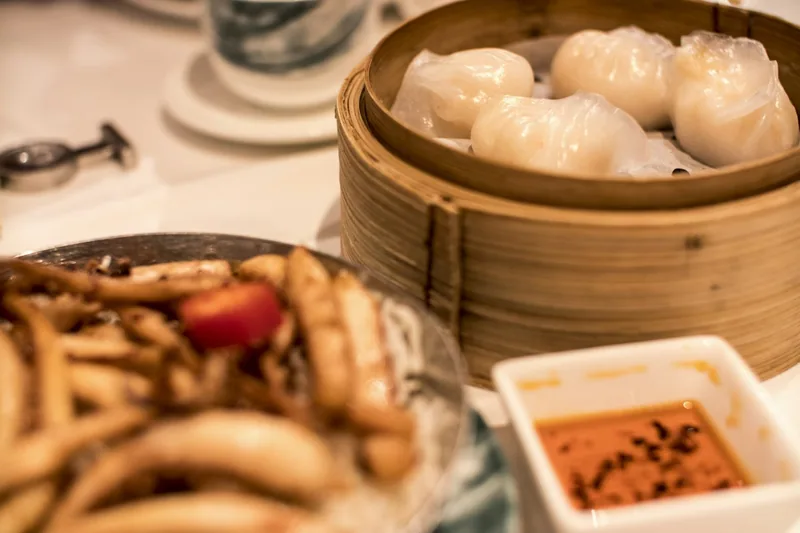
What to order first, and in what order to eat it
A first table of eight dishes, chosen so that nothing repeats and everything is recognisable:
| Dish | What it is | Why it is on the list |
|---|---|---|
| Har gau | Whole prawns wrapped in a pale, pleated skin made from wheat starch rather than flour | The dish by which a kitchen is judged. The skin should be thin enough to see through and should not split when lifted |
| Siu mai | Little cylinders of pork and prawn with the wrapper left open at the top, sometimes finished with roe | The other benchmark, and the one children eat without asking questions |
| Char siu bao | Soft white buns, steamed, hiding sweet barbecued pork inside | Filling. One each is plenty, and they are the last thing to order if you are hungry |
| Char siu sou | The baked version: glazed flaky pastry around the same pork | Better than the steamed bun and ordered half as often |
| Cheung fun | Wide sheets of rice noodle rolled around prawn, beef or a fried dough stick, with sweet soy poured over at the table | The one with the dough stick inside gives you crisp and slippery in the same mouthful |
| Lo bak go | Turnip cake: grated daikon steamed into a block, then pan-fried in slices | Savoury, soft inside, crisp outside. Nothing like a vegetable dish |
| Wu gok | Taro puff: mashed taro deep-fried into a lacy shell around minced pork | The most technically difficult thing on the sheet |
| Dan tat | Egg tarts, in flaky or shortcrust pastry | The finish. Order them at the end so they come out warm |
Eat steamed things while they are hot, fried things next, and sweet things last. Baskets cool quickly, and a table that orders sixteen dishes at once eats most of them lukewarm.
Order in two rounds, and keep the second one small. The standard mistake is filling the whole sheet at the start because the dishes look tiny. Three baskets per person is a full lunch; four is generous. Write five or six lines, see what arrives, then ask for another sheet. The kitchen expects it, the food stays hot, and the bill stays where you thought it would.
The dishes past the obvious ones
Once the first eight are familiar, the sheet opens up. Fung zao are chicken feet braised in black bean sauce, soft and sticky, and they are the dish Cantonese families order first and visitors order never; there is very little meat and the pleasure is in the texture and the sauce. Beef balls come on a bed of dried beancurd skin, springy rather than dense. Lo mai gai arrives as a parcel of lotus leaf tied at the top; inside is sticky rice packed around chicken and dried mushroom, and one of them will fill a person on its own.
Congee, a savoury rice porridge, is served in bowls with century egg and pork, or with fish, and is the correct thing to order if you are unwell or hungover. Jian dui are sesame-coated fried balls of sweet bean paste. Ma lai go is a steamed brown sponge cake, and mango pudding usually arrives as a pale set dome with evaporated milk poured over it.
For the sweeter end of a London afternoon more generally, see our guide to desserts, ice cream and chocolate.
Tea, and the two signals at the table
Tea comes automatically and is normally charged per person rather than per pot. The usual choices are jasmine, which is the default; pu-erh, dark and earthy and good with fatty dishes; chrysanthemum, floral and caffeine-free; and tieguanyin, a roasted oolong. Asking for a particular one is normal and costs no more.
Two pieces of table etiquette are worth knowing because both look strange if you do not.
- The lid. When the pot is empty, rest the lid on the rim at an angle or turn it upside down on top. Staff will refill it without being asked. Waving at a waiter with a teapot is the slower method.
- Who pours. You fill other people's cups before your own, starting with whoever is oldest at the table, and you keep half an eye on them through the meal. The two-finger tap on the tablecloth that comes back at you is an acknowledgement rather than a demand for more.
Nobody expects a visitor to do either, and doing them is received with mild pleasure rather than as an intrusion. Tea also makes this one of the easiest good meals in London to have without alcohol, which our page on drinking without alcohol covers more widely.
Why lunchtime, and what happens if you go later
Dim sum is breakfast and lunch food in Hong Kong and southern China, served from early morning until the middle of the afternoon. The dumplings are folded by hand in the morning, the steamers run continuously through the busy period, and a basket that comes out of a steamer that has been working for two hours is better than one made to order at eight in the evening from something that has been sitting.
London restaurants keep the same clock. Most serve dim sum from around midday to late afternoon and then move to the evening menu; Dragon Castle at Elephant and Castle, for instance, publishes a dim sum service from 12:00 to 17:00 with 49 dishes on the sheet. A few places in Chinatown carry a reduced dim sum list into the evening, and it is a smaller selection made for people who could not come at lunchtime.
The other reason to go early is the queue. Between half past twelve and two on a Saturday the popular rooms have a line out of the door and many of them do not take bookings at all. Arriving at half past eleven, when the restaurant opens, or after half past two gets you a table immediately and the same food.
Dim sum is the cheapest way to eat well in a good Chinese restaurant. The same kitchens that charge restaurant prices in the evening sell dumplings at lunchtime by the basket, which means you can eat the work of a serious chef for a fraction of what dinner costs there. Order three baskets each, drink the tea, and compare it with the prices in our guide to cheap eats in London.
Where to go, and how the areas differ
Chinatown is the obvious place and the most convenient, particularly before a matinee; our guide to Leicester Square and Theatreland covers the streets around it. It is also the busiest, the most rushed and the least likely to take a booking.
Bayswater and Queensway hold the largest concentration of serious Cantonese banqueting rooms in London, of the kind that do weddings on a Saturday and dim sum on a Sunday; the Royal China group has several branches across the city. See our page on Paddington and Bayswater. Marylebone has Phoenix Palace, a large room a short walk from Baker Street; see Marylebone.
South of the river, Dragon Castle at Elephant and Castle has been serving dim sum in a purpose-built room for close to twenty years. Canary Wharf has restaurants aimed at the office trade, which means weekday lunches and quiet weekends. Colindale, Hendon and Croydon have rooms that serve their own neighbourhoods and that visitors almost never reach.
At the top end, a few restaurants in Mayfair and Knightsbridge serve dim sum at a level and a price that belong in a different conversation; our page on Michelin-starred restaurants in London covers that end of the city.
Vegetarians, allergies and children
Dim sum is harder for vegetarians than it appears, because dried shrimp, lard and chicken stock are used as seasoning in things that look like vegetable dumplings. Several restaurants run a separate vegetarian dim sum list, which is the reliable route; ask for it rather than trying to pick items from the main sheet. See vegan and vegetarian London.
For allergies, assume shellfish is present unless told otherwise: prawn is in har gau, siu mai, cheung fun and many fillings, and dried shrimp seasons others. Wheat is in most wrappers and all the pastry, although har gau wrappers are wheat starch rather than flour, which is not the same as being gluten-free. Sesame, peanut and soy all appear. Our page on gluten-free eating in London explains what a restaurant must tell you.
Children generally take to dim sum better than to any other Chinese meal: small portions, nothing hot, and the interest of watching baskets arrive. Siu mai, char siu bao, cheung fun and egg tarts cover a child's whole lunch. Our family guide to London has more, and brunch in London makes the case for dim sum as the best Sunday late-morning meal in the city.
Chinese New Year is the one time the restaurants change: set menus, bookings weeks ahead and a very different atmosphere. Our guide to Chinese New Year in London covers the dates and the street events.
Frequently asked questions
Do London restaurants still serve dim sum from trolleys?
Almost none do. Trolley service has largely disappeared from London, and nearly every restaurant now uses a paper tick sheet instead. A few large rooms outside the centre run carts at weekends; telephone before travelling, because the practice has been fading for years.
How does a dim sum order sheet work?
The sheet lists every dish with a box beside it and several price columns representing basket sizes. Write your table number at the top and a number in each box, hand it to a waiter, and ask for a second sheet when you want more. The marked sheet becomes your bill.
How many dim sum dishes should I order per person?
Three baskets each is a full lunch and four is generous, with each basket holding three or four pieces. Order five or six dishes for two people first, see what arrives, then order again. Ordering everything at once means eating most of it cold.
What time is best for dim sum in London?
Between opening, usually around 11:30 or midday, and half past two. The kitchen is at its busiest then, the steamers run continuously and the food is freshest. Evening dim sum, where offered, is a smaller list made to order. Avoid 12:30 to 14:00 at weekends unless you like queueing.
What should I order on a first visit?
Har gau, siu mai, char siu bao, a baked char siu puff, cheung fun, turnip cake and a taro puff, with egg tarts at the end. Drink jasmine or pu-erh tea. Eat the steamed dishes first while they are hot.
Sources
- Dragon Castle, Elephant and Castle - dim sum service times and menu size (checked September 2026)
- Royal China Group - London branches (checked September 2026)
- Phoenix Palace, Marylebone (checked September 2026)
- Food Standards Agency - Food allergy and intolerance advice for consumers (checked September 2026)
- Food Standards Agency - Food hygiene ratings search (checked September 2026)