
Deptford is five minutes by train from London Bridge and looks nothing like it. A street market runs down the middle of the high street three days a week, a Baroque church stands at the end of it, and the river frontage was a royal naval dockyard for three hundred years. New Cross, a mile inland, is a student district built around an art college. Neither is polished, and that is the whole appeal.
This is south-east London at its least arranged. There are no ticket offices, no queues and almost no visitors. What there is instead is a working market street, some genuinely important history that nobody has made a visitor attraction out of, and the cheapest going-out in this part of the city.
If you are staying in central London and have three days, read our King's Cross page or head to Greenwich instead, which is two stops further on the same line and has everything arranged for you. Deptford is for a longer stay, or for the walk back from Greenwich.
Deptford and New Cross at a glance
- Best for
- A working street market, Vietnamese and West African food, cheap pubs, contemporary art
- Stations
- Deptford (National Rail, Zone 2); Deptford Bridge (DLR); New Cross and New Cross Gate (Overground Windrush line and National Rail)
- From London Bridge
- 5 minutes direct to Deptford; 6 minutes to New Cross Gate
- Market days
- Wednesday, Friday and Saturday, 9am to 5.30pm on Deptford High Street
- Free to see
- Goldsmiths CCA, St Paul's church, the market, the riverside
- Time needed
- Two to three hours, or an evening
Getting here is faster than you expect
Deptford rail station is in Zone 2 and Southeastern trains from London Bridge take five minutes. From Cannon Street it is about ten. That is genuinely quicker than crossing central London on the Tube, and it surprises people who assume anywhere in south-east London is a long way out.
Deptford Bridge, on the Docklands Light Railway, serves the southern end of the area and connects to Bank, Canary Wharf and Greenwich. New Cross and New Cross Gate are both on the London Overground's Windrush line, which runs north through Canada Water, Whitechapel and Shoreditch to Highbury & Islington, and both also take National Rail trains from London Bridge. Our explainer on the DLR and the Overground covers the renamed lines and which branch goes where; getting the branch wrong at New Cross is a common mistake, because the Windrush line splits and only some trains come this way.
There is no Night Tube anywhere near here. Trains from Deptford and New Cross stop at ordinary times, and the Windrush line's night service does not cover every branch. Several N-prefixed night bus routes run along New Cross Road and through Deptford towards Charing Cross and the West End through the small hours, so look up the one that serves your hotel before you go out rather than at one in the morning. Our page on London night buses explains how to read a night route.
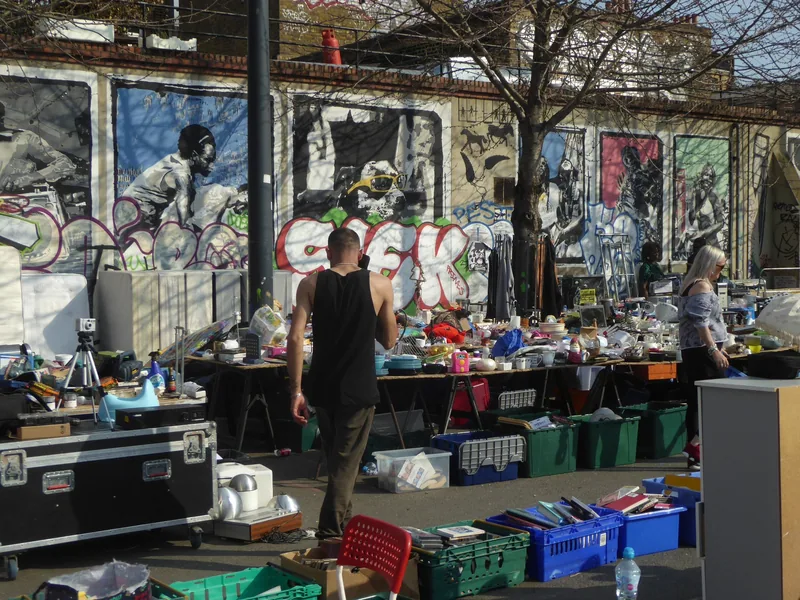
Photo: Ardfern · CC BY-SA 4.0 · Wikimedia Commons · resized
Deptford High Street on a market day
The market is the reason to come, and the days matter. Deptford High Street market runs on Wednesday, Friday and Saturday from 9am to 5.30pm, and the street itself is closed to traffic from 6am to 7pm on those days. On other days the high street is an ordinary road with shops on it and much less to look at.
What is sold is not aimed at visitors: fresh fish on ice, fruit and vegetables, fabric and curtain material, haberdashery, clothes, and household goods. Behind and around the stalls are Vietnamese cafés, West African grocers, Caribbean takeaways, a couple of long-established pie shops and an increasing number of small bars and galleries in converted shopfronts.
Around the corner on Douglas Way, the same market extends into a second-hand and bric-a-brac section, which is the part people photograph: records, tools, old electrical goods, crockery and furniture laid out on the ground. It is a real jumble market rather than a curated vintage one, and prices reflect that. Our guide to London's antiques markets covers the organised alternatives, which are a different sport entirely.
For the food, our pages on Vietnamese food in London and West African and Ethiopian cooking put Deptford next to Kingsland Road and Peckham.
Deptford Market Yard, which is a different thing
Beside the station, a row of railway arches has been converted into Deptford Market Yard: independent shops, bars, a coffee roaster and food businesses under the viaduct, with a covered yard in front. Community market days run in the yard on alternate Sundays.
It is newer, tidier and more expensive than the high street market fifty metres away, and the contrast between the two is the most honest thing about Deptford right now. Visit both; do not confuse them.
The naval history nobody has made into an attraction
Deptford was a royal dockyard. Henry VIII established it on the Thames here in 1513, and for three centuries it built and repaired the ships of the Royal Navy. Elizabeth I knighted Francis Drake aboard the Golden Hind at Deptford in 1581 after his voyage around the world. Peter the Great of Russia came in 1698 to learn shipbuilding and stayed at Sayes Court, the house of the diarist John Evelyn, whose celebrated garden he is said to have wrecked.
Almost none of this is visible. The dockyard site, Convoys Wharf, is a large riverside development area behind hoardings, and the history is commemorated with a monument near the river rather than a museum. There is a statue of Peter the Great on the Thames Path near Deptford Creek, which is the one obvious marker.
If you want the naval history presented properly, it is twenty minutes' walk east at the Cutty Sark and the Royal Observatory, and in the Old Royal Naval College. Deptford is where it actually happened; Greenwich is where it is explained.
Two churches worth ten minutes each
St Paul's, Deptford is one of the finest Baroque parish churches in London, designed by Thomas Archer and built between 1712 and 1730. It has a semicircular portico, a tower rising behind it and a bright, generous interior, and it sits in its own green churchyard a couple of minutes off the high street. It is a working parish church rather than a visitor attraction, so times vary; check before making a special trip.
St Nicholas', Deptford Green, nearer the river, is where the playwright Christopher Marlowe was buried in 1593 after he was killed in a house in Deptford at the age of 29. The medieval tower survives; the rest was rebuilt. The gatepiers are topped with carved skulls, which is exactly the sort of thing you hope for and rarely get.
New Cross: an art school and the streets around it
New Cross is dominated by Goldsmiths, University of London, whose art department produced a disproportionate number of well-known British artists. The campus spreads along and behind New Cross Road, and the area has the density of cheap food, pubs and live music that a large student population produces.
The one thing here that any visitor can use is Goldsmiths CCA, the university's public gallery on St James, SE14 6AD. It is free, it opens Wednesday to Sunday from midday to 6pm, and it is housed in a Victorian bath house converted by the architectural collective Assemble, so the building is worth the visit even when a show is between installations. Exhibitions are contemporary and often difficult; they are also free, which changes the calculation.
The Ben Pimlott Building on the campus, with a large steel scribble on its roof, is the local landmark. You cannot go in, but you can see it from the street.
Pubs, music and the question of cheap pints
New Cross and Deptford have a long-standing reputation as the cheapest places to drink inside inner London, driven by the student population. We should be straight about this: we have not found a published, reliable survey of pint prices by London district, so treat that reputation as local knowledge rather than a fact. What is true is that pubs here are priced for students rather than for tourists, and that a round costs noticeably less than the same round in Shoreditch or Soho.
The live music tradition is real and long-running, spread across pub back rooms and small venues along New Cross Road and Deptford High Street. Small venues in London close, move and reopen constantly, so use current listings rather than an old recommendation: our guide to live music venues in London explains how the small-venue circuit works and what a ticket costs. Our page on London on a student budget covers the discounts that apply here.
Deptford Creek is the reason the two halves feel separate. The creek, where the River Ravensbourne meets the Thames, cuts between Deptford and Greenwich and is crossed by only a few bridges. At low tide the creek bed is exposed mud and old timber, and a local environmental trust runs guided walks down into it in waders. Check what is running before you plan around it; the tide, not the timetable, decides.
The riverside walk to Greenwich
The best single thing to do here costs nothing. Pick up the Thames Path near Deptford Creek and walk east; within twenty-five minutes you are at the Cutty Sark, with the river on your left the whole way and the towers of Canary Wharf across the water. Doing it in that direction, with Deptford first and Greenwich second, is much the better order: you get the unvarnished version before the polished one.
Our page on the Thames Path and London's walking routes has the rest of the river walks, and Wapping and Rotherhithe covers the equivalent stretch on the north bank and at the Rotherhithe bend.
Who this suits
Worth the trip for
- A market street that exists for the people who live there
- Free contemporary art in a converted bath house
- A Baroque church almost nobody visits
- Cheap drinking and small-venue music
- The riverside walk into Greenwich
Not for you if
- You want the history displayed rather than merely present
- You are here midweek and not on a market day
- You need late trains back to a central hotel
- You expect anywhere to be tidy
- You have only a few days in London
The best way to use Deptford is as the first half of a day that ends in Greenwich, or as an evening out if you are staying south of the river. Our page on staying in Greenwich covers accommodation in this corner of London, and for another south London half-day that costs almost nothing, see Crystal Palace and Forest Hill or Herne Hill and Dulwich.
Frequently asked questions
When is Deptford Market on?
Deptford High Street market runs on Wednesday, Friday and Saturday from 9am to 5.30pm, and the high street is closed to traffic from 6am to 7pm on those days. The second-hand and bric-a-brac section on Douglas Way runs alongside it. Deptford Market Yard, by the station, holds its own community market on alternate Sundays.
How long does it take to get to Deptford from central London?
Five minutes on a Southeastern train from London Bridge, or about ten from Cannon Street. Deptford is in Zone 2 and contactless and Oyster work normally. New Cross Gate is six minutes from London Bridge, and both New Cross stations are also on the Overground's Windrush line towards Canada Water and Shoreditch.
What is there to see in Deptford?
The street market on Wednesday, Friday and Saturday; St Paul's, a Baroque church by Thomas Archer built between 1712 and 1730; St Nicholas' churchyard, where Christopher Marlowe was buried in 1593; Deptford Market Yard under the railway arches; and the riverside walk to Greenwich. The royal dockyard history is mostly behind hoardings.
Is Goldsmiths CCA free to visit?
Yes. The gallery is free to everyone and opens Wednesday to Sunday from midday to 6pm, at St James in New Cross, SE14 6AD. It occupies a converted Victorian bath house and shows contemporary art. Check the current exhibition dates on its website, as there are gaps between shows.
Are Deptford and New Cross safe for visitors?
They are ordinary inner-city areas with the usual urban problems, and no official advice suggests avoiding them. Daytime visits are unremarkable. At night, stay on the main roads, which are busy and lit, take the same care with your phone that you would anywhere crowded, and work out how you are getting home before you go out, since there is no Night Tube here.
Sources
- Lewisham Council - Deptford markets and opening days (checked September 2026)
- Deptford Market Yard - About and market dates (checked September 2026)
- Goldsmiths CCA - Visit (checked September 2026)
- National Churches Trust - St Paul, Deptford (checked September 2026)
- Transport for London - Journey Planner, train times from London Bridge and Cannon Street (checked September 2026)