
Few cities on earth make it simpler to eat without meat than this one, and the reason is not the vegan restaurants. It is that every pub, chain, supermarket and corner café has a vegetarian option as a matter of routine, and that whole cuisines here are vegetarian by tradition. The difficulty is narrower: a handful of British dishes look vegetarian and are not.
Where to eat, what the labels mean and how London's meat-free scene is organised are covered in our guide to vegan and vegetarian London. This page is the traveller's version: what happens at each British meal, which ingredients hide, and what to say.
One general point first. British restaurants are used to the question and nobody will be surprised or irritated by it. The 14 regulated allergens must be declared, but "contains meat" is not an allergen, so a menu that lists allergens still may not tell you about the stock in the soup. You have to ask.
The five questions worth asking
- Is the gravy made with meat stock?
- Usually yes, including on a vegetarian roast
- Is the pastry made with suet or lard?
- Traditional pies and steamed puddings often are
- Does the dressing contain anchovy?
- Caesar dressing and Worcestershire sauce normally do
- Is the cheese made with animal rennet?
- Many traditional hard cheeses are
- What is the fryer used for?
- A traditional minority of fryers still use beef dripping
The five things that hide
Gravy. The single most common problem. British gravy is made from meat juices and stock, and it is poured over roast dinners, pies, sausages and sometimes chips. A pub serving a vegetarian roast may still ladle the same gravy over it unless you ask, and many kitchens keep a separate vegetarian gravy but only bring it out on request.
Suet and lard. Suet is hard beef or mutton fat and it is the traditional pastry for steamed savoury and sweet puddings. Lard is pork fat and is used in some shortcrust. A mince pie at Christmas, a steak and kidney pudding, a treacle sponge: all can contain it. Vegetable suet exists and is widely used now, so the answer is often reassuring, but the question is worth asking.
Gelatine. Made from animal collagen, and found in many British sweets, some marshmallows, some mousses, trifles and cheesecakes, and in some fruit jellies. Supermarket packaging lists it in the ingredients; a dessert menu will not.
Anchovy. Worcestershire sauce, which appears in cheese on toast, Welsh rarebit, some soups and most Bloody Marys, is traditionally made with anchovies. Caesar dressing and many Thai and Vietnamese sauces contain fish sauce. Vegetarian versions of Worcestershire sauce are sold, but the default is not one.
Animal rennet in cheese. Several traditional hard cheeses, including Parmesan and some farmhouse Cheddars, are made with rennet from a calf's stomach. A British cheese labelled "suitable for vegetarians" uses a microbial alternative, and supermarket cheese usually says so on the pack. Restaurant cheese boards and grated Parmesan on pasta usually do not.
"Vegetarian" on a British menu is the restaurant's own claim, not a certification. Food law requires businesses to tell you about the 14 regulated allergens, and that is the only ingredient information they must give. Meat stock, rennet and fish sauce are not allergens, so a menu can be fully compliant and still tell you nothing about them. Ask specifically about stock, cheese and dressing rather than asking whether a dish is vegetarian.
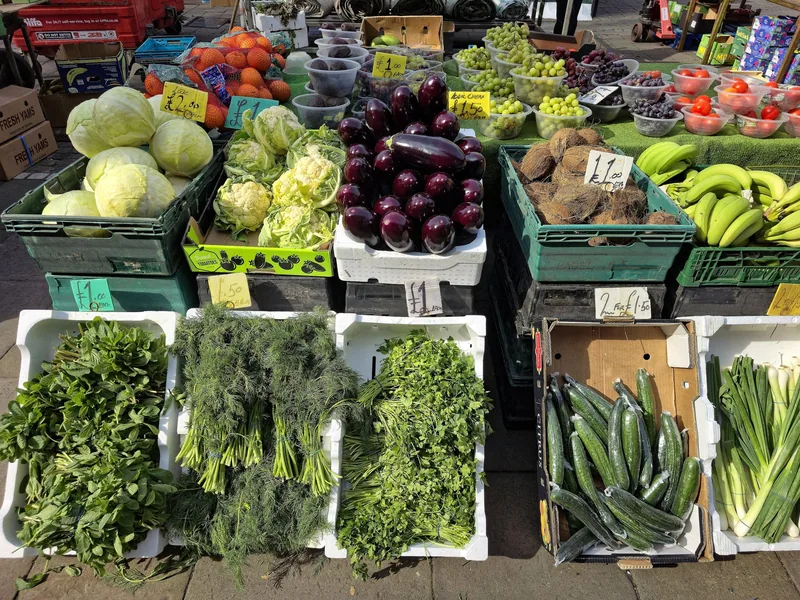
Photo: Acabashi · CC BY-SA 4.0 · Wikimedia Commons · resized
Breakfast
The cooked breakfast is straightforward once you know the parts. Ask for a vegetarian breakfast and you will normally get egg, beans, mushrooms, grilled tomato, toast and hash browns, with a vegetarian sausage in place of the meat. The two things to watch are the black pudding, which is blood sausage, and whether the mushrooms and eggs were cooked on the same griddle as the bacon, which in a busy café they will have been.
Beans on toast is entirely vegetarian and is a real meal, not a joke. Porridge, crumpets, croissants and a bacon-free bap are all everywhere. Hotel buffets are easy. Our guide to the full English breakfast explains the standard plate.
Lunch
In a pub. Every pub menu has at least one vegetarian main, usually a burger, a pie, a curry or a salad. Ask about the gravy if it comes with any, and about the stock in a soup. Ordering happens at the bar, and that is the moment to ask; our guide to pub etiquette explains how it works.
From a supermarket. The supermarket meal deal, a sandwich plus a snack plus a drink at one fixed price, always carries several clearly labelled meat-free choices. Prepacked food must highlight allergens such as milk and egg in the ingredients list, so it is quick to check. This is also the cheapest lunch in London, as our breakdown of what a day in London costs shows.
At a market. Street-food markets are where meat-free eating in London is at its best: Ethiopian, Sri Lankan, Lebanese, Indian and Mexican stalls all cook vegetarian dishes as a matter of course rather than as a concession. Borough Market also sells vegetarian cheeses, which are labelled.
The Sunday roast is the hard one
This is the British meal that resists adaptation, and it is worth planning for. A vegetarian roast is normally a nut roast, a mushroom or squash wellington, or a stuffed pastry, served with the same roast potatoes, vegetables and Yorkshire pudding as everyone else.
Three traps. The roast potatoes may have been cooked in goose fat or beef dripping. The Yorkshire pudding is made with eggs and milk and is usually fine, but it may have been baked in the meat tin. And the gravy, again, is the default meat one unless you say otherwise.
The answer is to ring or email the pub when you book and say you need a vegetarian roast, because good kitchens make a limited number and they run out by mid-afternoon. Sunday lunch is booked days ahead in London, and asking at the point of booking gets you a much better plate than asking at the table. Our guide to the Sunday roast explains the whole ritual.
Afternoon tea and the fish and chip shop
Afternoon tea is easy and almost every hotel offers a vegetarian version, but it must be requested when you book, usually 24 to 48 hours ahead. The standard finger sandwiches are smoked salmon, ham and egg, so the vegetarian set is a genuine substitution rather than a removal. Check whether the scone cream and the mousses contain gelatine if you are strict. See afternoon tea in London.
Fish and chips is the meal where vegetarians and pescatarians part company. Vegetable oil is what the great majority use, though a traditional minority still cook in beef dripping, and nearly all of them put fish and potatoes through the same fryer. A shop that advertises a separate vegetarian fryer is telling you something real. Battered halloumi, vegetarian sausage and battered vegetables are now common alternatives. Our guide to fish and chips in London covers the shops.
On pescatarianism generally: British menus treat fish as a separate category from meat, so "vegetarian" here never includes fish, and a dish described as vegetarian will not arrive with anchovies visible. The risk is in sauces and stocks, not in the main ingredient.
The cuisines that make London easy
The strongest argument for London as a vegetarian city is not British food at all. Whole traditions here cook without meat by default.
- South Indian and Gujarati. Dosa, idli, thali, bhel puri and chaat were never meat dishes that someone adapted; they are simply what the cooking is. Watch for ghee, yoghurt and paneer if you are vegan rather than vegetarian. Our guide to Indian food in London explains the regional differences, and London's curry scene covers the restaurant areas.
- Middle Eastern. A table of mezze, with hummus, moutabal, fattoush, falafel and flatbread, is a full meal with no substitutions. See Middle Eastern food on Edgware Road.
- Ethiopian. The fasting menu, served on injera, is vegan by religious tradition and is one of the best-value meals in London. Our guide to Ethiopian and West African food has the detail.
- Chinese. Buddhist vegetarian cooking is a long tradition, though a standard restaurant kitchen uses a great deal of oyster and fish sauce, so ask. Dim sum has good vegetable options: see dim sum in London.
- Italian. Easy, except for the Parmesan, which is often grated without being mentioned.
How to ask, and what the answer means
Ask early, ask specifically, and ask the right person. "Is the gravy vegetarian?" gets a better answer than "I'm vegetarian, what can I have?" because it is a question a server can check in the kitchen in ten seconds.
Useful phrasings that British staff respond well to:
- "Is the stock in that vegetable, or is it chicken?"
- "Does the cheese on that have animal rennet, do you know?"
- "Could I have that without the Parmesan?"
- "Is there a vegetarian gravy?"
- "Could you check with the kitchen for me?"
"I'll check" is a good sign; "it should be fine" is not an answer. If you are vegetarian by religious observance rather than by preference, say so, because British kitchens treat that as a harder requirement and will handle it differently. If your requirement is medical, say allergy, not diet, because the legal duties and the kitchen procedures are different; our guide to gluten-free eating in London explains why that distinction matters.
Chains are the safety net, and they are better at this than they look. The large British restaurant and pub chains publish full allergen and dietary information online, label vegetarian and vegan dishes on the menu, and train staff to answer. If you are tired, travelling with a mixed group or in an unfamiliar part of London, a chain removes the guesswork. Our guide to London's chain restaurants says what each one does.
Eating out with people who are not vegetarian
This is where London genuinely earns the reputation. Because the vegetarian option is standard rather than exceptional, a mixed group almost never has to choose a restaurant around one person. Pubs, gastropubs, Indian restaurants, Italian restaurants, pizza places, Middle Eastern grills and every chain can feed everyone at the same table.
The exceptions are the meat-specialist places: steakhouses, barbecue joints, some of the seafood restaurants, and the traditional carveries. Those will usually have one dish, and it will not be the reason anyone came. If you are booking for a group, check the menu online first rather than on arrival; almost every London restaurant publishes it.
One last piece of vocabulary. "Veggie" is the normal informal word and is not rude. "Plant-based" has become the common label on menus for vegan dishes. And a "V" symbol usually means vegetarian while "Ve" or "VG" means vegan, though the symbols are the restaurant's own choice rather than a standard. The rest of the menu vocabulary is in our guide to British food words explained.
Frequently asked questions
Is it easy to be vegetarian in London?
Yes, unusually so. Vegetarian dishes are standard on every pub, chain and supermarket menu, the markets are full of meat-free cooking, and several of the cuisines London does best, notably South Indian, Middle Eastern and Ethiopian, leave meat out as a matter of course. Your attention is needed on hidden ingredients, not on finding somewhere to eat.
Is the gravy on a vegetarian roast vegetarian?
Not automatically. Most pub gravy is made with meat stock, and many kitchens pour the same gravy over the vegetarian roast unless asked. Many pubs do keep a vegetarian gravy, so ask when you order, and preferably when you book, because vegetarian roasts are made in small numbers and run out.
Does Worcestershire sauce contain fish?
The traditional recipe contains anchovies, and it turns up in Welsh rarebit, cheese on toast, some soups and most Bloody Marys. Vegetarian versions exist and some kitchens use them, but the standard product is not vegetarian, so it is worth asking about any dish that tastes savoury and dark.
Is British cheese suitable for vegetarians?
Some is and some is not. Several traditional hard cheeses, including Parmesan and some farmhouse Cheddars, use animal rennet. Supermarket cheese states whether it is suitable for vegetarians on the pack. In restaurants it is rarely mentioned, so ask before accepting grated cheese on pasta or a cheese board.
Do I need to book ahead as a vegetarian in London?
Only for the set meals. A vegetarian afternoon tea and a vegetarian Sunday roast both need to be requested when you book, usually a day or two in advance, because they are prepared in limited numbers. For ordinary lunches and dinners, walking in is fine almost anywhere.
Sources
- Food Standards Agency - Food allergy and intolerance advice for consumers (checked September 2026)
- Food Standards Agency - The 14 regulated allergens and vegan food (checked September 2026)
- Food Standards Agency - Allergen guidance for food businesses (checked September 2026)
- Food Standards Agency - Food Hygiene Rating Scheme (checked September 2026)